Vatican joins calls for debt relief at development finance conference


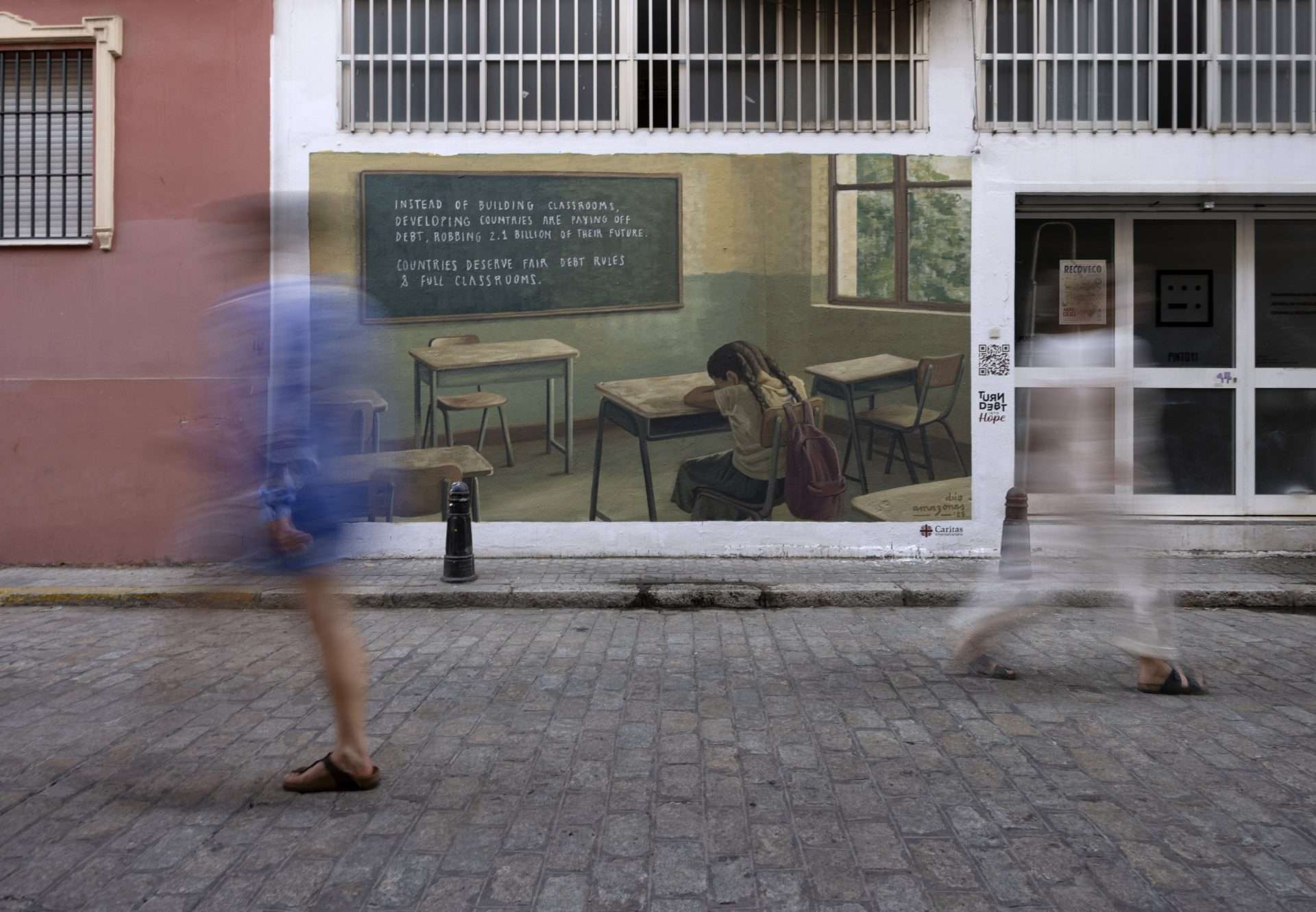
Caritas Internationalis painted a mural in the heart of Seville, depicting a child in an empty classroom staring at a chalkboard with the words ‘3.3 billion live in countries spending more on debt repayments than education’.
EPA / Caritas Internationalis and the Glasgow Actions Team
At the G20 Global Justice Symposium in Cape Town last week, a South African bishop warned of the impact of the continent’s debt to international finance institutions on children’s welfare.
Leaders gathered for the Financing for Development (F4D) conference in Spain faced urgent calls from leading economists and the Vatican for action to solve the international debt crisis.
On Monday, an international panel gathered in Seville discussed reform of the international financial architecture to place people rather than profit at the heart of the global economy. Panellists included Archbishop Gabriele Caccia, the Vatican representative to the United Nations.
The event “Tackling the Debt and Development Crisis in Jubilee Year 2025” on 3 July was due to feature the landmark report commissioned by Pope Francis and released last week by the Jubilee Commission. The F4D conference, from 30 June to 3 July, takes place once a decade, with governments, international organisations, as well as civil society, business and religious leaders, meeting to discuss how to fund global development.
Cafod’s public policy manager Pablo Soriano Mena said: “Every day nearly half the world’s population is caught up in the double crises of spiralling debt that is stifling development.” He added that “this once-in-a-decade opportunity in Seville is the perfect opportunity to create a more sustainable future for everyone and make this a decade to defend development and solve the causes of this debt crisis”.
Marches through Seville last weekend called for economic, debt and climate justice. A powerful mural installation by Caritas Internationalis was painted in the heart of the city, depicting a child in an empty classroom staring at a chalkboard with the words “3.3 billion live in countries spending more on debt repayments than education”.
At the G20 Global Justice Symposium in Cape Town last week, a South African bishop warned of the impact of the continent’s debt to international finance institutions on children’s welfare.
Bishop Thulani Mbuyisa of Kokstad raised concerns during the discussions arranged as part of South Africa’s G20 presidency. Its Catholic bishops have called on the government to use its role to shape discussions around debt cancellation for African countries to drive social welfare for ordinary people.
Bishop Mbuyisa, recently appointed by the Holy See to the Dicastery for the Institutes of Consecrated Life and the Societies of Apostolic Life, said debt relief must take into consideration children affected by the burden of debt that has affected social services on the African continent.
“The central theme of this symposium is feeding school going children. As a way of reducing poverty, if we are able to offer meals to children, we are able to keep them in school,” Mbuyisa said. Millions of children are out of school amid funding cuts to international aid programmes, with the debt burden of African countries affecting the provision of the right to education.
Economists call for new ‘economic architecture’ in Jubilee report
Jubilee 2025 – a cry for global economic justice
Stay updated — add us as a preferred news source on Google:


Help us keep The Tablet’s voice independent, clear and far-reaching.
Founded in 1840, The Tablet is the leading independent English-language Catholic weekly, celebrated for great writing, astute analysis, brilliant arts and books reviews and trustworthy reporting from correspondents in Britain, Ireland, Rome and across the world.
Independent, high-quality journalism is at the heart of what we do. The Tablet does not have deep pockets and we are not funded by rich donors. If you appreciate our work please consider supporting The Tablet’s Development Fund. It only takes a moment and you can cancel at any time.
- Support with £5 per month
- Support with £10 per month
- Support with other amount.

MOST READ ARTICLES
-
1
German bishops commit to global Synod process despite delay to reforms
-
2
The Tablet poem
-
3
A tiny gem
-
4
Word from the Cloisters
-
5
Bangladesh Christians ask president to help ease missionary visa restrictions
-
6
Nigerian first lady suffered death threat for practising Christian faith
FROM THE EDITOR'S DESK


