Surrogacy ‘violates dignity’ say bishops amid renewed debate in Germany


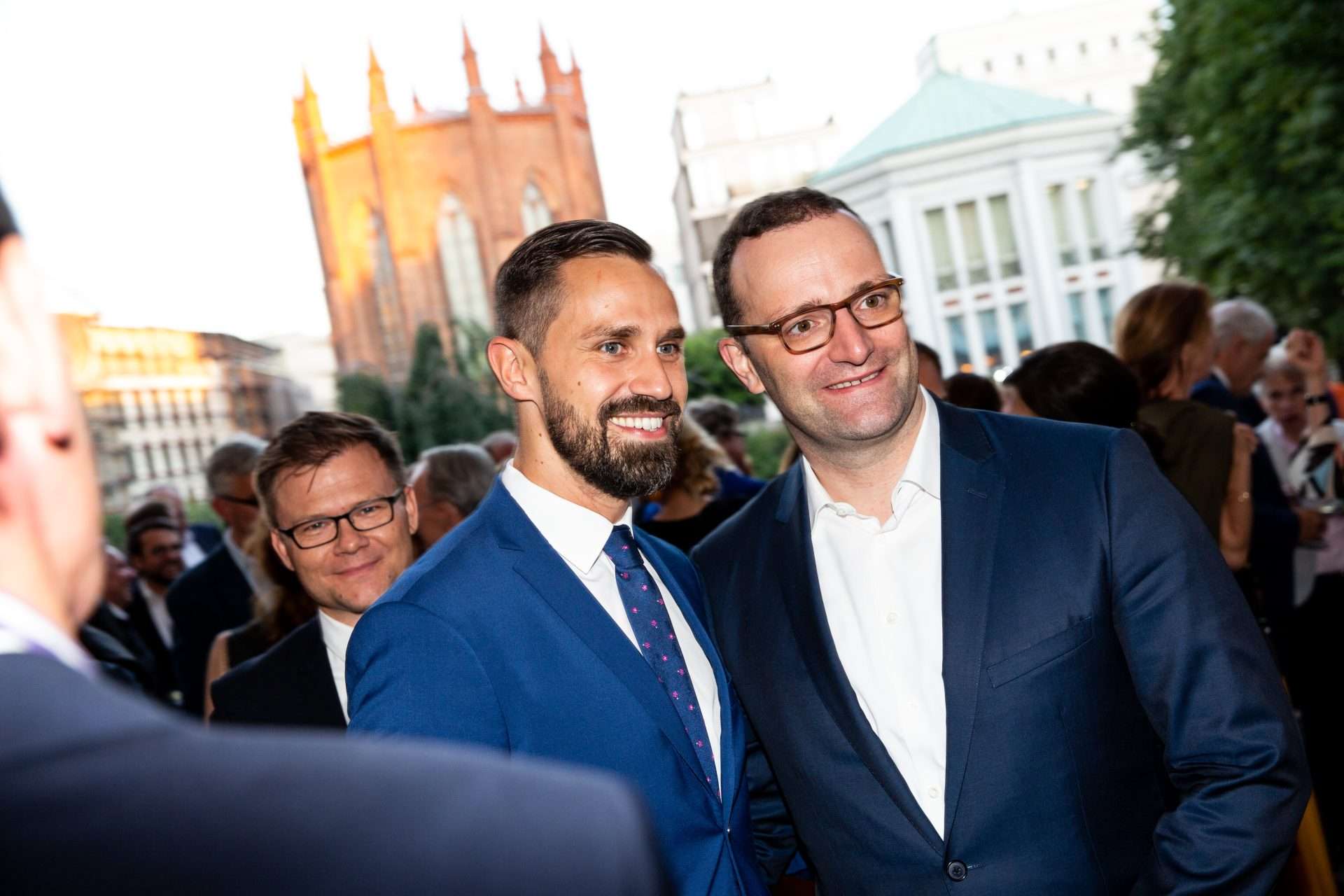
Jens Spahn, right, with his husband Daniel Funke in 2018
© Clemens Porikys for Hubert Burda Media
The latest controversy over Germany’s ban on surrogacy began after the resignation of the leader of the parliamentary leader of the Christian Democratic Party and former health minister Jens Spahn.
The German Bishops’ Conference confirmed its opposition to surrogacy in response to a renewed national debate on laws prohibiting the practice after the resignation of a government minister.
“In the current debate over the ban on surrogacy, I would like to emphasise that the fundamental concerns of the German Bishops’ Conference remain unchanged,” said Prälat Dr Karl Jüsten, director of the Commissariat of the German Bishops in Berlin, in a statement referring to a previous policy position.
This said: “We believe that the practice of surrogacy violates the dignity of women and children. The child should not be turned into an object of commercialisation, and the woman who carries the child should not be exploited.”
While many couples suffer due to involuntary childlessness, Jüsten continued, “human life is not something we can control, and there is no right to have a child”.
The latest debate on Germany’s ban on surrogacy began after the resignation of the leader of the parliamentary leader of the Christian Democratic Party (CDU) and former health minister Jens Spahn.
As health minister, Spahn had always opposed the legalisation of surrogacy. However, recently he and his husband had become parents of a son born in the United States by a surrogate mother.
Spahn’s announcement triggered a strong response in society, including the Church, with many – particularly in the CDU – accusing him of moral double standards.
Caritas President Eva Welskopp-Deffaa said “one could not close one’s eyes to exploitative transactions connected with this business model”.
“A nine-month pregnancy, during which women are subject to significant contractual obligations … does not correspond to our understanding of reproductive self-determination, physical integrity and human dignity,” she said.
Potential dangers included the exploitation of women, child trafficking and selection based on “quality marks” such as health, gender and ethnicity of the child, Welskopp-Deffaa warned, emphasising the risks of exploitation where financial motives apply: in Ukraine, for example, many war widows become egg cell donors and surrogate mothers.
Andrea Redding from the German Catholic Women’s Union (KDFB) said: “Of course women can make their own decisions … but the state is responsible that there is room for these own decisions and that it is protected.”
However, the KDFB did not support criminalisation of surrogacy as in Italy “as a child has come into being desired by an individual or a couple, and something has to happen with that child”.
The current legal position was the most sustainable, “even if it has a gap that surrogacy is a question of money”.
The power of the call to parenthood
German Catholic women’s group provokes alarm with abortion document
Stay updated — add us as a preferred news source on Google:


Help us keep The Tablet’s voice independent, clear and far-reaching.
Founded in 1840, The Tablet is the leading independent English-language Catholic weekly, celebrated for great writing, astute analysis, brilliant arts and books reviews and trustworthy reporting from correspondents in Britain, Ireland, Rome and across the world.
Independent, high-quality journalism is at the heart of what we do. The Tablet does not have deep pockets and we are not funded by rich donors. If you appreciate our work please consider supporting The Tablet’s Development Fund. It only takes a moment and you can cancel at any time.
- Support with £5 per month
- Support with £10 per month
- Support with other amount.

MOST READ ARTICLES
-
1
Church warns Zambian government against division after archbishop’s arrest
-
2
Breaking up … for now
-
3
A craving for beauty
-
4
The technological paradigm, AI and the human person
-
5
Bishops demand security investment to promote ‘common good’ in Nigeria
-
6
Rival church occupies Kyiv monastery in latest blow to Moscow-linked Orthodox
FROM THE EDITOR'S DESK