SSPX rejects Vatican dialogue offer


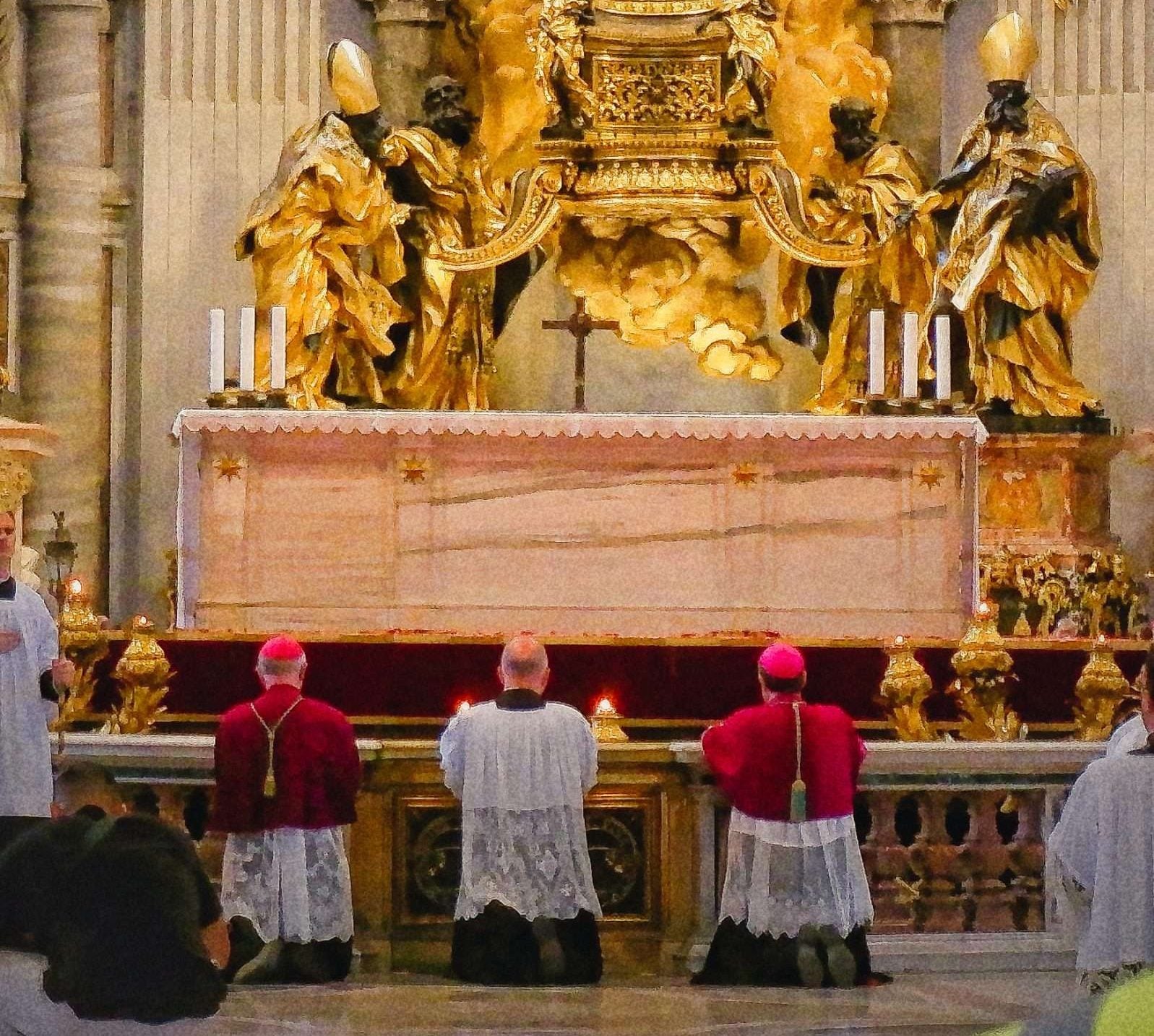
Fr Davide Pagliarani (centre) with the two surviving bishops of the SSPX, Bernard Fellay and Alfonso de Galareta, praying in St Peter’s during a Jubilee pilgrimage
Wikimedia Commons
‘We both know in advance that we cannot agree doctrinally, particularly regarding the fundamental orientations adopted since the Second Vatican Council,’ said Fr Davide Pagliarani.
The Society of St Pius X said it will continue with plans to ordain bishops without papal approval, rejecting a proposal for dialogue with the Holy See.
In a letter to the prefect of the Dicastery for the Doctrine of the Faith (DDF) dated 18 February, the society’s superior general Fr Davide Pagliarani said he “cannot accept the perspective and objectives in the name of which the dicastery offers to resume dialogue in the present situation, nor indeed the postponement of the date of 1 July” when it plans to conduct the ordinations.
Pagliarani met the DDF prefect Cardinal Víctor Manuel Fernández on 12 February, 10 days after the ultra-traditionalist Society of St Pius X (SSPX) announced the plans.
The dicastery subsequently published a statement saying Fernández had offered to open a “specifically theological dialogue” to establish “the minimum required for full communion with the Church and consequently to demarcate a canonical status” for the SSPX.
In a separate statement, Pagliarani said he would present the proposal to the SSPX council but also reported that Fernández had told him the documents of the Second Vatican Council “could not be corrected”.
Archbishop Marcel Lefebvre founded the SSPX in 1970, rejecting many of the reforms of the Council and celebrating the liturgy in the old rite. In 1988 he ordained four bishops for it without papal approval, incurring excommunication latae sententiae for the clergy involved and leaving the society’s canonical status in dispute.
“We both know in advance that we cannot agree doctrinally, particularly regarding the fundamental orientations adopted since the Second Vatican Council,” said Pagliarani in his letter to Fernández, which the SSPX published on Thursday.
“I therefore do not see how a joint process of dialogue could end in determining together what would constitute ‘the minimum requirements for full communion with the Catholic Church’, since – as you yourself have recalled with frankness – the texts of the Council cannot be corrected, nor can the legitimacy of the liturgical reform be challenged.”
In a series of other explanations for the decision, Pagliarani referred to documents issued since 1965 – in particular Redemptor hominis, Ut unum sint, Evangelii gaudium, and Amoris lætitia, as well as Traditionis custodes – which he said already determine what the Holy See considers acceptable interpretation of the Council.
He also complained that the SSPX had previously requested a dialogue in 2019, “but it is only when episcopal consecrations are mentioned that an offer to resume dialogue is made, which thus seems dilatory and conditional”.
The DDF’s public offer of dialogue, he said, which also stated that the ordinations would constitute a schism, creates “pressure that is hardly compatible with a genuine desire for fraternal exchanges and constructive dialogue”. The SSPX denies that the ordinations would be schismatic because they would not impart any jurisdiction against the Pope’s will.
While denying that it would be possible for dialogue to determine “what the minimum requirements for ecclesial communion might be”, Pagliarani also claimed that the Holy See had undermined previous attempts, notably that begun in 2009 when Benedict XVI lifted the excommunication of the remaining SSPX bishops.
In June 2017, the prefect of the Congregation for the Doctrine of the Faith Cardinal Gerhard Müller wrote to the society’s then-superior general Bishop Bernard Fellay, setting out terms for full communion – including acceptance of the Council and post-conciliar teaching – with the SSPX refused. Pagliarani succeeded Fellay in 2018 and reportedly did not share his predecessor’s interest in reaching a compromise with the Holy See.
“This [decision by Müller] shows that, if one persists in a doctrinal dialogue that is too forced and lacks sufficient serenity, in the long term, instead of achieving a satisfactory result, one only worsens the situation,” said Pagliarani in his letter to Fernández.
“Thus, in the shared recognition that we cannot find agreement on doctrine, it seems to me that the only point on which we can agree is that of charity toward souls and toward the Church.”
He said this “charity” should allow the SSPX to continue to respond to “a concrete, short-term need” for the sacraments among those who attend its churches. He cited Pope Francis’ and Fernández’s support for “‘listening’ and understanding of non-standard, complex, exceptional, and particular situations” and “a use of law that is always pastoral, flexible and reasonable”.
“I pray for you in particular to the Holy Ghost and – do not take this as a provocation – His Most Holy Spouse, the Mediatrix of all Graces,” Pagliarani said in his conclusion. In November, the DDF published a document titled Mater Populi Fidelis which said “special prudence is required when applying the term ‘Mediatrix’ to Mary”.
SSPX talks pose greatest challenge of Leo’s pontificate to date
Stay updated — add us as a preferred news source on Google:


Help us keep The Tablet’s voice independent, clear and far-reaching.
Founded in 1840, The Tablet is the leading independent English-language Catholic weekly, celebrated for great writing, astute analysis, brilliant arts and books reviews and trustworthy reporting from correspondents in Britain, Ireland, Rome and across the world.
Independent, high-quality journalism is at the heart of what we do. The Tablet does not have deep pockets and we are not funded by rich donors. If you appreciate our work please consider supporting The Tablet’s Development Fund. It only takes a moment and you can cancel at any time.
- Support with £5 per month
- Support with £10 per month
- Support with other amount.

MOST READ ARTICLES
-
1
The Tablet poem
-
2
Battling confession fatigue
-
3
Pope Leo announces operation to remove growth in lung
-
4
Breaking up … for now
-
5
Nigerian first lady suffered death threat for practising Christian faith
-
6
Refugees admire ‘talent’ and ‘understanding of the topic’ of young competition winners
FROM THE EDITOR'S DESK