Report urges economy to prioritise ‘what really matters for people and planet’


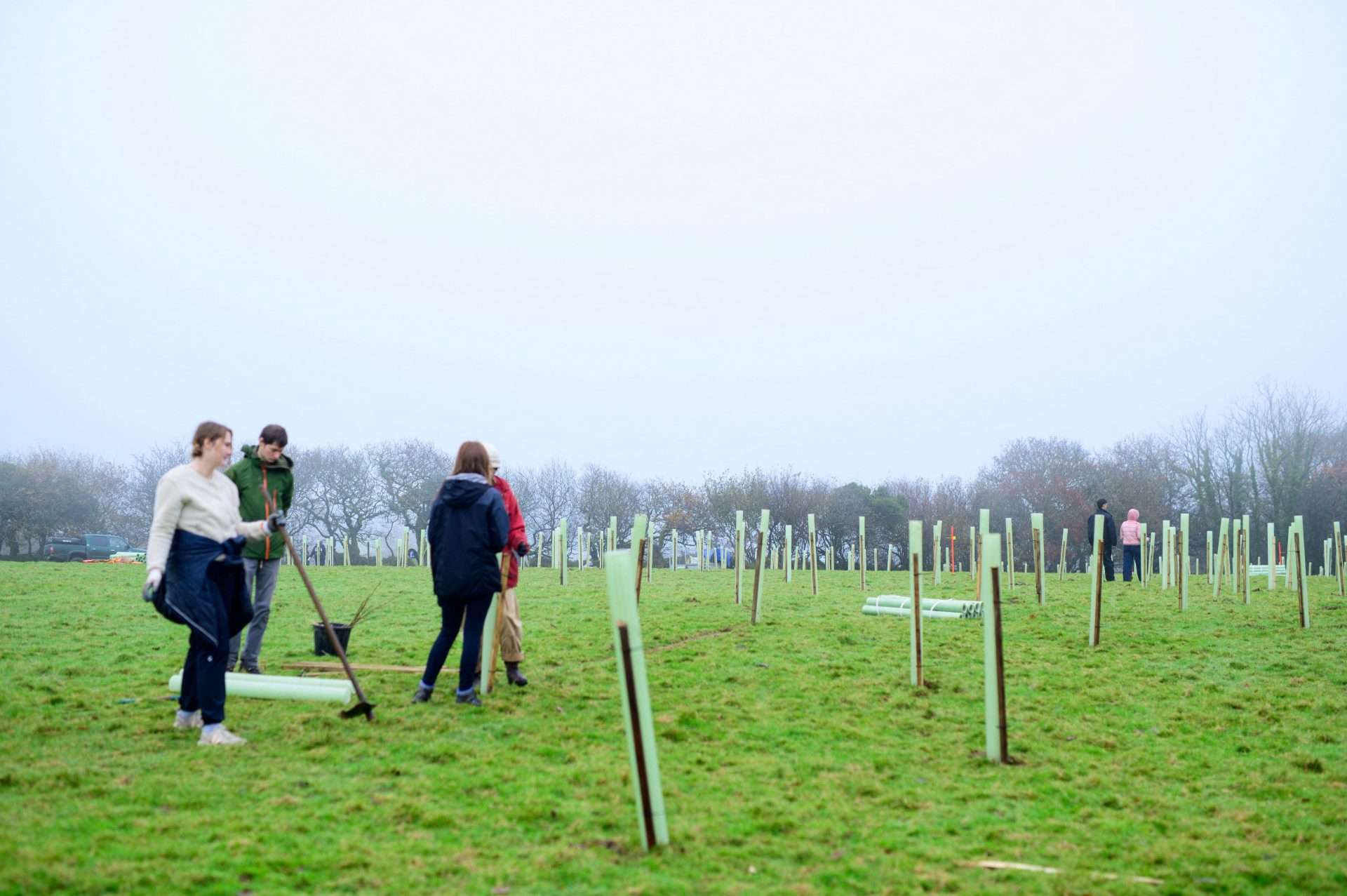
Community tree planting on Bodmin Moor, Cornwall
Alamy/Leela Channer
Dr Lorna Gold, Executive Director of the Laudato Si’ Movement, has said that an ‘economy of enough’ is not about ‘asking people to accept less’ but about ‘recovering what genuinely matters: time, relationships, community and meaning’.
Dr Gold gave the keynote address at the Earth Day conference at Queen’s University Belfast last April and her observations are contained in a new report titled: “An Economy of Enough in a Time of Crisis and Opportunity”.
Her argument challenges economic models based on continual expansion in a planet of finite resources and the assumption that “more” necessarily means “better”.
The conference brought together people from faith communities, academia, civil society and local initiatives to explore whether society needs to rethink what is meant by prosperity and a good life.
Six priorities emerged from the discussion in April. The first of these calls for stronger links among community, faith, academic, cooperative and environmental initiatives in the sharing of experience, resources and good practice, rather than creating unnecessary new structures.
Another priority calls for economic and environmental education for young people, schools, faith communities and community organisations and the development of new measures of prosperity.
The “An Economy of Enough in a Time of Crisis and Opportunity” report notes that markets, advertising, culture and technology encourage greater consumption and create a sense that satisfaction is always just beyond reach.
The report highlights how the idea of living within limits is not new and suggests that limits need not mean deprivation. “Chosen and shared wisely, they can create the conditions for freedom, community and wellbeing.”
Juanita Majury, a member of the “Join the Dots Together” steering group which organised the conference, explained that the report invites people “to ask what really matters for a good life, both for people and for the planet”.
Practical alternatives, the report notes, are already emerging through credit unions, community energy, Doughnut Economics, regenerative agriculture, wellbeing economics, co-operatives and faith-based initiatives.
Stay updated — add us as a preferred news source on Google:


Help us keep The Tablet’s voice independent, clear and far-reaching.
Founded in 1840, The Tablet is the leading independent English-language Catholic weekly, celebrated for great writing, astute analysis, brilliant arts and books reviews and trustworthy reporting from correspondents in Britain, Ireland, Rome and across the world.
Independent, high-quality journalism is at the heart of what we do. The Tablet does not have deep pockets and we are not funded by rich donors. If you appreciate our work please consider supporting The Tablet’s Development Fund. It only takes a moment and you can cancel at any time.
- Support with £5 per month
- Support with £10 per month
- Support with other amount.

MOST READ ARTICLES
-
1
Battling confession fatigue
-
2
Under endless skies
-
3
Nicaraguan bishops visit Rome as Ortega regime tightens grip
-
4
Would the Church miss us?
-
5
Vatican confirms Pope’s Latin America travel plans despite operation
-
6
Church from the 1950s receives £1 million government grant for new roof
FROM THE EDITOR'S DESK


