Pope Leo rejects ‘might is right’ at start of first foreign visit


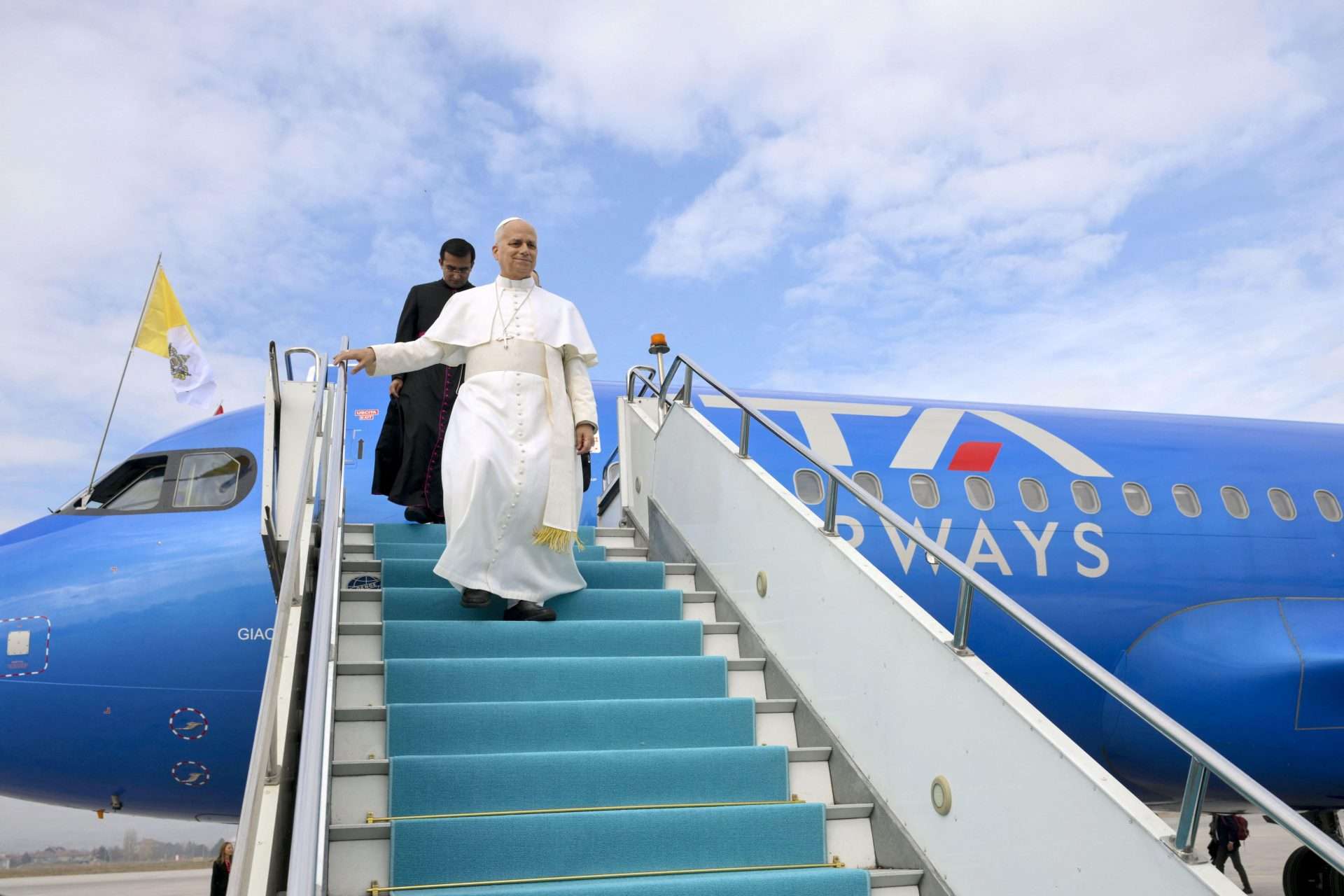
Pope Leo arrives at Esenboga International Airport in Ankara for the official welcome beginning his visit to Turkey
Vatican Media / Abaca Press / Alamy
The Pope arrived in Ankara on Thursday to begin the first apostolic journey of his pontificate, which will include celebrations marking 1,700 years since the Council of Nicaea.
Pope Leo XIV opened his first international trip on Thursday with a call for unity, renewed dialogue and a rejection of division and violence.
Speaking in the Turkish capital Ankara on 27 November during his formal welcome by President Recep Tayyip Erdoğan, the Pope said he hoped Turkey could be “a source of stability and rapprochement between peoples” and serve the cause of a “just and lasting peace”.
He said the country was “inextricably linked to the origins of Christianity” and a land that invites a fraternity “that recognises and appreciates differences”.
Beginning a six-day apostolic journey that will also take him to Lebanon, Leo said the region’s peoples can help remind the world that peace, human dignity, and fraternity “are the only sure foundations for our common future”.
The Presidential Palace where he spoke has become a symbol of Turkey’s contemporary political authority since Erdoğan inaugurated it in 2014. Bombed during the failed 2016 coup attempt, it remains the seat of his authority. Before meeting Erdoğan, the Pope paid his respects at the tomb of Mustafa Kemal Atatürk, founder and first president of the Turkish Republic.
In his remarks welcoming Leo, Erdoğan praised the cultural openness and interreligious harmony of Turkish society and his country’s commitment to peace and humanitarian assistance, citing its welcome to refugees from Syria’s long civil war.
In his speech, the Pope rejected the mentality of “might is right”, calling for a renewed “culture of encounter” to respond to the “globalisation of indifference”. Justice and mercy, he said, must guide political and social life. He also warned that artificial intelligence risks entrenching existing inequalities because it “simply reproduces our own preferences”. He appealed for cooperation to “repair the damage already done to the unity of our human family”.
Recalling his predecessor’s description of today’s conflicts as “a third world war fought piecemeal”, Pope Leo warned: “We must not give in to this! The future of humanity is at stake.” He said the Vatican seeks to work with all nations committed to the integral development of each person.
Calling Turkey a “crossroads of sensibilities”, the Pope emphasised that the country’s social vitality depends on plurality. “Uniformity would be an impoverishment,” he said, warning that communities today risk becoming “polarised and torn by extreme positions”. He said the official emblem for his visit – a bridge spanning the Dardanelles – symbolises not only a link between Asia and Europe but also a deeper call to unity: “It connects Turkey to itself.”
Pope Leo recalled John XXIII, remembered locally as the “Turkish Pope” because he spent nearly a decade as a Vatican diplomat in Turkey before becoming pontiff and worked to ensure Catholics were not marginalised in the early decades of the republic.
Echoing his teaching, Leo dismissed isolationism as “a false logic”. He also emphasised the contributions of women to society and international life and the importance of the family, where “without the ‘other’ there is no ‘I’”.
Turning to the 1,700th anniversary of the Council of Nicaea, which he will mark at ecumenical meetings with Eastern Orthodox leaders, the Pope said the fourth-century council still speaks of encounter and sustained dialogue.
Speaking on the flight from Rome to Ankara, Leo said the commemorations expressed “the very meaning of unity”. He said he hoped the visit would “announce, transmit and proclaim how is important peace throughout the world”, and “invite all people to come together to search for greater unity, greater harmony, and to look for the ways that all men and women can truly be brothers and sisters”.
Churches seek ‘common understanding’ of Nicaea, says Pope before anniversary visit
What really happened at Nicaea
Stay updated — add us as a preferred news source on Google:


Help us keep The Tablet’s voice independent, clear and far-reaching.
Founded in 1840, The Tablet is the leading independent English-language Catholic weekly, celebrated for great writing, astute analysis, brilliant arts and books reviews and trustworthy reporting from correspondents in Britain, Ireland, Rome and across the world.
Independent, high-quality journalism is at the heart of what we do. The Tablet does not have deep pockets and we are not funded by rich donors. If you appreciate our work please consider supporting The Tablet’s Development Fund. It only takes a moment and you can cancel at any time.
- Support with £5 per month
- Support with £10 per month
- Support with other amount.

MOST READ ARTICLES
-
1
Would the Church miss us?
-
2
Nicaraguan bishops visit Rome as Ortega regime tightens grip
-
3
Church from the 1950s receives £1 million government grant for new roof
-
4
Pope Leo thanks staff at Mass in Gemelli Hospital
-
5
Henri Nouwen: Christ’s acrobat
-
6
The technological paradigm, AI and the human person
FROM THE EDITOR'S DESK