News Briefing: Church in the World


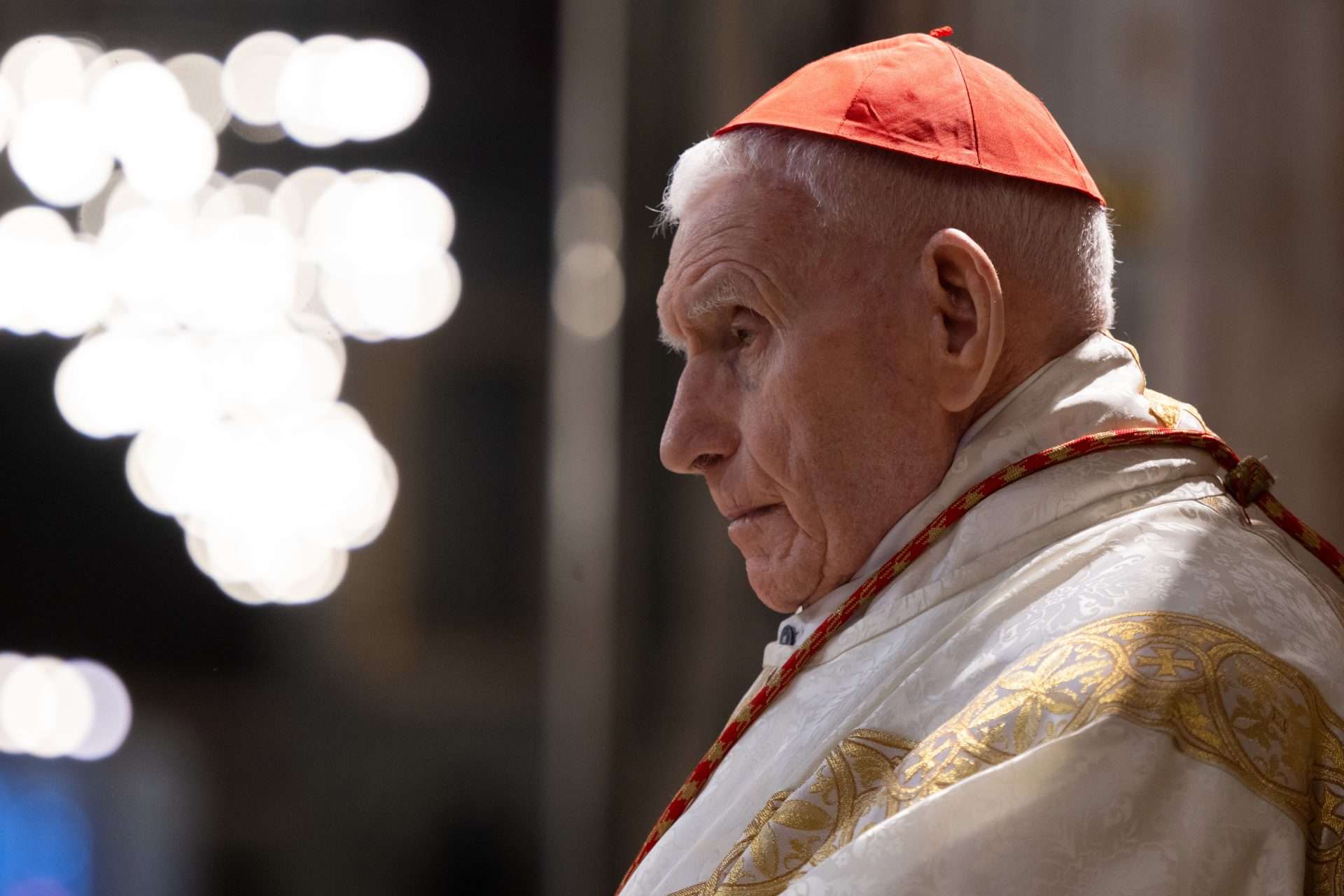
Cardinal Ernest Simoni celebrated a Mass at the former Spaç Prison in Albania, where he was imprisoned for 18 years from 1963 to 1981.
Catholic Church in England and Wales / Mazur
The Archdiocese of Ljubljana holds 22 undisclosed letters from women alleging abuse by the Slovenian artist Fr Marko Rupnik, according to former members of a community where he served as spiritual director.
Fabrizia Raguso told OSV News that she was among the women of the Loyola Community in Slovenia who wrote letters addressed to Rupnik detailing their relationship with him at the behest of their superior Sr Ivanka Hosta, as part of a reconciliation initiative for the Jubilee of the Year 2000.
Former members of the community have accused Rupnik of spiritual, psychological and sexual abuse before he left for Rome in 1993 and established a successful mosaic workshop. The Society of Jesus expelled Rupnik in 2023 for disobeying restrictions after wider allegations of abuse became public. He is currently subject to a canonical trial at the Holy See.
For the sixth year running the authorities of the city of Zurich banned the annual “March for Life” from the city centre. Citing potential security risks due to counter demonstrations, Switzerland’s largest pro-life event on 19 September will once again take place in the northern suburb of Oerlikon.
The march’s organisers complained that moving the event from public spaces in the city deprived it of the visibility required for exercising freedom of expression. They also announced that they would take legal action.
Beatrice Gall, the president of March for Life, told CNA that the city authorities’ argument for moving the march “does not address the root cause of the security concerns”. The march has taken place peacefully and without incident for 16 years.
“In a constitutional democracy the appropriate reaction is to prevent violence and to protect the basic rights instead of limiting those who exercise them peacefully,” Gall said. She questioned if pro-life events were treated with the same standards as other demonstrations of national significance in Zurich.
The opening hearing in the criminal case against the head of the Armenian Apostolic Church and six of its bishops ended without substantive proceedings in the Vagharshapat Court of First Instance. The presiding judge Hakub Manukyan recused himself explaining that doubts about his impartiality may be raised due to his previous work as a lawyer.
Ara Zohrabyan, the defence lawyer representing Catholicos Karekin II and his fellow bishops, told reporters after the hearing that although this did not constitute sufficient legal grounds for recusal, “I welcome the judge’s decision from the standpoint that he refused to become part of this shameful process.”
The Church rejects the charges relating to its refusal to comply with a court order to reinstate the former Primate of Masyatsotn, maintaining that the appointment and dismissal of clergy are outside the jurisdiction of the state.
The World Council of Churches, of which the Armenian Apostolic Church is a member, issued a statement affirming the Church’s vital role “in the spiritual, cultural and historical life of the Armenian people and in the wider Christian family … we express our concern about undue interference in inner church matters”.
The Diocese of the Armenian Church of the United Kingdom and Ireland said: “These developments also have significant consequences … throughout the diaspora. They hinder the normal pastoral ministry of the Catholicos of All Armenians and the Mother See of Holy Etchmiadzin, create uncertainty among the faithful and limit the Church’s ability to fulfil its spiritual mission to Armenian communities throughout the world.”
Pope Leo recalled the sufferings of Albanian Catholics under Communism in a message to Cardinal Ernest Simoni as he celebrated a Mass at a camp where the former regime imprisoned him for 18 years.
“I risked my life every time I celebrated Mass,” the 97-year-old said on his return to Spaç Prison, where he did forced labour from 1963 to 1981. The Mass on 31 July was in memory of those who suffered or lost their lives there during the Communist era of 1946-91.
The cardinal recalled how during his imprisonment, he celebrated Mass in secret from memory in Latin. He also heard confessions and distributed Communion in secret. “If they had found me, they would have hanged me immediately,” he said.
In his message, the Pope said Spaç Prison was “deeply engraved in the memory of the Albanian people” and the persecution there “remains one of the most painful chapters in the nation’s history”.
The audience ombudsman for Spanish Radio and Television (RTVE) received 111 complaints concerning the news coverage of the Pope’s apostolic journey to Spain in news bulletins. Complainants described coverage of papal visit in June as “excessive given we are in a secular and non-confessional state”.
The presenter Beatriz Ariño said: “The fact the events were broadcast via Simulcast meant that there were times when then daily news bulletin was not broadcast.” She pointed out that while the relevance and exceptional nature of the visit were “undeniable” in future broadcast executives “might consider alternative news programmes in order to maintain the coverage and broadcast of current affairs”.
Ministers from the outgoing Colombian government criticised the newly-elected President Abelardo de la Espriella after he was filmed at a spiritual retreat before taking office on 7 August. The former labour minister Antonio Sanguino called the footage “absolutely grotesque”. The retreat was at Marymount College, a private bilingual Catholic school in Barranquilla.
A United States Bankruptcy Court in Vermont will allow clergy abuse claimants to sue for an estimated half-billion dollars in parish assets to fund settlements under the Diocese of Burlington’s current financial reorganisation case.
In a written order issued in late July, Judge Heather Cooper said creditors could pursue trust-sheltered local property and possessions of nearly 70 parishes in addition to the highest-level bank and building holdings of the diocese. The order did not promise any parish assets but permits claimants to file a lawsuit to determine whether they’re entitled to local holdings.
“Unless settled,” Cooper wrote of the question in her ruling, “there may be years of litigation ahead and millions of dollars spent in attorneys’ fees and costs that could have been paid valid abuse claims.”
The Diocese of Burlington filed an 18-page objection to the pursuit of parish assets on 21 July. Attorneys for a federally-appointed committee representing more than 100 clergy abuse claimants filed a lawsuit in early August asking the judge to declare all church assets available to pay creditors.
The Florida Attorney General James Uthmeier wrote a letter to the Florida Conference of Catholic Bishops calling on the state’s Catholic schools to honour religious exemptions to vaccination requirements.
In his four-page letter dated 31 July, Uthmeier argued that Florida law requires public and private schools to accommodate objections to vaccine mandates. He asked the conference to provide a written response by 7 August explaining its position. Failure to comply with the state law, Uthmeir added, could jeopardise Catholic schools’ eligibility for state scholarship programmes.
“If the conference nevertheless refuses to comply with Florida law, then please state clearly the religious grounds on which Catholic schools may force persons to take vaccines derived from abortions against their deeply held moral and religious objections,” the letter said.
A spokeswoman for the Florida Conference of Catholic Bishops said the conference was reviewing the attorney general’s letter and anticipated responding by 7 August, but otherwise had no further comment.
According to published reports, a majority of Catholic schools in Florida enrol pupils who pay tuition with assistance from private school vouchers provided by the state. More than 500,000 pupils across Florida participate in the programme.
A federal judge in early August ordered New York state not to enforce parts of its new Medical Aid in Dying Act against four orders of Catholic religious sisters and several Catholic health care ministries that are challenging the law in court.
The plaintiffs argue that the law will force them to violate their faith by mandating that they counsel patients about assisted suicide, help them qualify for lethal drugs and direct them to providers who are willing to prescribe the drugs.
Signed by Governor Kathy Hochul on 6 February, the law was scheduled to take effect on 5 August. The measure allows eligible New York residents who are terminally ill, mentally capable and expected to live six months or less to request medication they may self-administer to end their lives.
Hochul’s office said the law includes important safeguards, such as a five-day waiting period, a recorded oral request, an in-person initial physician evaluation and a mandatory mental health evaluation.
Medical aid in dying laws have been passed by 12 states including Washington, DC. A lawsuit challenging the New York law was filed on 17 July by four orders of Catholic nuns, the Diocese of Rockville Centre and several Catholic health care ministries.
The Diocese of Imus in Cavite, the Philippines’ province with one of the highest numbers of voters, endorsed a signature drive against political dynasties. Imus is the latest diocese to back the Dapat Isa Lang (“One Is Enough”) campaign, which aims to pass an anti-political dynasty law through a “people’s initiative” recognised by the constitution.
In a circular posted on social media on 8 August, the Bishop of Imus Reynaldo Evangelista said the campaign “aims to break the cycle of dynasties, curb corruption and create space for capable leaders to serve the common good”. He said: “May our participation and discernment be constantly inspired by the Lord’s call for justice and social responsibility.”
Experts have long identified political dynasties as one of the causes of poverty and inequality in Asia’s biggest Catholic-majority country. Both President Ferdinand Marcos Jr and Vice President Sara Duterte belong to such dynasties.
An ecumenical group criticised a court order suspending a government-mandated wage increase for workers in the Philippines’ capital region. The minimum hourly wage for Filipino workers was supposed to increase by 85 pesos (£1.03), but a court suspended the increase following a case filed by two construction companies.
The Church People-Workers Solidarity, chaired by the Catholic Bishop of San Carlos Gerardo Alminaza, said the 85-peso wage increase is already insufficient for Filipino families. The wage adjustment “represents a modest step toward restoring the dignity of labour”, Alminaza said in a statement on 7 August.
“When delayed wages mean delayed meals, unpaid medicines or children’s unmet educational needs, justice becomes not merely a legal question but a profoundly moral one,” he said. The government maintains the country has one of the highest minimum wages in Southeast Asia, but studies show the cost of living in the Philippines is among the highest in the region.
Pope Leo XIV appointed two Indians – Sr Maria Nirmalini AC and Bishop George Pallipparambil of Mia – to curial posts.
Sr Nirmalini, superior general of the Sisters of the Apostolic Carmel, was appointed as a consultor of the Dicastery for Institutes of Consecrated Life and Societies of Apostolic Life, while Bishop Pallipparambil, a Salesian, was appointed to the International Council for Catechesis.
Sr Nirmalini, who is also the president of the Conference of Religious Women India, said the appointment “is an unexpected gift and a profound call to serve” in a response on 18 June. “I felt very humbled, unworthy, emotional, and grateful to God for this blessing. I see it as a gift entrusted to me by God and an opportunity to serve the universal Church,” she said.
Bishop Pallipparambil’s appointment to the International Council for Catechesis, announced by the Dicastery for Evangelisation, recognised his missionary work among indigenous communities in his Diocese of Miao in the north-eastern state of Arunachal Pradesh.
Pope Leo prayed for an end to violence in Sudan after international agencies warned of further atrocities in its civil war. Speaking after the Angelus on Sunday, the Pope addressed “the tragic situation in Sudan, especially in the city of El-Obeid”, where almost 600,000 people are under siege by the rebel Rapid Support Forces (RSF).
Leo appealed to “those in authority to guarantee humanitarian corridors for the civilian population” and for “the international community to support efforts aimed at bringing about an immediate ceasefire”.
International observers say El-Obeid is subject to intense drone attacks and could become the site of civilian massacres repeating those perpetrated by the RSF when it captured the city of El-Fasher. “Let us pray that the Lord may sustain those who are suffering, convert the hearts of those who sow violence and grant the long-awaited peace,” Pope Leo said.
Gunmen attacked a Catholic church in eastern Nigeria during Sunday Mass on 2 August. According to residents, seven attackers armed with AK-47 rifles struck the Church of St Joseph in Inoyi, Affa community in Udi Local Government Area in Enugu State, despite heavy rainfall in the area. The residents said local youths attempted to pursue the kidnappers into the bush but were forced to retreat after coming under fire from the attackers.
“It was raining at our place when we were preparing for church when suddenly others ran to us and said that the seminarian who came to conduct Mass, our catechist, and others had been taken away,” one of the residents said.
“As we were running helter-skelter, police came and asked us where it happened, and we showed them. Some youths went after them because those who came to inform us said the seven kidnappers were fully armed with AK-47s. There is no peace in our community – we live in fear, and now kidnappers come to church to kidnap us. We need help!” On Sunday government sources reported that security forces had liberated those abducted in the attack.
A bishop announced that the Church will expand its healthcare facilities in Ghana’s rural areas in response to the lack of access to adequate medicines for the country’s poorest amid high costs in government and private hospitals.
Bishop Matthew Gyamfi of Sunyani, who serves as president of the Ghana Catholic Bishops’ Conference, made the comments after meeting the health minister last week during the launch of a government health programme. “Health care is undoubtedly a complex issue and this is precisely why the Catholic Church has chosen to establish health care facilities in rural areas,” Bishop Gyamfi said.
The government has partnered the Catholic Church to drive the expansion of healthcare infrastructure to meet the medical needs of millions of people who are struggling to access basic services. The programme seeks to establish more than a hundred district hospitals while also renovating existing health facilities.
“Building infrastructure is always extremely difficult. There is often no electricity and even access to clean water,” Bishop Gyamfi said. “Once the facilities have finally been built, it becomes necessary to persuade healthcare professionals to relocate and work in these remote regions.”
Health mandates and safety protocols in the eastern Democratic Republic of Congo designed to lessen the spread of the virus have deepened the grief of Congolese families, according to Fr Edouard Makimba Milambo, executive secretary of Caritas Congo ASBL.
The latest outbreak of the virus has so far killed at least 1,800 people with 3,973 cases confirmed. Fr Makimba said that behind the staggering infection rates are families enduring unimaginable psychological trauma, forced to navigate the painful intersection of public health mandates and deeply held cultural traditions.
“We hear reports of parents who can no longer hold their children in their arms whilst they are in care or undergoing monitoring, of children who do not understand why a loved one is being taken away, and of families who must accept measures to ensure a dignified and safe burial even as they are going through immense grief,” the Congolese priest told Crux Now.
He said that families do not reject these measures out of malice, but rather because the protocols touch upon highly sensitive cultural and spiritual practices. Caritas is responding to this complex dynamic, offering pastoral and social support to ensure families understand the necessity of the measures and do not feel abandoned in their darkest moments of grief.
A Cameroonian bishop sparked outrage by suggesting that young women bore the blame for clerical sexual abuse.
In a homily, Bishop Michael Bibi of Buea accused women of “pursuing priests”, telling them: “Stop pursuing or ‘running behind’ priests romantically. Priests will never marry you and cannot live with you as husbands.” He urged women who desire marriage to consider unmarried men: “There are many single young men available for marriage. Pursue them instead.”
Bishop Bibi also appealed to the faithful to respect the vocation of priests and allow them to concentrate on their spiritual responsibilities without romantic pressure or unnecessary distractions. “Leave priests free to carry out their sacred duties,” he said.
Fellow clerics and feminist activists condemned the bishop’s remarks, accusing him of ignoring the inherent power imbalance within the Church and painting predatory priests as victims.
Eileen Tabuwe Akwo, a Catholic gender advocate, argues that the message places the burden of priestly discipline almost entirely on women. “You frame the matter as if the primary threat to priestly celibacy is a woman,” she wrote.
She said such language presents priests as passive victims instead of adult men responsible for vows they freely made. It also follows a familiar pattern in which Eve is blamed for Adam’s fall and Delilah for Samson’s downfall.
Akwo further argued that a priest is not simply another man. He may be a woman’s spiritual father, confessor, counsellor or trusted adviser, giving him considerable authority and influence within the Church. “We are not distractions. We are not pursuers. We are the Church,” she concluded.
Catholic bishops joined other faith leaders in Malawi to call on the government to act on the looming El Nino and the wider effects of the climate crisis.
The faith coalition presented their concerns to parliament last week, suggesting how the government should approach the climate crisis that has affected millions of people. They urged the government to increase funding towards disaster preparedness, responding to the neglect of vulnerable communities which have suffered hundreds of deaths in climate-linked floods and famine.
The coalition is made up of the Malawi Conference of Catholic Bishops, the Evangelical Association of Malawi, the Centre for Environmental Policy and Advocacy and the Civil Society Network on Climate Change.
The government welcomed the plea, acknowledging the urgency of climate change as experts forecast a Super El Nino that is expected to bring extreme weather that will trigger crop failure in East Africa.
“Faith leaders are present in our communities and where the government cannot reach, they are always there to help. We are going to work together to conserve the environment,” said Oliver Kumbambe, a senior government official.
The cause for the canonisation of Julius Nyerere, Tanzania’s first president who died in 1999, has advanced to hearing evidence, according to a local bishop.
“We are in the process of interrogating witnesses,” said Bishop Henry Mchamungu, an auxiliary in the Archdiocese of Dar-es-Salaam. “This is a very important stage because we have to ask people many questions to obtain sufficient information about the life, virtues and faith of Mwalimu Nyerere.”
The canonisation process began in 2005 when the country’s bishops officially approached the Holy See to open the cause. “Each witness is asked many questions – sometimes one person can be asked 30 or even 40 questions. We have to listen to many witnesses because we need to gather enough evidence concerning his life and his virtues,” Mchamungu said.
Nyerere is celebrated across the continent for helping other African countries gain independence from Britain in the 1960s. He is also revered in Tanzania for his simple life and for championing the lives of the poor and unity among diverse tribal and ethnic groups.
“We continue asking God that the cause may continue. The day will come, God willing, when he will be declared blessed,” Bishop Mchamungu said.
The World Catholic Association for Communication (SIGNIS) elected the Nigerian priest Fr Walter Chikwendu Ihejirika as its new president. The announcement was made during the SIGNIS World Congress in Kigali, Rwanda.
A professor of Development Communication and Media Studies at the University of Port Harcourt, Nigeria, Fr Chikwendu Ihejirika holds a doctorate in Social Communication from the Pontifical Gregorian University in Rome. He has served two terms as president of SIGNIS Africa.
The congress in Rwanda brought together Catholic communicators from over 40 countries to discuss “Digital Communication for Cultural Harmony and Environmental Well-Being”. One of those who addressed the congress was Archbishop Fortunatus Nwachukwu, secretary of the Dicastery for Evangelisation.
Speaking to Vatican News, he encouraged communicators to ensure that every digital journey becomes a path of encounter rather than one of tribalism, polarisation or division. Care for creation, he emphasised, is “an essential part of the stories they tell”.
Stay updated — add us as a preferred news source on Google:


Help us keep The Tablet’s voice independent, clear and far-reaching.
Founded in 1840, The Tablet is the leading independent English-language Catholic weekly, celebrated for great writing, astute analysis, brilliant arts and books reviews and trustworthy reporting from correspondents in Britain, Ireland, Rome and across the world.
Independent, high-quality journalism is at the heart of what we do. The Tablet does not have deep pockets and we are not funded by rich donors. If you appreciate our work please consider supporting The Tablet’s Development Fund. It only takes a moment and you can cancel at any time.
- Support with £5 per month
- Support with £10 per month
- Support with other amount.

MOST READ ARTICLES
-
1
German bishops commit to global Synod process despite delay to reforms
-
2
The Tablet poem
-
3
Battling confession fatigue
-
4
Bangladesh Christians ask president to help ease missionary visa restrictions
-
5
Pope Leo announces operation to remove growth in lung
-
6
Catholic Social Teaching and universities
FROM THE EDITOR'S DESK