News Briefing: Church in the World


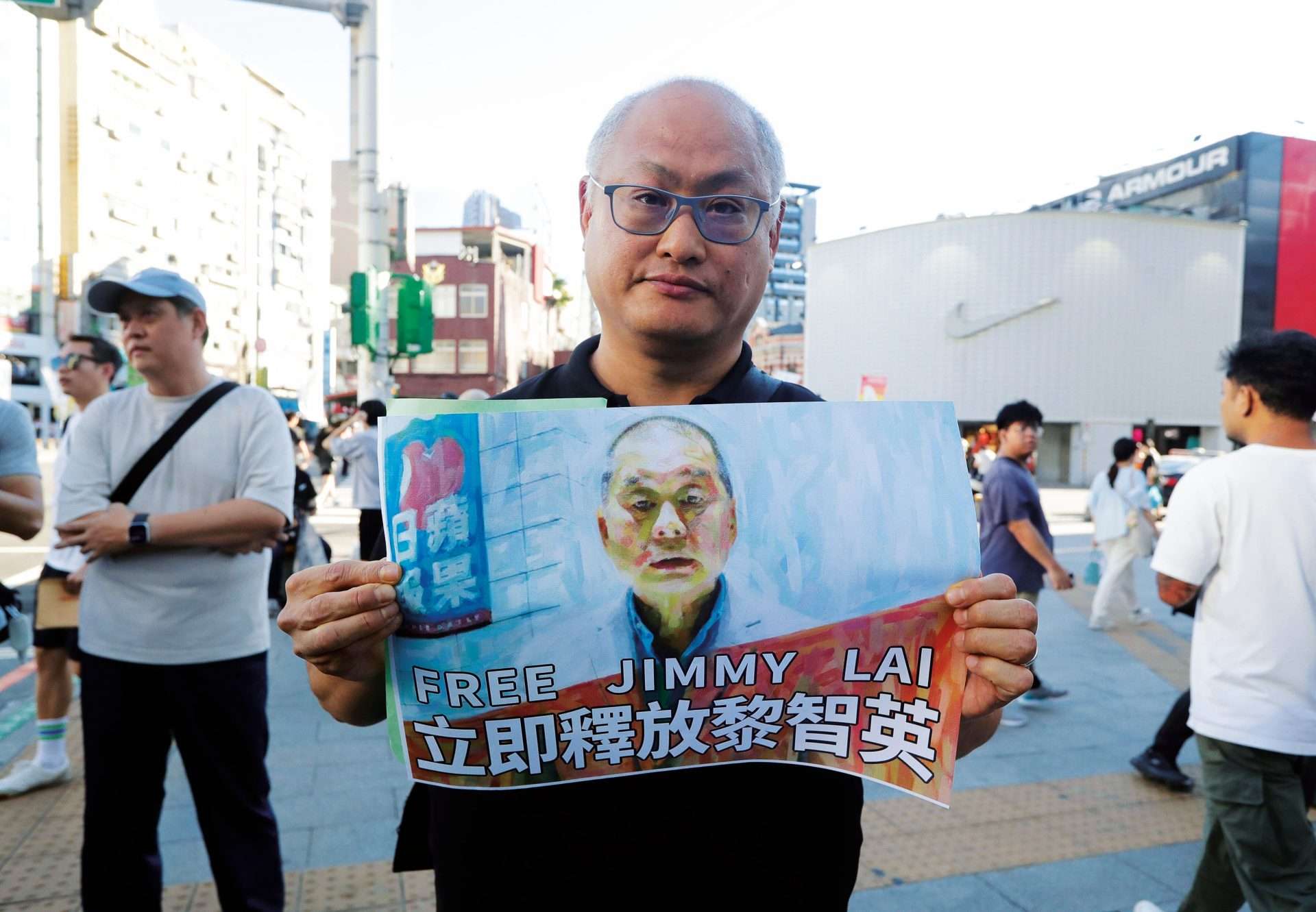
A protester in Taiwan calling for the release of Jimmy Lai. US President Donald Trump said he would discuss the imprisonment of the Catholic democracy activist with Xi Jinping.
Chiang Ying-Ying / Associated Press /Alamy
Pope Leo will take part in an ecumenical prayer service close to the archaeological excavations of the Basilica of St Neophytos, a submerged ancient church linked to the first Council of Nicaea, during his visit to the modern site of the council in Iznik.
The Vatican published the itinerary for the Pope’s six-day visit to Turkey and Lebanon on Monday, detailing his meetings with officials in Ankara on his arrival on 27 November, liturgies with Orthodox and Catholic leaders in Istanbul and Iznik, and further state and church events in Beirut where he will travel on 30 November.
His time in Istanbul will include the signing of a joint declaration with the Ecumenical Patriarch Bartholomew I of Constantinople and liturgies at the Patriarchal Church of St George. In Lebanon, the Pope will hold a private meeting with patriarchs of the Eastern Catholic Churches and pray at the site of the 2020 Beirut Port explosion.
Christians in the Holy Land must “ask Our Lady of Palestine to open our hearts to hope”, the Latin Patriarch of Jerusalem said on the Feast of Mary, Queen of Palestine and the Holy Land.
Cardinal Pierbattista Pizzaballa said Mass at the Marian Shrine of Deir Rafat on 25 October, reminding the congregation that “however turbulent and difficult these times may be, we are called to return to living with fullness, passion and vitality”. He thanked churches around the world who offered support with prayer and action during the war in Gaza.
On 22 October the Greek Orthodox Patriarch of Jerusalem Archbishop Atallah Hanna issued an open letter to US Vice President J.D. Vance, urging him to listen to Palestinian voices during his visit to the Holy Land.
“You crossed the oceans to reach Jerusalem, but a Palestinian who is half an hour away from Jerusalem by car cannot reach the Holy City, because there are barriers, gates and fences manned by the military,” he said, describing restrictions on access to the city’s holy sites including the Church of the Holy Sepulchre – where Vance prayed during his visit – and the Al-Aqsa Mosque.
Archbishop Hanna demanded protection of “freedom of worship and movement for all who call this land home”. Last week, Pax Christi International joined a coalition of global civil society organisations opposing US sanctions on Palestinian rights organisations.
A court in Pakistan dismissed a petition seeking the appointment of judges in regional high courts from religious minority groups, prompting criticism from minority leaders and rights activists.
Fr Inayat Bernard, chaplain of Caritas Pakistan, said minorities are too often ignored despite their vital contributions to the nation. He said the state denied them major posts – such as high court judges or senior military appointments – and left minorities “feeling like third-class citizens”.
Chief Justice Aalia Neelum of the Lahore High Court in Punjab province dismissed the petition filed by Naseeb Masih, a Christian lawyer, on 21 October. Masih argued that despite the constitution allocating a five per cent job quota for minorities, no judges from religious minority groups have been appointed to a high court for years. None of Pakistan’s five high courts have a non-Muslim judge.
The Salesians of Don Bosco in India’s Gujarat State launched a 100-day awareness-raising campaign to eradicate child marriage, a persistent problem in the state despite national laws prohibiting it. The initiative, running from 1 November to 26 January 2026, seeks to educate communities about the problem of child marriage and promote action to tackle it.
Although Indian law sets the minimum marriage age at 18 for girls and 21 for boys, Unicef data shows that India is “the country with the highest number of young people forced into marriage before reaching adulthood”.
More than 300 parents from three Gujarat districts have already signed a written pledge “not to marry off their underage children”. The Salesians said that “these written pledges are a testament to change and a commitment to a more secure future for every child”.
Pope Leo XIV should visit North Korea to “help promote peace” on the Korean Peninsula when he attends the 2027 Seoul World Youth Day, South Korean parliamentarians said. The speaker of the Republic of Korea’s National Assembly Woo Won-shik met the Vatican’s Secretary of State Cardinal Pietro Parolin in Rome on 21 October and handed him a letter for the Pope making the request.
Woo said a papal visit to North Korea would hold great significance for both global and inter-Korean peace. He hoped World Youth Day “will mark a new turning point for peace on the Korean Peninsula”. President Lee Jae Myung proposed in July that Pope Leo consider such a visit during the event.
President Donald Trump said he intended to ask Chinese President Xi Jinping to release Jimmy Lai, the Catholic democracy activist and former publisher who faces imprisonment under Hong Kong’s security laws.
Asked about Lai’s treatment as he prepared to depart for Asia last week, Trump said: “Look, they’re big enemies. But we’ll see what happens, you know. Jimmy Lai, Jimmy Lai and President Xi are big enemies but it’s been a long time and I will be … it’ll be on my list.”
He acknowledged receiving a letter from a bipartisan group of senators asking him to raise the issue with Xi. “The humanitarian case for Mr Lai’s release is stronger and more dire than ever, which is why this must be addressed at the highest possible level,” the letter said.
The Catholic Church in Toronto observed its first archdiocesan day for Palliative Care last Sunday.
“This new observance is born out of a deep pastoral concern for those who suffer and for those approaching the end of life,” said the Archbishop of Toronto Cardinal Frank Leo in a pastoral letter on 23 October. He expressed hope that the day on 26 October would “inspire every parish community to pray, reflect, and act with renewed compassion toward those in need of comfort, dignity, and accompaniment in their final journey”.
The cardinal said it was “imperative” for Catholics to “raise awareness and encourage prayerful dialogue among the faithful and the larger community about what to do when someone we love is suffering, especially in a life-threatening manner”. Assisted suicides account for roughly one in 20 deaths in Canada.
Cardinal Leo continued: “With its proximity to the month of November when we remember those who have gone before us, the Archdiocesan Day for Palliative Care connects the suffering of this world and in our bodies and souls, with the hope that we have in the world to come.”
A bishop who resigned last year said he had married a Peruvian woman in a civil ceremony. Reinaldo Nann, 65, formerly bishop of the prelature of Caravelí in southern Peru, announced in a blog post that while depression was the “trigger” for his resignation in July 2024, “the cause was love”.
Nann, who was born in Germany, originally said he had resigned for health reasons. “Since Covid, my physical and mental health have become debilitated and I feel I no longer have the strength I once enjoyed,” he announced in a statement.
“After some medical checks, doctors have suggested I take some time to rest and recover, thus I have decided to renounce my post and ask for a sabbatical,” he said. “My treatment and convalescence will take place in Germany where my mother and siblings will provide me with emotional support.”
In his recent blog post, Nann said the Vatican had not yet laicised him although he had informed the Holy See last December of his plans to enter matrimony and leave the priesthood.
Christian Solidarity Worldwide (CSW) called for the Mexican authorities to conduct a full and transparent investigation into the murder of a Catholic priest in Guerrero State.
After the body of 59-year-old Fr Bertoldo Pantaléon Estrada was discovered riddled with gunshot wounds, CSW’s director of advocacy Anna Lee called on “authorities at both the state and federal levels to ensure that all of those responsible for Fr Pantaléon Estrada’s death are held to account and the motive behind this murder firmly established”.
Guerrero is dominated by criminal gangs linked to narcotics trafficking. Bishop José de Jesus González of Chilpancingo-Chilapa told Aid to the Church in Need in September that Guerrero had been “hijacked” by organised crime leaving the Church as “the only voice that can speak for the people”. Throughout Mexico around 30 priests have been killed over the past decade.
More than 3,000 people signed a petition to ask the Archbishop of Seville to remove a priest who refused an 18-year-old girl with Down’s syndrome permission to become a godmother.
Fr José Antonio Morón of Benacazón, 23 kilometres from Seville in southern Spain, reportedly described Noelia Vega as “unsuitable” to become a godmother to her cousin for the sacrament of baptism following an interview with her.
A petition written by “the neighbours” of Benacazón describes Noelia as having received the sacraments of Christian initiation and “actively participating in the faith and incarnating with purity and joy the Gospel values”.
The petition, signed by nearly half the 7,000 residents of Benacazón, adds: “Denying her this right is not an administrative act: it is cruel and unjust discrimination which contradicts the message of love, respect and welcome which the Church should represent.” The signatories also demand a public apology from the priest whom they accuse of other instances of “exclusion” involving people who are transgender, divorced or single parents.
Archbishop José Ángel Saiz Meneses of Seville told ACI Prensa that the priest’s decision was not about her having Downs’ syndrome.
He said Fr Morón was following the archdiocesan instructions on Christian initiation which, echoing the catechism, establish ecclesial criteria regarding the choice of godparents to ensure that those selected “are competent to realise this mission and intend to carry it out”.
The Pope approved the beatification of nine Polish Salesians martyred at the concentration camps of Dachau and Auschwitz in Germany. Jan Świerc, Ignacy Antonowicz, Ignacy Dobiasz, Karol Golda, Franciszek Harazim, Ludwik Mroczek, Włodzimierz Szembek, Kazimierz Wojciechowski, and Franciszek Miśka were killed in the camps between 1941 and 1942.
He also approved the beatification of two Czech priests, Jan Bula and Václav Drbola, of the Diocese of Brno. Both were killed by the Communist regime in Czechoslovakia between 1952 and 1953.
Fr Bula was arrested in April 1951 but was accused of inspiring an attack where several communist officials were killed in July the same year. Following a trial, he was sentenced to death and on 20 May 1952 was hanged in Jihlava prison. Fr Drbola, arrested in June 1951, was also accused of involvement in the Babice attack while imprisoned. He was condemned to death and executed on 3 August 1951.
The third assembly of the Italian Church’s Synodal Path approved a summary document after organisers postponed a vote an earlier draft.
The approved text, titled “Leaven of Peace and Hope”, summarises the findings of the four-year consultation process, described by the chair of the Synodal Path’s national committee Archbishop Erio Castellucci of Modena-Nonantola as “a unique phenomenon in the history of the Church in Italy”.
More than 75 per cent of the 809 delegates backed each proposal in the document on 25 October, including calls to include laypeople – particularly women – in leadership and decision making, and for greater engagement with “excluded” groups including LGBT Catholics and couples in “irregular” situations, though these received less support than others.
Delegates had complained that a previous version of the text presented in April failed to address these subjects fully.
Jesuits must be “at the frontiers, whether they be geographical, cultural, intellectual or spiritual”, the Pope told senior figures in the Society of Jesus.
Addressing its first meeting of Major Superiors since 2005 on 24 October, Pope Leo said that the Society’s members went “to the margins, where faith and reason intersected with new cultures and great challenges” from its foundation.
“These are places of risk, where familiar maps are no longer sufficient,” he said, offering the Church’s path of synodality, the need for reconciliation amid the “globalisation of indifference”, and the development of technology including artificial intelligence as important frontiers during “a change of epoch”.
A coalition of major African Catholic entities appealed to global leaders convening for the G20 summit in South Africa to put the world’s most vulnerable at the centre of economic policy.
Led by the Justice and Peace Commission of the Southern African Catholic Bishops’ Conference and joined by organisations including Caritas Internationalis and the Jesuit Conference of Africa and Madagascar, the group urged global leaders to prioritise maternal health and child hunger, both critical issues in a continent in which 64 million children live in severe food poverty, and the maternal mortality rate stands at a tragic 199 per 100,000 live births.
“The cries of the hungry echo across our continent. The tears of mothers who bury their children stain the soil of our shared humanity. These are not statistics. They are sacred lives, made in the image of God,” the coalition said. “When world leaders gather for the G20 summit, they bring with them competing priorities – markets, security, technology, and power. Yet, as people of faith, we call for a different kind of priority.”
They said this should be focused “firmly upon the most vulnerable, the women and children who bear the heaviest burdens of the current global economic crisis in Africa”.
Stay updated — add us as a preferred news source on Google:


Help us keep The Tablet’s voice independent, clear and far-reaching.
Founded in 1840, The Tablet is the leading independent English-language Catholic weekly, celebrated for great writing, astute analysis, brilliant arts and books reviews and trustworthy reporting from correspondents in Britain, Ireland, Rome and across the world.
Independent, high-quality journalism is at the heart of what we do. The Tablet does not have deep pockets and we are not funded by rich donors. If you appreciate our work please consider supporting The Tablet’s Development Fund. It only takes a moment and you can cancel at any time.
- Support with £5 per month
- Support with £10 per month
- Support with other amount.

MOST READ ARTICLES
-
1
The Tablet poem
-
2
A craving for beauty
-
3
Battling confession fatigue
-
4
Massachusetts abuse report finds over 1,000 victims in three dioceses
-
5
Bishops demand security investment to promote ‘common good’ in Nigeria
-
6
Woman religious becomes first female president of Pontifical Mission Societies
FROM THE EDITOR'S DESK