News Briefing: Church in the World


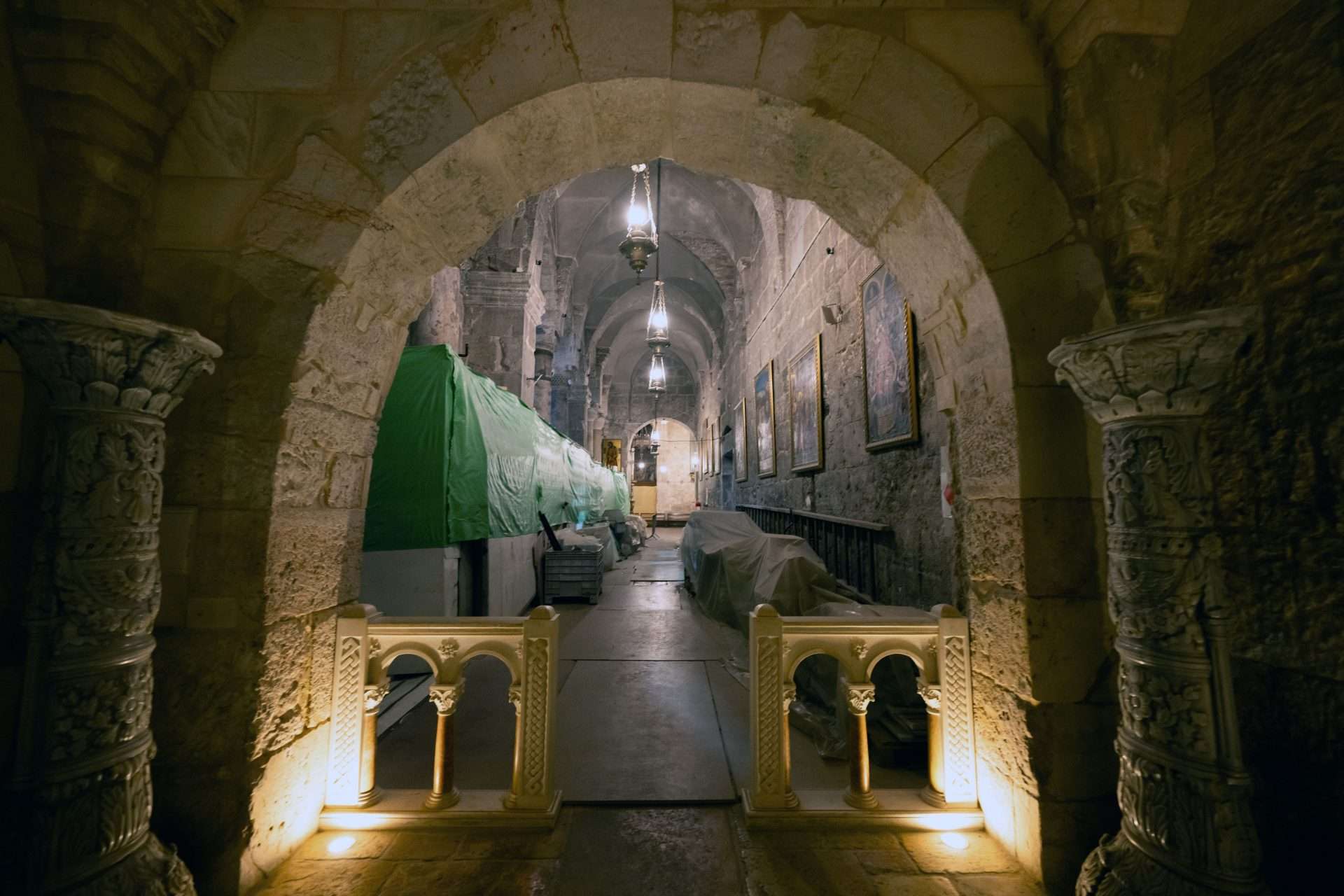
Excavations in the Church of the Holy Sepulchre have found evidence of a 2,000-year-old garden matching the description of the tomb in St John’s gospel.
Catholic Church in England and Wales / Mazur
Theodore McCarrick, the former Archbishop of Washington and once one of the most influential cardinals in the United States, died at a nursing home in Missouri on 3 April.
The 94-year old resigned from the College of Cardinals in 2018 after church authorities determined an allegation of sexual abuse of a minor was credible, and he was laicised the following year. In a civil court in Massachusetts, he was accused of sexually assaulting a teenage boy in 1974, and faced similar allegations in Wisconsin. Both cases were dismissed because the former cardinal’s declining health made prosecution impossible.
McCarrick rose through the ranks of the hierarchy during the pontificate of John Paul II, despite rumours of his inappropriate behaviour with seminarians. Born in New York, he became the Bishop of Metuchen, New Jersey in 1981, Archbishop of Newark in 1986, and Archbishop of Washington in 2000. The next year, McCarrick was elevated to the cardinalate.
Cardinal Robert McElroy, the current Archbishop of Washington, said: “Today I learned of the death of Theodore McCarrick, former archbishop of Washington. At this moment I am especially mindful of those who he harmed during the course of his priestly ministry. Through their enduring pain, may we remain steadfast in our prayers for them and for all victims of sexual abuse.”
The Archdiocese of Chicago filed a countersuit against two people who claimed they were sexually assaulted by the former priest Daniel McCormack.
The suit alleges their claims were false and, with five others named in the suit, amounted to a conspiracy to defraud the archdiocese by filing false claims. The countersuit says that the alleged conspirators never attended the church where McCormack served, nor participated in the basketball programme the priest ran in the neighbourhood.
“The point of this action is to protect the interests of legitimate victims,” said James Geoly, general counsel for the archdiocese. “We do not want this action to deter any legitimate victim from coming forward. I would encourage anybody who’s had a problem with a priest or cleric to do that.”
He added: “This was a very egregious case of very bad behaviour. We have a very open, compassionate system, and these people took advantage of that.”
Fraudulent claims result in lower settlements for those with genuine claims. Much of the evidence for the conspiracy allegations came from telephone calls to and from prison inmates, one of whom had previously obtained a settlement from the archdiocese. Such calls are monitored by police.
Sexual abuse survivors held a protest demonstration when John Paul II was canonised
A Catholic pro-life activist was assaulted by a pro-choice woman she was interviewing outside a Planned Parenthood abortion clinic in New York. The assault was captured on video, which quickly went viral.
Savannah Craven Antao asked the woman “Do you know what Planned Parenthood does?” The woman explained that she did know what abortions were and then, when Antao questioned the woman’s previous assertion that children in foster care were killed, too, the woman punched her in the face. Antao’s husband intervened to stop the assault, after which she had to go to hospital and received stiches.
Antao said that she often conducts similar recorded interviews, posting them on Youtube, and did not anticipate getting hit. “I had absolutely no time to see that it was coming,” she said. Live Action President Lila Rose posted the video online, writing: “Her bravery in the face of violence is heroic. We are grateful she is safe and receiving support.”
Two religious sisters were among five people killed during an armed gang’s offensive near the Haitian capital Port-au-Prince on 31 March. The Episcopal Conference of Haiti described the murders as a “heinous crime” that has “once again plunged our country and our Church into mourning”.
Evanette Onezaire and Jeanne Voltaire, Sisters of the Order of Saint Teresa, were killed by members of the Vivre Ensemble coalition, a group uniting the country’s most powerful gangs. The sisters had sought refuge in a house as the gang attacked public buildings in Mirebalais, 30 miles north-east of the capital. Gang members found the sisters’ hiding place and shot them dead.
The bishops lamented “the inaction of the authorities”, saying “the lack of an effective response to persistent insecurity is a serious failure that endangers the nation, abandoned to the mercy of destructive forces”. It called on the armed groups to “cease their acts of violence and rediscover a sense of respect for human life”.
According to UN data, more than 4,200 people were killed in Haiti between July 2024 and February 2025, while over one million have been displaced by gang violence.
A group of experts issued a 200-page report for the UN Human Rights Council detailing human rights abuses by the Nicaraguan authorities since 2018.
“Since April 2018 the government of President Ortega and Vice-President Murillo has executed a gradual strategy to establish absolute control. To achieve this it has systematically carried out serious human rights violations,” it said in its conclusion.
“This tendency has culminated in a constitutional reform designed to consolidate an uncontrolled executive authority – a final blow to the rule of law and basic freedoms in Nicaragua.” The report includes a list of 54 officials considered guilty of the most serious abuses and calls for prosecutions and economic sanctions against them and the Nicaraguan state.
The exiled auxiliary Bishop Silvio José Baez, an auxiliary of the Diocese of Managua, called for the officials named to be prosecuted. “Now that we know the names of those who have inflicted repression on the people of Nicaragua, the demand for justice is greater and more urgent. They have caused too much pain, humiliation and death,” he said. “Each of them should be tried and pay for their crimes.”
Nicaraguan regime attacks ‘depraved’ Vatican after Álvarez interview
Government urged to seize religious freedom ‘opportunity’
Pope Francis will canonise the first saint from Papua New Guinea. Bl Peter To Rot was born on 5 March 1912 and became a lay catechist with the permission of his father, part of the first generation of Papua New Guinean Catholics, who disagreed with the local priest’s suggestion his son should enter the priesthood. To Rot married and became a father of three.
During the Japanese occupation of Papua New Guinea in the Second World War, missionaries were imprisoned and To Rot prepared couples for marriage. When his ministry was banned, he continued in secret. He opposed the practice of polygamy, confronting his older brother, Joseph, who had taken a second wife. His brother reported To Rot to the police who sentenced him to two months in prison, where he died of poisoning in 1945.
In January 1995, John Paul II beatified To Rot at Port Moresby, the capital of Papua New Guinea.
Eleven Filipino clergymen signed a petition to the Supreme Court demanding action against the dominance of political dynasties in the Philippines. The four bishops and seven priests made the submission alongside other prominent figures, including two former Supreme Court justices, on 31 March.
The petition urged the 15-member Supreme Court to direct Congress to create a law banning political dynasties, as mandated by the Philippine Constitution of 1987. A 2022 study by the Ateneo School of Government, a Jesuit-run institution, found that nearly 80 per cent of Filipino parliamentarians belong to political dynasties.
“We now have a government filled with elective officials whose primary qualifications are neither their character nor their competence, but rather their luck in the genetic lottery,” the signatories said in their 48-page petition. The “sheer shameful official inaction” by Congress to bring an anti-dynasty law into effect has resulted in “the worsening grave poverty of our people”, they said.
Clergy back Supreme Court petition to end Filipino political dynasties
The irrepressible rise of the ‘Church of Duterte’
Five South Korean bishops visited Gyodong Island, close to the border with North Korea, where they met North Korean refugees and prayed for peace on the Korean Peninsula.
The visit on 2 April was part of the Church’s efforts for peace and reconciliation on the eightieth anniversary of the separation of South and North Korea, according to a statement from the bishops’ conference. The bishops visited the Reconciliation and Peace Centre operated by the Missionary Sisters of Our Lady of the Martyrs.
They were told how Gyodong Island became a haven for displaced North Koreans after the Korean War. The bishops met some elderly North Koreans displaced by the Korean War, before praying for peace. They then walked along a coastal barbed wire fence looking out at North Korea, and wrote messages of hope for unification which they hung on the wire.
The Chinese government published new regulations imposing further restrictions on religious activities by foreign missionaries.
The regulations were published by the National Religious Affairs Administration on 1 April, to come into effect on 1 May. They contain 38 articles, titled “Rules for the Implementation of the Provisions on the Administration of Religious Activities of Foreigners in the People’s Republic of China”.
It follows the National Joint Meeting of Religious Groups conference last month, which instructed state-approved religious groups, including the Chinese Patriotic Catholic Association, to integrate Chinese Communist Party principles into their sermons.
The restrictions apply to believers of any religion, strictly prohibiting non-Chinese citizens residing in the country from establishing religious organisations, preaching without authorisation, founding religious schools, producing or selling religious books, accepting religious donations, or recruiting Chinese citizens as religious followers.
Foreign clergy must acknowledge the principle of “independence and self-government” of religions in China. They are banned from presiding over religious activities for Chinese people without the invitation of the Chinese government. “Collective religious activities organised by foreigners in China are restricted to foreign participants only.”
Foreign religious clergy may only preach if they are invited by one of the Chinese state-run national religious organisations and approved by the National Religious Affairs Administration.
The enduring church – Catholicism in China
Talking to the dragon – Francesco Sisci untangles China-Vatican relations
On 22 March, police entered the Church of Our Lady of Lourdes in Juba, part of the Diocese of Berhampur, in India’s eastern state of Odisha amid a wider surge in hostilities against Christians.
They attacked a group of girls who were cleaning the church and Fr Joshi George and his assistant Fr Dayanand Nayak who rushed out to help, Fr Ajay Kumar Singh told The Tablet. He said Fr Nayak suffered a shoulder bone fracture and was hospitalised for a week. The policemen confiscated his mobile and also took away 40,000 rupees from his room.
Christians in Odisha have faced mounting persecution these days since the Bharatiya Janata Party (BJP) assuming power in the state last year, said Fr Singh, a long-serving justice and peace activist.
To get a first-hand information, a team of six lawyers, including priests and nuns, went on a fact-finding mission to the Diocese of Balasore, he explained. “There some Christians told us they faced social boycott threats for practicing their faith.”
Two Catholic priests were attacked by Hindu nationalist activists in India’s central Madhya Pradesh state. Police filed a complaint report only after widespread outrage and protests by opposition politicians.
The attack took place on 31 March, when a group of 50 Catholics were on a Jubilee pilgrimage from Mandla parish in the state visiting churches in Jabalpur city. Their bus was attacked and the entire group was taken to the police station by the attackers who alleged they were being taken to be converted to Christianity.
The incident generated widespread public outrage, with opposition members walked out of parliament when their demand for a discussion on the incident was turned down. Terming it a shocking attack on religious freedom and human dignity, the Catholic bishops condemned the assault on the priests – Fr Davis George, Vicar General of Jabalpur, and Fr George Thomas, diocesan procurator.
The bishops urged federal ministers to intervene and ensure that the constitutional rights of the Christian community are upheld. The Conference of Catholic Bishops of India also called upon the Madhya Pradesh state government to take stringent action against the anti-national forces and ensure the safety and security of all minority communities.
India denies US findings of religious freedom violations
Hindu nationalism threatens India’s collective spirit
A man wielding an axe wounded three people at an Assyrian Christian New Year parade in northern Iraq. Thousands of Assyrians from across the diaspora had gathered for the parade in Dohuk. Witnesses said the attacker ran toward the crowd shouting Islamic slogans.
He struck three people with the axe before he was stopped by participants and security forces. Videos circulated online showed him pinned to the ground, repeatedly shouting, “Islamic State, the Islamic State remains”.
A 17-year-old boy and a 75-year-old woman suffered skull fractures. A member of the local security forces was also wounded. The mother of the teenager reported that her family was displaced by Islamic State militants in 2014. “We were already attacked and displaced by ISIS, and today we faced a terrorist attack at a place we came to for shelter,” she said.
The Syrian provisional government said it would investigate sectarian killings after Amnesty International warned that attacks on the minority Islamic Alawite community in coastal areas last month may amount to war crimes.
Amnesty called on the government to ensure independent, effective investigations of the killings and hold perpetrators to account. President Ahmed al-Sharaa pledged to do this, and established a fact-finding committee to investigate the events, alongside forming a higher committee to maintain civil peace.
On 6 March 2025, armed groups affiliated with the former government led by President Bashar al-Assad launched multiple coordinated attacks on security and military sites in the coastal governorates of Latakia and Tartous. In response, the Ministry of Defence and Ministry of Interior, launched a counteroffensive with allied militias, leading to the deaths of hundreds of civilians.
The militias killed more than 100 people in the coastal city of Banias on 8-9 March, according to Amnesty. It investigated 32 of the deaths, and concluded that they were deliberate, targeted at the Alawite minority sect and unlawful.
On 29 March, Sharaa appointed the Catholic academic Hind Kabawat to his new government, the only woman and only Christian among the 23 ministers.
Syrian patriarchs beg government to stop massacres
Rebuilding Damascus – the liberation of Syria
Archaeologists have found evidence of a 2,000-year-old garden matching the description of Calvary in St John’s gospel under the Church of the Holy Sepulchre in Jerusalem.
A team from Italy’s Sapienza University found remnants of 2,000-year-old olive trees and grapevines in analysis of soil samples extracted from underneath the stone floor of the church. The findings tally with the description of Calvary and the tomb in John 19:41: “At the place where Jesus was crucified, there was a garden, and in the garden a new tomb.”
Radio-carbon dating will establish the exact age of the samples of pollen and seeds. The excavation, which began in 2022, is part of a restoration project at the church licensed by the Israel Antiquities Authority and endorsed by the three communities which manage the Holy Sepulchure: the Orthodox Patriarchate, the Custody of the Holy Land and the Armenian Patriarchate.
A Mill Hill missionary who was kidnapped in Cameroon’s war-torn North West region last week has been released. The 83-year-old Br Huub Welters and his assistant Henry Kang were released last Friday, according to a statement by the Mill Hill Missionary Society of St Joseph.
The two men were taken on 1 April in Bambui, a town on the outskirts of the regional capital Bamenda. They were travlling to a site for the construction of a school for displaced people when their abductors seized them.
At least 6,000 people have been displaced by separatist conflict over the past eight years, and over one million displaced in the increasingly volatile region. Catholic clergy have been kidnapped, tortured and even killed in the fighting.
Cameroon’s bishops warned against apathy in October’s presidential election, saying it could be the most consequential in the country.
“Elections represent significant moments that engage the attention of all citizens, while at the same time, an occasion for the people to assert their sovereignty through the free and deliberate choice of their leaders,” they said in a pastoral letter on 28 March. They said the Church would be engaged in the process “to guarantee a transparent, free, fair and impartial election”.
Corruption and extremely low turnout have undermined past elections in Cameroon. The bishops also set out their expectations of a presidential candidate, insisting they candidate must be imbued with the qualities of integrity, humility, modesty, and moral leadership qualities. A future president “must not use his power to enrich himself” and “must be able to travel throughout the country, visiting each region at least once during his term”.
President Paul Biya, though visibly ailing, is set to seek re-election, after 43 years in power. He could be challenged by a former deputy justice minister Prof Maurice Kamto, who has become one of his fiercest critics. Others who have indicated their willingness to challenge the 93-year old president include Osih Josua of the opposition Social Democratic Front, the parliamentarian Cabral Libi, and the barrister Akere Muna, a one-time president of Transparency International Cameroon.
Cameroon bishops condemn separatist violence
Bishops accuse Cameroon government of ‘plundering’ economy
The bishops of Burundi and Rwanda said closing borders “hinders economic growth, social cohesion, and cultural exchange” in a statement on 1 April, at the end of a three-day meeting in Rwanda. They were referring to the Burundi government closing its land border with Rwanda, accusing Rwanda of supporting Burundian rebels in eastern Democratic Republic of Congo.
The bishops asked political leaders “to act wisely and mercifully to restore normalcy and promote unity between our nations”. The crisis between Burundi and Rwanda is linked to the crisis in eastern Democratic Republic of Congo, where large parts of the provinces of North and South Kivu have fallen under the control of the Rwandan-backed M23 guerrilla movement, which has threatened incursions into Burundian territory and the expansion of the conflict to the entire Great Lakes region.
The Sisters of the Precious Blood in Bulawayo offered free health consultations at St Mary’s Basilica. The nuns’ apostolate is dedicated to providing medical care to the poor and underprivileged in Zimbabwe’s second city.
They held the event to encourage local residents to access their services, which are offered with reference to the patient’s faith or religion, after consultations with locals and the diocese regarding the health needs of many locals who have been excluded from medical insurance. The nuns work as certified nurses, physicians, nutritionists and physiotherapists.
Church leaders and human rights officials met to discuss educating Zimbabwean citizens on the intersection of faith and human rights. The Zimbabwe Human Rights Commission (ZHRC) attended the meeting on 28 March with the Catholic Commission for Justice and Peace in Zimbabwe (CCJPZ) and the Catholic Parliamentary Liaison Office (CPLO).
The CCJPZ has noted increased human rights violations by the government, while recent reports have alleged that the government sponsors political violence against its citizens. The meeting was meant to “to forge stronger partnerships in our shared mission to promote and protect human rights in our beloved country,” according to Fr Tryvis Moyo, secretary general of the Zimbabwe Catholic Bishops’ Conference.
“We recognise the vital intersection between our work and the promotion of human rights, and we believe that effective governance is rooted in respect for human dignity which is what our engagement with policy makers is centred on,” said Fr Johannes Maseko of the CPLO.
Zimbabwe bishops speak out against government violence
Catholic lawyers in Malawi responded to an appeal from priests to represent poor prisoners pro bono. A number of lawyers said they would assist those who cannot afford legal representation to navigate the cumbersome legal system, and would otherwise be left without legal counsel.
There are growing concerns that people from poor backgrounds have been routinely incarcerated for long periods after an allegation before their case could come to trial.
“This year, the Church is commemorating a Jubilee year under the theme: Pilgrims of Hope. As a faculty, can we not go to our prisons and help liberate those who do not belong there,” said Fr Wilfred Sumani, a director in Malawi’s Catholic University. He was addressing Catholic lawyers early this month on how they can use their skills for a greater good.
Church leaders in South Africa praised a seven-year old girl for her courage in reporting that she had been sexually abused.
The girl, named Cwecwe, was raped at Bergview College in Matatiele, in the Eastern Cape, while waiting for school transport. The attack sparked national fury, with thousands taking to the streets to demand justice for the child.
The Southern African Council of Churches (SACC) said that many abuse cases go unreported, and hoped that the girl’s courage could encourage other victims to come forward. “We honour the resilience of this child in speaking out by reporting the abuse and will continue to pray and advocate for her safety, and the well-being of all children in our communities,” they said. The SACC called for a full investigation to uncover the perpetrator, and to understand if the police had helped the child at all.
The abuse of women and children is a widespread problem in South Africa, with the UN estimating that one in three women experiences physical and sexual abuse in her lifetime. Few perpetrators face justice: of the 42,500 rapes reported in 2023-24, 17,100 involved children, yet only 449 child rape cases were prosecuted, according to official data.
Archbishop Paul Gallagher, the Vatican’s secretary for relations with states, spoke to Russia’s foreign minister Sergey Lavrov on 4 April about the war in Ukraine and ongoing ceasefire initiatives.
A statement from the Vatican said that Archbishop Gallagher reiterated the Vatican’s long-standing support in the humanitarian sphere and its commitment to facilitating prisoner exchanges. The Russian foreign ministry reported that during the conversation, which it said was initiated by the Holy See, Lavrov expressed gratitude for its involvement in humanitarian efforts.
“In particular, the situation around Ukraine was touched upon, including in the context of the ongoing Russian-US dialogue on ways to resolve the Ukrainian crisis with the obligatory reliable elimination of its root causes,” it said.
Gallagher and Lavrov discuss ‘humanitarian sphere’ of Ukraine conflict
The war in Ukraine: diplomacy beyond revenge
Different church groups in Latvia were to participate in the Night Way of the Cross on 11 April.
“The idea comes from Poland, where such a Way of Cross has been taking place for several years. During the first time, we adapted this Way to Latvia’s needs, and involved both Lutheran and Baptist churches in the organisation of this event,” said Fr Ilmārs Tolstovs, the parish priest of the Church of the Our Lady Queen of the Rosary in Salaspils.
“Anyone can join this Way of Cross, regardless of their beliefs. Currently, the number of participants is constant, about 150-200 people. Both athletes with orienteering skills and people who walk only a part of the route participate,” he told The Tablet.
Teams of two to five people participate, combining orienteering by map, prayer and personal reflection on an overnight route. According to Fr Tolstovs, the event is especially popular among young people because it offers a chance to live a traditional devotion in a more modern form.
Artificial intelligence could be useful to potential converts to Catholicism because it doesn’t judge people who admit their ignorance, a German theologian suggested.
“It’s easy to confess to a language-savvy computer that you have no idea about the Christian feast days or don’t know the Lord’s Prayer,” said Michael Brendel from the Diocese of Osnabrück. The curious “would first have to climb the metre-high church walls of rituals and linguistic codes that churches have built around themselves over the last 2,000 years”, he said.
Brendel has already used artificial intelligence in church study groups, for example to summarise psalms in one sentence and reflect on their meaning. Once AI has overcome a newcomer’s initial reticence, he said, one-on-one meetings with a pastoral leader are necessary.
“Artificial Intelligence is both a provocation and an opportunity,” he said. “In order to be able to speak and act in this regard, the established church would first have to recognise the scope and significance of the technology.”
Cardinal Reinhard Marx of Munich broke his right shoulder in early March, as 88-year-old Pope Francis was battling for his life in a Rome hospital. “If there’s a conclave now,” he told the surgeons, “you’ll have to patch me up somehow. I have to be there, even if I’m brought in on a stretcher.”
The burly 71-year-old prelate told a Sunday morning talk show round on Bavarian television that he was healing well. “You’ll still have to reckon with me,” he said.
Asked what he thought of the film Conclave, Marx – who took part in the 2013 papal election – said it showed what could happen if white smoke did not rise from the Sistine Chapel after two days. “Then it might look like in the film, with individual groups saying: Where do we actually want to go, who stands for what? Who do we have to stop?” he answered.
Joe Kaeser, another guest and a former chief executive of the Munich-based multinational Siemans, said the Vatican apparently did not see succession planning as the “supreme discipline” of personnel policy. Marx agreed, saying Pope Francis had not scheduled enough time for cardinals to meet, for example at common meals, when they gather in Rome for consistories. “That hasn’t happened in recent years, so many don’t even know each other,” he regretted.
Cardinal choice – Isabelle Grey reviews Conclave
The French bishops’ conference elected Cardinal Jean-Marc Aveline of Marseilles its new president, adding that job to his long list of factors that make him papabile whenever the next conclave takes place.
The affable prelate, 66, was chosen at the group’s spring assembly in Lourdes. He will take over from Archbishop Éric de Moulins-Beaufort of Reims, whose six years in post were dominated by the Church’s clerical sexual abuse scandal.
Algerian-born Aveline has made Marseille, the Mediterranean and its migrants a focus of his ministry, knitting ties throughout the region over the decades. That has brought him close to Pope Francis, whom he hosted in 2023 for the interfaith Mediterranean Encounters for young people from the region.
Last October, he was elected to the Ordinary Council of the Synod of Bishops. He is already a member of the Dicastery for Bishops and the Dicastery for Interreligious Dialogue. After his election, Aveline said he did not know how he could handle another responsible job, “but I know that with God’s grace, we’ll get there!”
Pope Francis greeted the more than 20,000 pilgrims including patients, doctors, nurses, physiotherapists, and other healthcare professionals who took part in the Jubilee of the Sick and Healthcare Workers at the Vatican last weekend, where he made a surprise appearance.
They came from 90 countries including the United States, the UK, Spain, Colombia, Argentina, Brazil, France, Mexico, Germany, Croatia, the Philippines, Peru, Australia, Chile, Ethiopia, Canada, and Cameroon. The two-day Jubilee included a conference entitled “Hospice = Hope” at the Pontifical University of the Holy Cross, exploring the importance of care for the chronically ill or dying.
In an address written by Francis but read aloud by Archbishop Rino Fischella, the Pope said: “The sickbed can become a holy place where charity burns away indifference and gratitude nourishes hope.” Reflecting on his recent hospitalisation, he added that depending on others was a lesson in trust, gratitude, and hope, saying: “Let us not push back … Let us allow ourselves to be loved.”
The International Theological Commission published a 70-page document to mark 1,700 years since the Council of Nicaea. “Jesus Christ, Son of God, Saviour”, written and approved in 2024, offers a theological study of “the Symbol of the Council” as a moment of Christian unity and its role – particularly through the Creed – in making Revelation “available” to the faithful. It makes “a pressing invitation” to the proclamation of the Council’s teaching in the Jubilee Year.
Nicaea anniversary to witness ‘growing communion’ of Catholic and Orthodox
The Council of Nicea – Jesus or Dionysus?
Stay updated — add us as a preferred news source on Google:


Help us keep The Tablet’s voice independent, clear and far-reaching.
Founded in 1840, The Tablet is the leading independent English-language Catholic weekly, celebrated for great writing, astute analysis, brilliant arts and books reviews and trustworthy reporting from correspondents in Britain, Ireland, Rome and across the world.
Independent, high-quality journalism is at the heart of what we do. The Tablet does not have deep pockets and we are not funded by rich donors. If you appreciate our work please consider supporting The Tablet’s Development Fund. It only takes a moment and you can cancel at any time.
- Support with £5 per month
- Support with £10 per month
- Support with other amount.

MOST READ ARTICLES
-
1
Pope Leo diagnosed with lung cancer after operation
-
2
The Tablet Lecture 2026: Keeping the dream of peace alive
-
3
Battling confession fatigue
-
4
Vatican confirms Pope’s Latin America travel plans despite operation
-
5
Under endless skies
-
6
Nicaraguan bishops visit Rome as Ortega regime tightens grip
FROM THE EDITOR'S DESK


