Leo’s first encyclical invites Catholics to ‘get our hands dirty’ with AI


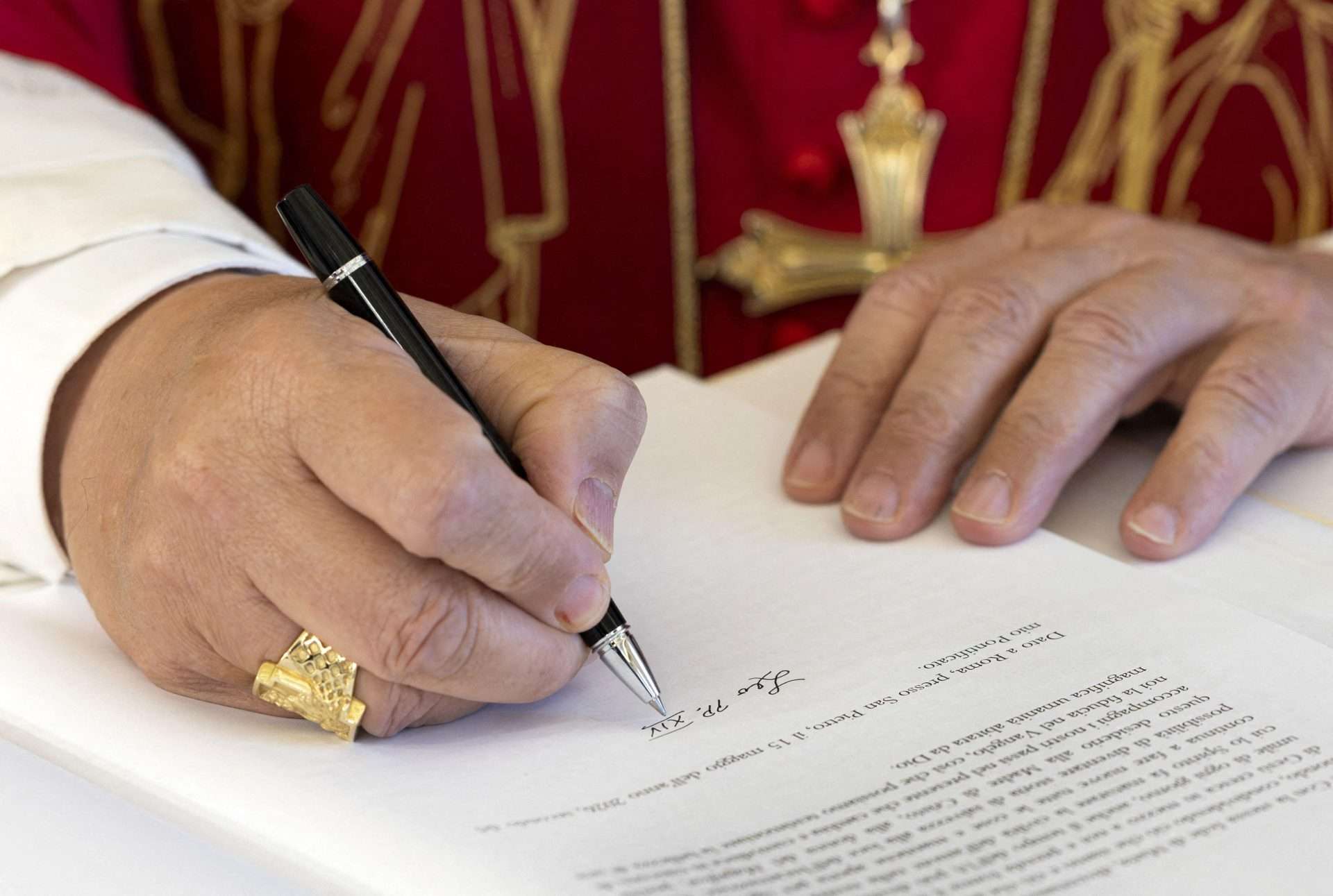
Pope Leo XIV signed the encyclical on 15 May, 135 years after Pope Leo XIII signed Rerum Novarum.
Simone Risoluti / Vatican Media / Abaca Press / Alamy
‘If technological development advances without a corresponding ethical and social progress, the result may be an increase in means without a growth in humanity: having more without being more.’
Pope Leo presented his first encyclical Magnifica Humanitas at the Vatican on Monday.
The encyclical “on the safeguarding of the human person in the time of artificial intelligence” calls for Catholics to engage with the changes caused by new technology.
“Let us not be afraid to get our hands dirty on the ‘construction site’ of our time,” the Pope writes.
The first chapter follows the development of Catholic Social Teaching from Pope Leo XIII’s encyclical Rerum Novarum in 1891, to Pope Francis’ last, Dilexit Nos, published in 2024.
“The result is a harmonious, though not always linear, development that is marked by different emphases, progressive insights, and, at times, changes in perspective that do not break with what came before, but allow its implications to mature,” Leo writes.
In the second chapter, he calls for the fuller expression of Catholic Social Teaching in the life of the Church, starting with the principle of the common good, and for its application “in the context of the digital revolution”.
While affirming the right to private property, he says it is “always subordinate to the universal destination of goods”, including “new forms of property such as patents, algorithms, digital platforms, technological infrastructure and data”.
Social doctrine, the Pope continues, “is also an examination of conscience for the Church”.
He explains that “the common good takes the form of a synodal approach for mission in the service of the Kingdom” and other principles of subsidiarity, solidarity and justice must “become incarnate in ecclesial life”.
The third chapter continues: “As technological development rapidly transforms languages, relationships, institutions and forms of power, we believers must and can choose which projects to work on and in what manner, so as to safeguard and value the grandeur of humanity that has been given to us as a gift.”
Citing Laudato si’, Pope Leo denounces the “technocratic paradigm” that reduces “creation to an object of exploitation and human beings to mere cogs in a system driven toward ever greater efficiency”.
“If technological development advances without a corresponding ethical and social progress, the result may be an increase in means without a growth in humanity: ‘having more’ without ‘being more’,” he warns, describing the particular danger posed by the power of “major economic and technological actors” over such development.
Noting the practical benefits of artificial intelligence as well as its social and ecological dangers, Leo insists that “we cannot consider AI to be morally neutral” and demands recognition of human responsibility for it “at every stage”.
“We cannot be satisfied with merely calling for the moralisation of machines – the so-called ‘alignment’ of AI with human values – without also having the courage to insist on a further condition: the possibility of openly discussing the ethical frameworks involved and subjecting them to shared standards of social justice,” he says. “A more moral AI is not enough if that morality is determined by a few.”
Speaking alongside the Pope at the presentation of Magnifica Humanitas in the Vatican’s Synod Hall, the co-founder of the AI developer Anthropic Chris Olah acknowledged that companies such as his operate “inside a set of incentives and constraints that can sometimes conflict with doing the right thing”.
“The questions raised by AI are bigger than the AI research community,” he said, considering the possibility of the technology causing mass redundancies. “If that happens, supplying those displaced will be a moral imperative of historic proportions.”
The prefect of the Dicastery for the Doctrine of the Faith Cardinal Víctor Manuel Fernández also spoke at the launch, considering the “theological” aspects of the document’s third chapter where it addresses ideas of “transhumanism and posthumanism”.
Cardinal Fernández said the idea that “humanity has passed its expiry date” or could exceed the limitations that define it was “false mysticism”, referring to the document’s contention that “those who love and desire cannot avoid passing through trial and suffering”.
The document continues: “To renounce this adventure, both tragic and splendid, in the name of a presumed transcendence of all limits, could mean many things, but it would no longer be human.”
The fourth chapter discusses measures “to protect the dignity of work and to safeguard freedom against all forms of dependence and commercialisation”.
Pope Leo endorses regulation to prevent the spread of misinformation through digital media and calls for education to respond to these challenges, while also urging schools to adopt “rhythms that incorporate silence, in-depth study, reading and judicious analysis”.
“Schools are not called to follow the pace of the digital world, but to offer that which the digital sphere by itself cannot provide, namely a shared time for learning and developing trustworthy relationships,” he says.
Regarding the threat to employment from AI, Pope Leo warns that the groups formed to protect workers during the Industrial Revolution “are no longer sufficient by themselves”, calling for collaboration “among political leaders, labour organisations, the business world and the scientific community”.
He proposes “social criteria for innovation” to protect human dignity and criticises the failings in the global economy that new technology threatens to perpetuate.
“More than ever, in the age of AI and robotics, it is no longer possible to rely solely on the ‘invisible hand’ of the market,” he says.
In a discussion of the effects of the digital revolution on human freedom, Pope Leo warns of “a technocratic and post-humanist mentality that tends to regard the human being as an object to be manipulated or a resource to be optimised”, and that some “even go so far as to envision ‘second-class’ human beings”.
He argues that this contributes to the exploitation of people in the digital economy and the failure to recognise human trafficking as “a contemporary form of slavery”. He compares this to “the delay with which both society and the Church came to denounce the scourge of slavery” before the nineteenth century.
“For this, in the name of the Church, I sincerely ask for pardon,” Leo writes. “This is why the memory of past complicity and blindness in the face of the injustice of slavery becomes a call to vigilance.”
The fifth chapter addresses “the yet more tragic issue of war” and the “spread of a culture of power characterised by polarisation and violence” in contrast with the “civilisation of love” promoted by Paul VI during the Cold War.
“Today, more than ever, without prejudice to the right to self-defence in the strictest sense, it is important to reaffirm that the ‘just war’ theory, which has all too often been used to justify any kind of war, is now outdated,” the Pope says. “No algorithm can make war morally acceptable.”
He argues for the importance of dialogue for preventing conflict and describes international organisations – and the United Nations in particular – as “essential instruments for promoting the civilisation of love”.
Speaking at the presentation of the encyclical, Pope Leo emphasised how artificial intelligence is “dramatically changing how war is waged”, reporting that a process of “listening” over past months had led him to “a disturbing conviction expressed in Magnifica Humanitas: artificial intelligence must be disarmed”.
In the third chapter, he calls for a “disarmed” AI freed “from the mentality of ‘armed’ competition” which constitutes “an economic and cognitive phenomenon” across the world.
“The word is strong, I know, but deliberately chosen because this moment needs words capable of attracting attention, awakening consciences and indicating paths forward for humanity,” he told the audience in the Synod Hall, comparing it to nuclear disarmament.
“In a similar sense, artificial intelligence now demands to be ‘disarmed’, freed from logics that turn it into an instrument of domination, exclusion and death,” he said. “Decisions about technology must never be separated from conscience and responsibility.”
On this basis, he continued, artificial intelligence “can be a construction site of history with a horizon of communion, in which technical progress learns to serve human life”.
“Let’s not fear artificial intelligence, but constantly keep the question of the human in play. We cannot be careless with our most powerful technical instruments,” he said, insisting that each individual has “a freedom, an interiority and a vocation to love and worship that no machine can replace or block”.
“Only with such an integral vision can artificial intelligence be directed toward the common good.”
In the conclusion of Magnifica Humanitas, Pope Leo proposes “a sober yet demanding programme of Christian life with which we can navigate this epochal change” in the era of artificial intelligence.
The Incarnation, he writes, offers a “different pathway” from “the promises of transhumanism and some post-humanist currents of thought, which seek an enhanced and almost disembodied humanity”.
“For this reason, as a believer among believers, I invite everyone to contemplate, in the face of the Son of God, the grandeur of humanity that shines a light also on the era of AI,” he says.
“In Christ, we are called to cooperate in the work of creation, rather than be disinterested observers of technological processes that limit our freedom and responsibility.”
The document concludes with a reflection on the Magnificat, which Pope Leo identifies as the moment when “Mary suddenly sees all of history through the lens of this revelation” of God’s plan for salvation through the Incarnation.
“In the humble fidelity of daily life, even the era of AI can become a time in which the Holy Spirit brings about the civilisation of love in our lives.”
‘Integral humanism’: how Magnifica Humanitas responds to the challenge of AI
Stay updated — add us as a preferred news source on Google:


Help us keep The Tablet’s voice independent, clear and far-reaching.
Founded in 1840, The Tablet is the leading independent English-language Catholic weekly, celebrated for great writing, astute analysis, brilliant arts and books reviews and trustworthy reporting from correspondents in Britain, Ireland, Rome and across the world.
Independent, high-quality journalism is at the heart of what we do. The Tablet does not have deep pockets and we are not funded by rich donors. If you appreciate our work please consider supporting The Tablet’s Development Fund. It only takes a moment and you can cancel at any time.
- Support with £5 per month
- Support with £10 per month
- Support with other amount.

MOST READ ARTICLES
-
1
Church warns Zambian government against division after archbishop’s arrest
-
2
A craving for beauty
-
3
Breaking up … for now
-
4
Nurturing young Catholics in STEM
-
5
Bishops demand security investment to promote ‘common good’ in Nigeria
-
6
Rival church occupies Kyiv monastery in latest blow to Moscow-linked Orthodox
FROM THE EDITOR'S DESK