Leo prays to Our Lady of Africa after migrant ‘invasion’ in Ceuta


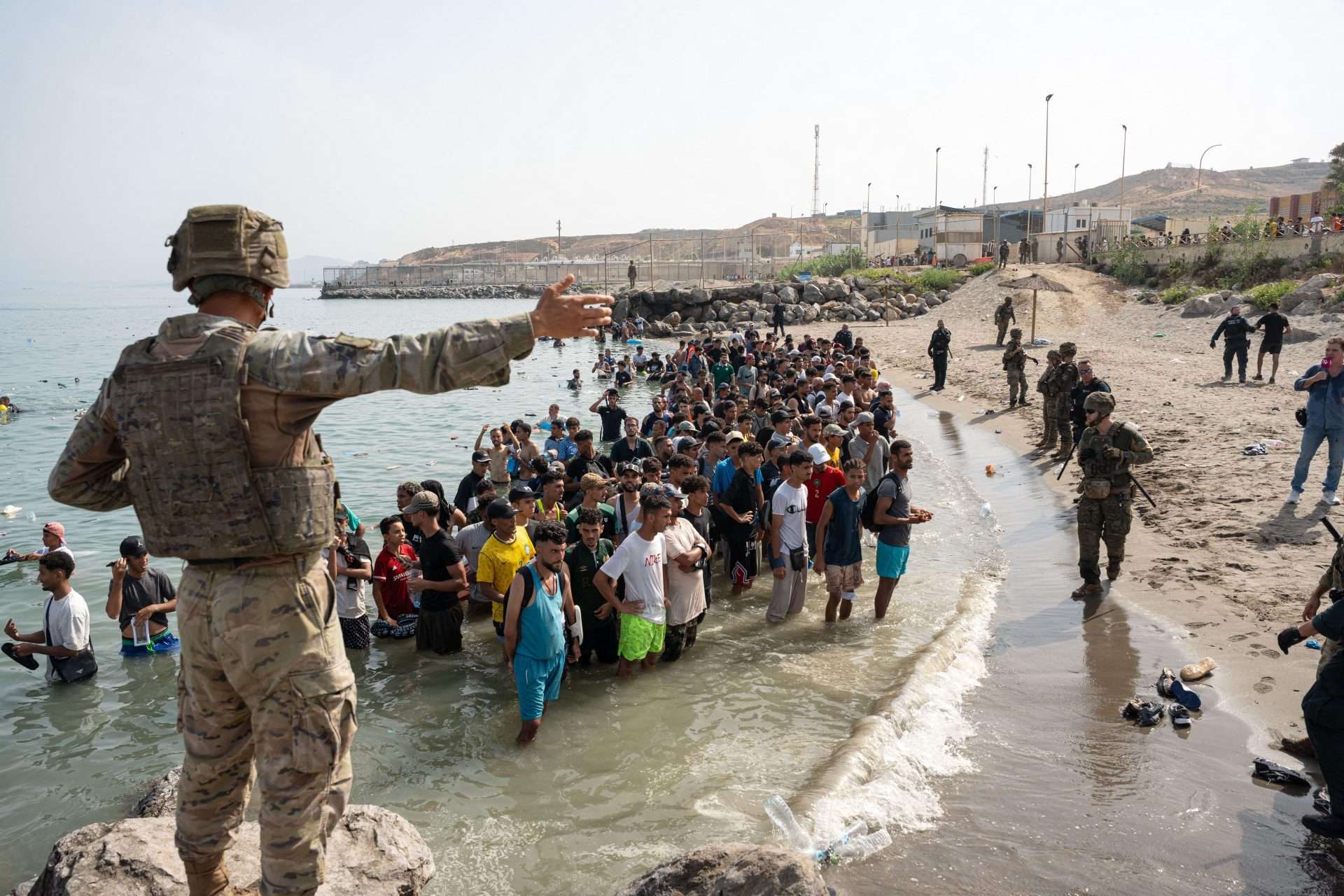
An estimated 48,000 people had returned from Ceuta to Morocco by the evening of 31 July.
Mario Moron / JNA Press / Sipa USA / Alamy
Bishop Xabier Gómez of San Feliú de Llobregat said Ceuta’s ‘terrible and truly human drama’ had benefited neither those who had risked their lives by sea nor the residents of the Spanish enclave who ‘have the right to live securely’.
Pope Leo XIV voiced concern over the “alarming situation” in Ceuta after an estimated 60,000 Moroccans illegally entered the Spanish enclave on the tip of north Africa.
Many swam or climbed over borders separating Morocco from Ceuta on 30-31 July, overwhelming the city’s 83,000-strong populace.
By the night of 31 July, 48,000 Moroccans had returned home, escorted to the border by Spanish soldiers, after what has been described as the largest migrant “invasion” in Europe.
Speaking after praying the Angelus in St Peter’s Square on Sunday, Pope Leo said he was “praying to God that, through the intercession of Our Lady of Africa, solutions may be found to bring peace, stability and justice”.
The president of the Spanish Bishops’ Conference described the “invasion” of Ceuta, which is part of the European Union, as a “test”.
In a social media post on Sunday, the Archbishop of Valladolid Luis Argüello said: “Demography is a weapon. Bio-politics are key in world power right now: money and power favour playing with life, and using the dreams, hunger, sexuality and data of individuals. Migrations form part of this strategy.”
Citizens of Ceuta – who are both Spanish and Moroccan – were frightened, according to the president of the enclave, which lies 11 miles from the port of Cádiz.
“This city was under siege,” Juan Jesús Vivas told the Spanish daily El País. “People perceived this as not a migratory crisis but fundamentally an attack, a violation of the territorial integrity of Spain.”
The 73-year-old president continued: “People perceive what happened as being supported or allowed by Morocco, even if it did not orchestrate this.”
Vivas said that by last Saturday 88 people had died in the incursion. He said that in Ceuta “the feeling it is Spain” was “very clear” and “shared by all Ceutans, however they pray and whatever their names are. Ceuta is a model of co-existence between different credos, cultures and [people of differing] origin”.
Some Ceutans posted on social media that they had locked themselves in their homes as thousands of Moroccans poured over the border.
According to El País, in some neighbourhoods locals erected the yellow barriers used to indicate building work to keep migrants out. Armed with sticks, residents of three or four neighbourhoods had urged remaining Moroccans to leave. Around 5,000 remain, including unaccompanied minors.
“We are not facing an ordinary migratory drama,” said Bishop Xabier Gómez of San Feliú de Llobregat. He said Ceuta’s “terrible and truly human drama” had benefited neither those who had risked their lives by sea nor the residents of Ceuta who “have the right to live securely, without being startled, amid peaceful co-existence”.
Gómez, a Dominican who leads on migratory and inter-cultural affairs for the Bishops’ Conference of Tarragona, added in a reflection published in Catalan that the event played to the agenda of “those who use human mobilisation as an instrument for political pressure, who seek to bring tension to diplomatic relations through ‘hybrid threats’ … or who manage to profit in electoral terms from the suffering of others and fear”.
Fr Fernando Redondo, director of the Migration Office of the Spanish Bishops’ Conference, said that the Church wanted to “emphasise the humanitarian issue”.
Redondo told the website noticiasobreras.es (“The Workers’ News”) that while governments have the power to “control borders” and to try and “order” the flow of people, management of the situation in Ceuta should be conducted “according to existing law” and “bearing in mind the needs of individuals”.
He said the Church, particularly the Diocese of Cádiz and Ceuta, had made available resources to attend to the basic needs of those arriving from Morocco. He emphasised the need to ensure that “migrants received dignified treatment in any circumstance” and to be treated with “the dignity they deserve”.
He criticised the migrant question being used as a “projectile weapon” and urged people not to use what is occurring in Ceuta to “criminalise migrants” or to “generate fear”.
Redondo said the event “had nothing to do” with Spain’s amnesty to regularise 1.2 million illegal immigrants, a measure he described as “very positive and necessary”.
The Church also denied claims the “invasion” was triggered by a recent ruling from Spain’s Supreme Court that any migrant intercepted at sea en route to Ceuta or Melilla cannot be immediately returned. The Telegraph reported that some of the Moroccans referred to seeing social media posts about the ruling after reaching Ceuta.
Spain’s Prime Minister Pedro Sánchez thanked the Moroccan government for its co-operation in tackling illegal immigration.
Italy’s Prime Minister Giorgia Meloni cancelled freedom of movement between Italy and Spain and demanded Spain be suspended from the Schengen Zone, the group of 29 European nations who have abolished internal border controls.
Spanish Church denies far-right ‘slander’ of profit from migrant work
Stay updated — add us as a preferred news source on Google:


Help us keep The Tablet’s voice independent, clear and far-reaching.
Founded in 1840, The Tablet is the leading independent English-language Catholic weekly, celebrated for great writing, astute analysis, brilliant arts and books reviews and trustworthy reporting from correspondents in Britain, Ireland, Rome and across the world.
Independent, high-quality journalism is at the heart of what we do. The Tablet does not have deep pockets and we are not funded by rich donors. If you appreciate our work please consider supporting The Tablet’s Development Fund. It only takes a moment and you can cancel at any time.
- Support with £5 per month
- Support with £10 per month
- Support with other amount.



