Israel objects to ‘genocide’ charge at Vatican event


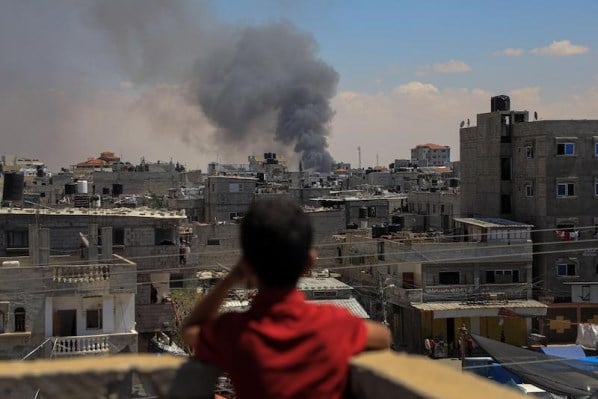
A fire burns in Rafah after an airstrike on 7 May.
Xinhua / Alamy
Israel’s Embassy to the Holy See issued a protest on Monday after a Yemeni Nobel laureate accused Israel of “genocide” while speaking at a Vatican event.
Tawakkol Karman, a Yemeni journalist who became the first Arab woman to win the Nobel Peace Prize in 2011, spoke at the second “World Meeting on Human Fraternity” sponsored by the Vatican’s Fratelli Tutti Foundation. She told an audience in the atrium of St Peter’s Basilica: “The world is silent in front of the genocide and the ethnic cleansing of the Palestinian people in Gaza.”
Karman was applauded by an audience comprising fellow Nobel prize laureates, politicians, and Church officials, although the Pope was not present. The Israeli embassy issued a statement calling Karman’s accusations “lies”.
Last week, Christian groups joined more than 250 humanitarian and human rights organisations signing an international petition calling on all UN member states to stop fuelling the violence in Gaza and avert further humanitarian catastrophe and loss of civilian life.
The petition demanded a halt to arms supplies to Israel and to Palestinian armed groups. Signatories included the French a Canadian branches of Caritas Internationalis – Secours Catholique and Development and Peace – and Church and Peace, the ecumenical peace network in Europe.
The Israel Defence Forces (IDF) began an offensive in Rafah last week, seizing control of the Gaza side of the Rafah border crossing and Kerem Shalom crossing.
Students at Catholic universities in the US joined other students in the US and Europe in campus protests, calling for an immediate ceasefire and for their universities to cut financial ties with companies they say are profiting from the oppression of Palestinians.
After protests, Chicago’s DePaul University issued a letter to faculty, staff and students on 6 May saying it was asking its third-party fund managers to commit to the UN’s “responsible investment” guidelines, which hold investors accountable for following environmental, social and corporate governance standards.
Loyola University in Chicago, the University of Notre Dame in Indiana, and the Jesuit Gonzaga University in Spokane, Washington, have all seen protests.
At Columbia University in New York, which has seen weeks of major protests, a Catholic chaplain claimed they had been partly organised by “explicitly communist” non-student “agitators”.
Fr Landry said in an interview with EWTN: “There’s an instrumentalisation of what’s going on in Gaza to advance an agenda…to deconstruct our present world order at which the United States is considered the top of that order.”
He said almost half of the 300 protesters arrested at the campus since the demonstrations began on 17 April belonged to “explicitly communist groups who have been handing out Marxist materials against Israel since 7 October”.
On 7 May, Cafod and Christian Aid were among 30 charities calling on the UK government to take meaningful action to stop any further attacks on Rafah in southern Gaza by the IDF.
They asked it to work urgently “to stop any further assault on Rafah from going ahead, demand an immediate lasting ceasefire, resume funding to UNRWA, and suspend arms sales to Israel for as long as there is a risk they may be used to violate international law”.
In Israel, thousands marched in Tel Aviv on 9 May to demand a ceasefire and hostage deal, as well as a revived Israeli-Palestinian peace process. The march was led by Standing Together, a joint Jewish-Palestinian peace movement in Israel.
The exodus from Rafah reached 360,000 last weekend amid an IDF bombardment and orders to evacuate, according to the United Nations Relief Work Agency (UNRWA), which works with Palestinian refugees. It warned that “restricted humanitarian access” to the Gaza Strip was now “a matter of life or death” for Gazans already suffering “relentless bombardments and food insecurity”.
On Monday The White House condemned an attack on an aid convoy heading to Gaza by Israeli settlers who threw packages of food into the road and set fire to the vehicles.
“We immediately and urgently need safe passage for humanitarian aid and workers,” UNWRA insisted. Further reports emerged of clashes and shelling in Jabalia refugee camp in the north of Gaza.
On Tuesday at least 14 Palestinian civilians, most of them children, died in an IDF airstrike on a house where 10 displaced families lived in the Al Nuseirat refugee camp in the middle of the Gaza Strip.
“There’s nowhere to go” said UNWRA. “There’s no safety without a ceasefire.” It also reported on Monday that another of its staff members had been killed in Gaza, bringing the total number of UN staff killed in the war to 188.
After more than seven months of war in Gaza, at least 35,000 people have been killed, according to the Gaza health authorities. Another 70,000 more are wounded or missing, with many more trapped under the rubble.
The Latin Patriarchate of Jerusalem announced a Pentecost Prayer Vigil for 18 May, with Cardinal Pierbattisa Pizzaballa presiding over prayers for “the peace of the Holy Land”. Bishops, priests, religious and laity have been invited to the service at the Basilica of St Stephen in Jerusalem.
The presidents of the World Council of Churches issued a Pentecost message saying: “We need the renewing presence of the Holy Spirit to transform our societies through the Gospel values. Empower us to articulate more concretely our missionary engagement in all parts of the world, and particularly at these critical moments in the Middle East.”
On 11 May, groups in the West Bank marked the second anniversary of the killing of the Palestinian Christian journalist Shireen Abu Akleh.
In a statement, Pax Christi International deplored that “she was targeted and killed by an Israeli sniper” while reporting on an attack on Jenin Refugee Camp for Al Jazeera and then “the appallingly violent scenes at her funeral, when Israeli forces attacked the coffin bearers, family and other members as they emerged from the hospital in Jerusalem”.
Last year, a Pax Christi International delegation met her family, who have continued to appeal for justice and accountability for her death.
Bedouin in the West Bank have condemned the Israeli authorities’ demolition of dozens of buildings in the unrecognised southern Bedouin village of Wadi al-Khalil in the Negev on 8 May, which left over 300 people homeless.
Unrecognised Bedouin villages are regularly served with demolition orders as they were built without permits. However, many have existed on the same plots of land for generations. Securing building permits for Bedouin communities is nearly impossible and their leadership has accused the authorities of discriminatory practices and neglect.
Stay updated — add us as a preferred news source on Google:


Help us keep The Tablet’s voice independent, clear and far-reaching.
Founded in 1840, The Tablet is the leading independent English-language Catholic weekly, celebrated for great writing, astute analysis, brilliant arts and books reviews and trustworthy reporting from correspondents in Britain, Ireland, Rome and across the world.
Independent, high-quality journalism is at the heart of what we do. The Tablet does not have deep pockets and we are not funded by rich donors. If you appreciate our work please consider supporting The Tablet’s Development Fund. It only takes a moment and you can cancel at any time.
- Support with £5 per month
- Support with £10 per month
- Support with other amount.

MOST READ ARTICLES
-
1
Battling confession fatigue
-
2
Nicaraguan bishops visit Rome as Ortega regime tightens grip
-
3
Would the Church miss us?
-
4
Vatican confirms Pope’s Latin America travel plans despite operation
-
5
Restless statelessness
-
6
Church from the 1950s receives £1 million government grant for new roof
FROM THE EDITOR'S DESK


