Irish archbishops praise Pope Leo’s insights on Artificial Intelligence


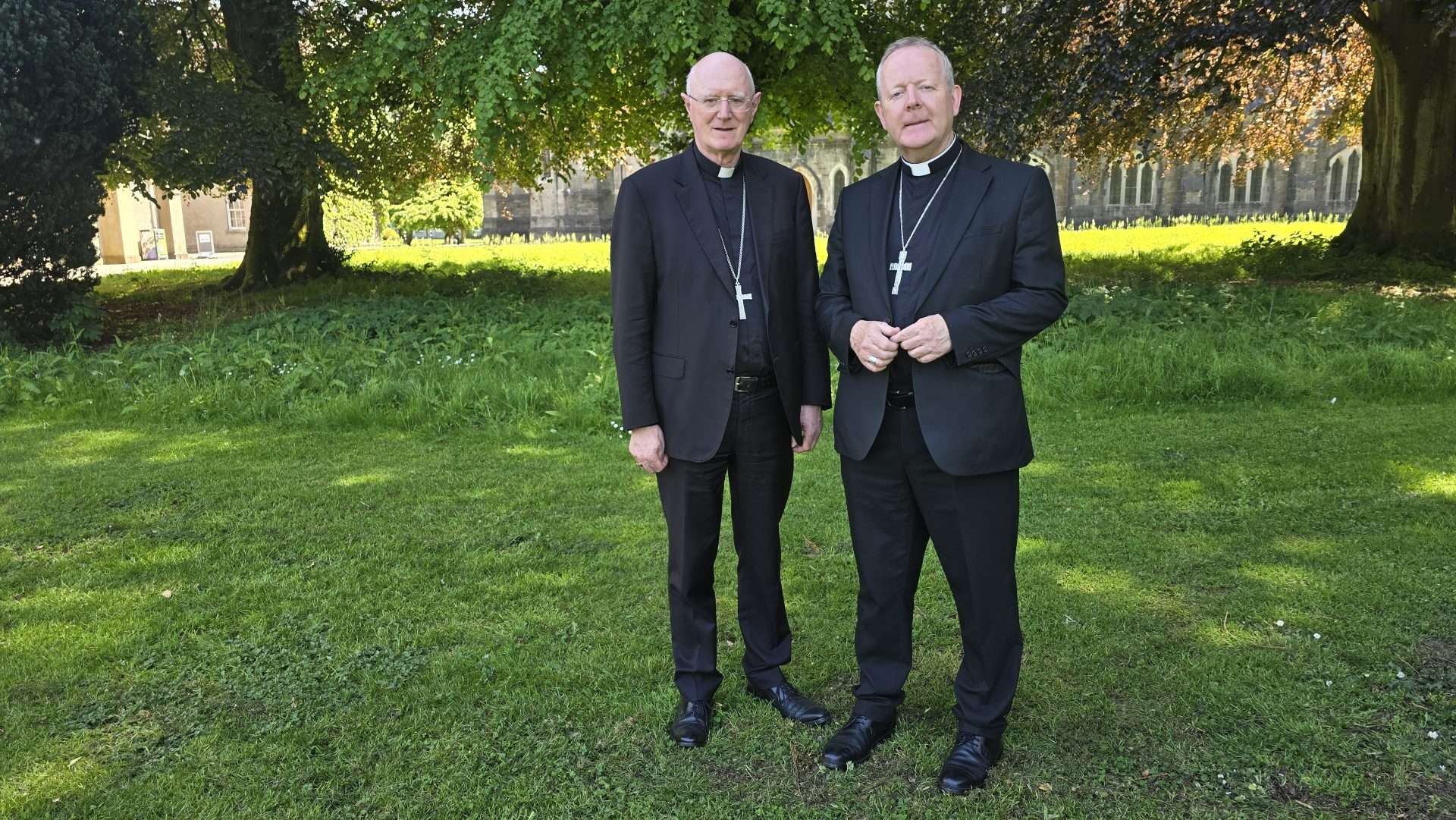
Archbishop Dermot Farrell of Dublin and Archbishop Eamon Martin of Armagh
Sarah Mac Donald
“A human person can never be reduced to data to be copied or manipulated,” said the leader of the Irish Church, Archbishop Eamon Martin responding to the publication of Pope Leo XIV’s first encyclical Magnifica Humanitas: on safeguarding the human person in the time of artificial intelligence.
The Archbishop of Armagh added: “In a world of screens, artificial voices and digital masks, the Church defends the dignity of the human person with a real face and authentic voice.”
He said:“We are at a phase in human history when artificial intelligence is already shaping our personal lives, homes, workplaces, schools and communities, hospitals, public services, economies and democracies.”
The choice before us, he said, is not whether to accept or reject technology, but whether we will use AI advances to nurture a world grounded in fraternity and cohesion.
The underlying premise of the encyclical’s five chapters is that technology is not “a force antagonistic to humanity”, nor is it “inherently evil”. However, Pope Leo argues that “technology is never neutral, because it takes on the characteristics of those who devise, finance, regulate, and use it.”
Archbishop Martin acknowledged that AI can do remarkable things: sort through vast amounts of information, recognise patterns, and create words, images and voices that feel very real. It can even at times mimic human behaviour and qualities, “but AI does not have a conscience”, he underlined.
“When technology protects life, relieves suffering, supports learning, strengthens good work and helps us care for the vulnerable and for our common home, we welcome it with gratitude. We must therefore work to ensure that AI brings good, and assists real advances in medicine, education, accessibility, public services, scientific discovery, environmental protection and care for those often forgotten by society,” he added.
On the issue of AI and war, Martin highlighted Pope Leo’s warning that life-and-death decisions cannot be delegated to “automated systems” in a way that “the protection of civilians is subordinated to strategic logic.”
This is especially urgent where AI and machines are used for war and violent purposes. Pope Leo is clear: human responsibility and discernment regarding the use of force can never be “reduced to a technical calculation”. “No algorithm can make war morally acceptable,” said the Primate of All Ireland, quoting the encyclical.
Encouraging people across the island of Ireland to read and reflect upon Magnifica Humanitas, he stressed that from Ireland’s perspective, the development of Artificial Intelligence is neither an abstract issue nor happening far away. He said: “AI is being hosted, shaped, governed and developed here on this island. It is already shaping the lives of our people in real and significant ways.”
He also expressed the hope that Magnifica Humanitas will open a serious, honest and practical conversation across Ireland about AI that will involve Church, State, universities, schools, legislators and public bodies, technology companies, workers, families, young people and wider society.
He told The Tablet that legislators need to “step up” and establish “some kind of forum where people are able to voice their concerns and their hopes on AI”, which he said was “a matter of major importance to the country”.
He criticised politicians north and south of the Irish border for “rarely” talking about the impact of AI “in the legislative assemblies on these islands”.
Archbishop Dermot Farrell of Dublin, in whose diocese many of the world’s multinational tech corporations have their European headquarters, said: “In a world where inequality is already embedded in ‘structures of sin’ – unfair economic and political systems which perpetuate poverty and exclusion the Pope was calling on the human family to be alert to the capacity of AI to exacerbate injustices.
“The Pope is inviting us to think about the values, traditions, social customs and practises that help the human community to flourish,” he said.
Referencing Pope Leo’s call for the disarmament of AI so that technology can help us to build a better world, Archbishop Farrell said disarming AI means freeing it from the mentality of ‘armed’ competition, which today is not limited simply to the military context, but is also an economic and cognitive phenomenon.
In Magnifica Humanitas, Pope Leo addresses transhumanism and posthumanism, writing: “If the human being is treated as something to be perfected or surpassed, it becomes easier to accept that some lives are less useful, less desirable or less worthy. In the name of progress, ‘necessary sacrifices’ may begin to be justified, placing the burden on the most vulnerable in pursuit of a supposed optimization of the species. … For this reason, a clear distinction must be made.”
“It is one thing to integrate technology within a human-centred, relational vision; it is quite another to be guided by an outlook that devalues human limits and promises a purely technical form of ‘salvation.’”
Speaking to The Tablet, Archbishop Farrell said, “We all know human beings are not perfect, we are not created perfect. The way we learn to be better is by how we interact, learning things like justice, mercy and love. We learn that from relationships, we don’t learn it from a machine.”
“When a government makes decisions about the distribution of wealth, one hopes that it is based on justice, on mercy, and on equality. These are not things you find in a machine. Human beings make these decisions. Conscience is a human faculty and it helps us to make decisions about the way we treat people.”
Stay updated — add us as a preferred news source on Google:

Archbishop Dermot Farrell of Dublin
Archbishop Eamon Martin of Armagh

Help us keep The Tablet’s voice independent, clear and far-reaching.
Founded in 1840, The Tablet is the leading independent English-language Catholic weekly, celebrated for great writing, astute analysis, brilliant arts and books reviews and trustworthy reporting from correspondents in Britain, Ireland, Rome and across the world.
Independent, high-quality journalism is at the heart of what we do. The Tablet does not have deep pockets and we are not funded by rich donors. If you appreciate our work please consider supporting The Tablet’s Development Fund. It only takes a moment and you can cancel at any time.
- Support with £5 per month
- Support with £10 per month
- Support with other amount.