Increase in numbers joining the Church at Easter


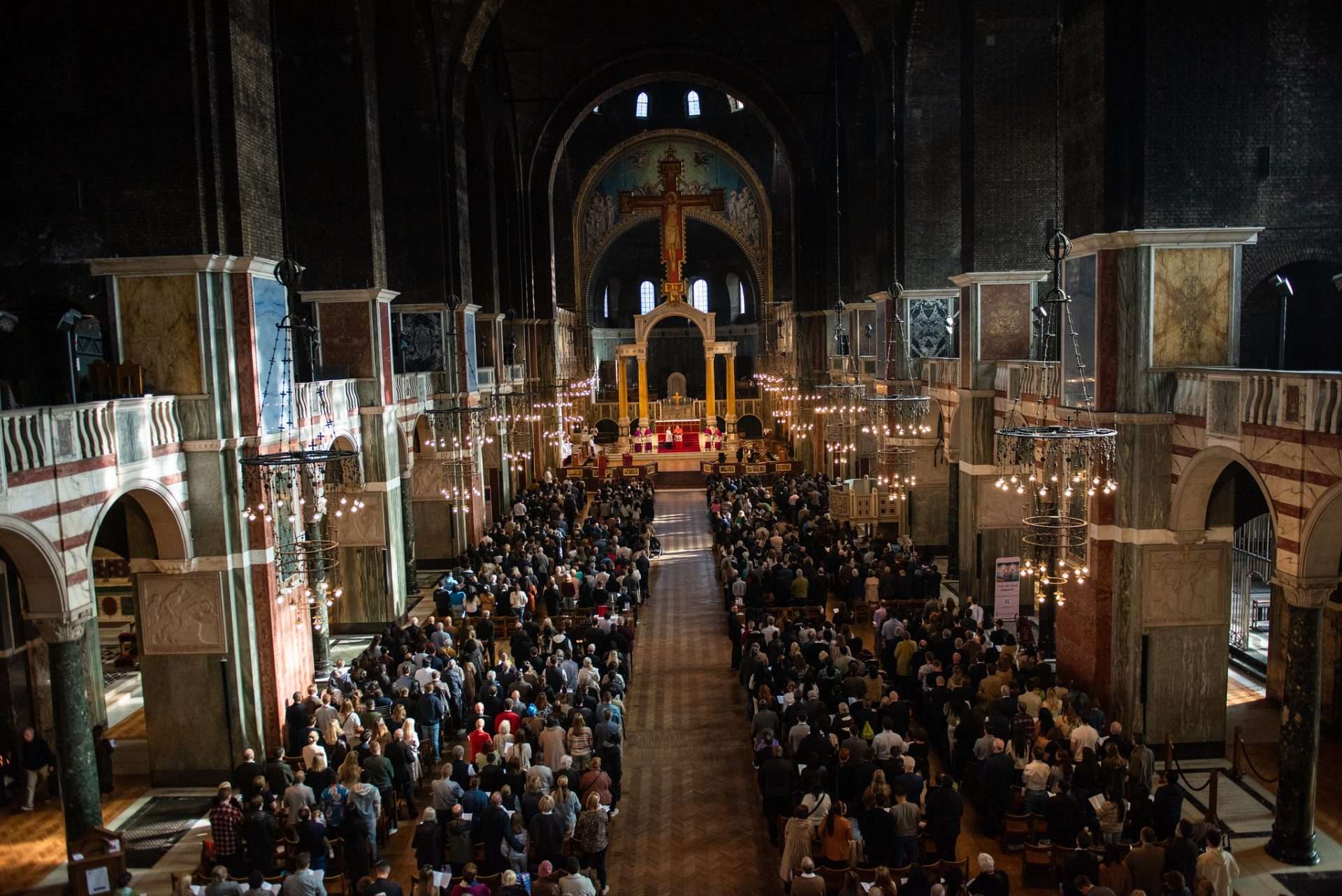
More than 500 people attended the Rite of Election liturgy on Saturday 8 March in Westminster Cathedral
Diocese of Westminster
More than 500 people are taking the RCIA in the Diocese of Westminster.
Catholic dioceses across England, Wales, Scotland and Ireland are reporting a sizeable increase in the number of adults who will join the Church this Easter.
For the first time since 2018, more than 500 people from more than 80 parishes attended the Rite of Election Mass at Westminster Cathedral. That number included more than 250 catechumens, who are unbaptised but will receive the sacraments this Easter.
The Archdiocese of Southwark reported for the second successive year that more than 450 adults had attended the Rite of Election liturgy, a key stage in the Rite of Christian Initiation of Adults (RCIA) .
A similar trend was reported by other dioceses contacted by The Tablet.
In the Archdiocese of Birmingham, 201 catechumens and candidates (who are from other Christian traditions) representing around 50 parishes attended the 2025 Rite of Election liturgy. Nearly 130 from 31 parishes attended the ceremony in 2024.
In the Archdiocese of Liverpool, 140 people are set to join the Church at Easter, of whom 84 are candidates, including those making their confirmation and 56 are catechumens. In 2024, 110 adults joined the Church in the Archdiocese of Liverpool, 50 of whom were catechumens and 60 were candidates including confirmands.
A spokesman for the Archdiocese of Cardiff-Menevia said of this year’s Rite of Election, “We had 75 people in Cardiff which represented an increase of 100 per cent on last year and 35 are to be baptised.”
In the Diocese of Arundel and Brighton 60 catechumens and just under 90 candidates joined the Church last year: this year, 105 catechumens and 105 candidates will do so.
The Diocese of Salford had 18 candidates and 21 catechumens in 2023. This year, it has 50 candidates and 53 catechumens.
Joe Hopkins, Rite of Election co-ordinator for Nottingham which has 88 candidates and 121 catechumens said the numbers had been increasing for some times: “For the last four years, there has been an increase in numbers.”
There are 62 catechumens and 49 candidates in the Diocese of Clifton. The Diocese of Northampton has 38 catechumens and 62 candidates this year compared to 25 catechumens and 38 candidates in 2024. The Diocese of Shrewsbury has 105 candidates and 60 catechumens.
In the Diocese of Brentwood, 186 adults are to join the Church, a contrast with 165 last year, and 94 adults will become Catholics this Easter in the Diocese of Shrewsbury.
The trend was mirrored in Scotland where 72 people are due to join the Church in the Diocese of Motherwell, compared to 45 last year. In the Archdiocese of Glasgow, 99 people will become Catholics this Easter, a “slight increase” since 2024 according to a spokesman.
In the Diocese of Paisley, 28 adults are due to join the Church. June Clunie, RCIA co-ordinator for the diocese told The Tablet: “What is noticeable is that this year there is an increase in ‘younger’ people [aged between] 20-30 years-old.” In the Diocese of Galloway, Fr William McFadden noted the presence of “so many young people” among the 16 catechumens and 25 candidates.
In the Diocese of Argyll and the Isles there are eight RCIA candidates for this Easter and potentially two more after Easter.
Nearly 70 people sought full Initiation and Communion with the Church in Dublin this year. They took part in the Rite of Election at St Mary’s Pro Cathedral last Sunday 9 March. The liturgy was led by Archbishop Dermot Farrell and the candidates were joined by sponsors, parish representatives and families. All are continuing their preparation towards initiation into the Catholic Faith at the Easter vigil.
As the largest and most multicultural diocese in the country, Dublin is seeing larger numbers taking part in the RCIA preparation.
In the Diocese of Meath, Bishop Tom Deenihan celebrated the Rite of Election on Sunday with two catechumens.
Big increase in Mass attendance recorded in Britain
What do the green shoots mean?
Stay updated — add us as a preferred news source on Google:


Help us keep The Tablet’s voice independent, clear and far-reaching.
Founded in 1840, The Tablet is the leading independent English-language Catholic weekly, celebrated for great writing, astute analysis, brilliant arts and books reviews and trustworthy reporting from correspondents in Britain, Ireland, Rome and across the world.
Independent, high-quality journalism is at the heart of what we do. The Tablet does not have deep pockets and we are not funded by rich donors. If you appreciate our work please consider supporting The Tablet’s Development Fund. It only takes a moment and you can cancel at any time.
- Support with £5 per month
- Support with £10 per month
- Support with other amount.

MOST READ ARTICLES
-
1
Leo pleas for besieged Ukrainian town in call with Putin
-
2
Under endless skies
-
3
Battling confession fatigue
-
4
Restless statelessness
-
5
Pope Leo thanks staff at Mass in Gemelli Hospital
-
6
Study finds German dioceses failed to guard against spiritual abuse in lay groups
FROM THE EDITOR'S DESK


