German churches alarmed by far-right victory in regional election


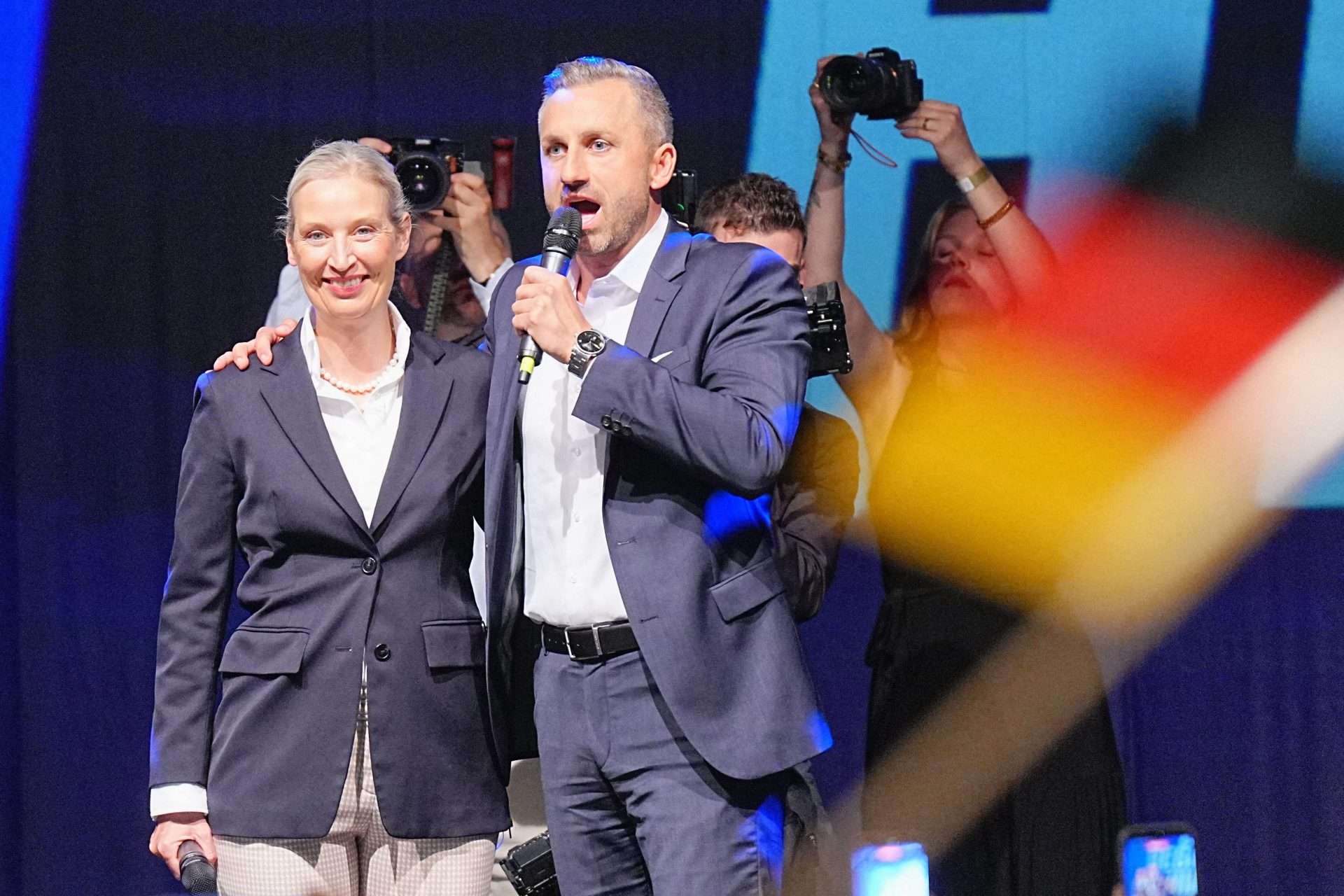
Alice Weidel, federal chair and co-chair of the AfD parliamentary group in the Bundestag, with Ulrich Siegmund, lead candidate and co-chair of the AfD state parliamentary group in Saxony-Anhalt, on 6 September
Michael Kappeler / dpa / Alamy
Although the AfD did not win an outright majority in Saxony-Anhalt, the election marks the first time in the history of post-war Germany that a far-right party could form a government.
Church leaders from across denominations in Germany voiced deep concern following the victory of a far-right party in a state election.
The Alternativ für Deutschland (AfD) won 43.8 per cent of the vote in regional elections in the federal county of Saxony-Anhalt on Sunday, far ahead of the Chancellor Friedrich Merz’s centre-right Christian Democratic Union with 17.2 per cent.
In a joint statement the Diocese of Magdeburg, the Evangelical Church of Central Germany and the Evangelical Church of Anhalt said: “The country is divided. We are concerned about social peace and the way people live alongside each other in our region.”
“Our concern is also about the consequences the AfD has warned will result for culture and education, the community and volunteer work, Diakonie, Caritas and the churches, and for internal and external security,” it continued.
“As churches, we have a long history of resilience; we have survived dictatorships and oppression, wars and crises, and we will continue to open our doors to all who seek protection and peace, healing and guidance in the presence of God.”
Bishop Gerhard Feige of Magdeburg appealed to the AfD “to honour our country’s constitution without restriction and to protect the dignity of all people”, insisting that those who want to take on government responsibility must take on responsibility for all people in the country.
Before the election, Feige had told the Augsburger Allgemeine daily that “people can be led astray, at all times. This makes me afraid. And now again.”
“Democracy has the potential to self-destruct. It can be abolished with its own methods. Not everyone who is elected democratically is a democrat,” he warned.
A joint statement from the leaders of the main national churches, including the president of the German bishops’ conference Bishop Heiner Wilmer of Münster, said the result “shows how great the dissatisfaction and loss of trust are”.
“This is to be taken seriously. What remains unchanged, however, is how many hundreds of thousands of people in Saxony-Anhalt and nationwide take care of each other day after day, take responsibility and carry our community,” they said.
“We want to keep their confidence, their willingness to help and their commitment visible and strengthen them. Together we will continue to work for a society that sticks together – in responsibility before God and humanity.”
Saxony-Anhalt in the former East Germany is a small region with a population of 3 million. Although the AfD did not win an outright majority, the election marks the first time in the history of post-war Germany that a far-right party could form a government.
Merz said that parties that reject the rule of law, including the AfD, won 60 per cent of the vote. While traditional parties maintain a “firewall” against the far right, refusing to form a coalition with the AfD, other parties involved in the election do not maintain this policy. Some share the AfD’s pro-Russia position.
Voter turnout was unusually high at 77.8 per cent. Before the election, church leaders had warned against the AfD and populist nationalism, urging citizens to “vote responsibly”.
German elections and the advance of the far right
Radio: a documentary looks at the Anastasia movement
Stay updated — add us as a preferred news source on Google:


Help us keep The Tablet’s voice independent, clear and far-reaching.
Founded in 1840, The Tablet is the leading independent English-language Catholic weekly, celebrated for great writing, astute analysis, brilliant arts and books reviews and trustworthy reporting from correspondents in Britain, Ireland, Rome and across the world.
Independent, high-quality journalism is at the heart of what we do. The Tablet does not have deep pockets and we are not funded by rich donors. If you appreciate our work please consider supporting The Tablet’s Development Fund. It only takes a moment and you can cancel at any time.
- Support with £5 per month
- Support with £10 per month
- Support with other amount.

MOST READ ARTICLES
-
1
German bishops commit to global Synod process despite delay to reforms
-
2
The Tablet poem
-
3
A tiny gem
-
4
Word from the Cloisters
-
5
Bangladesh Christians ask president to help ease missionary visa restrictions
-
6
Nigerian first lady suffered death threat for practising Christian faith
FROM THE EDITOR'S DESK