Congo basin forest critically at risk, warns Cardinal Ambongo at COP30


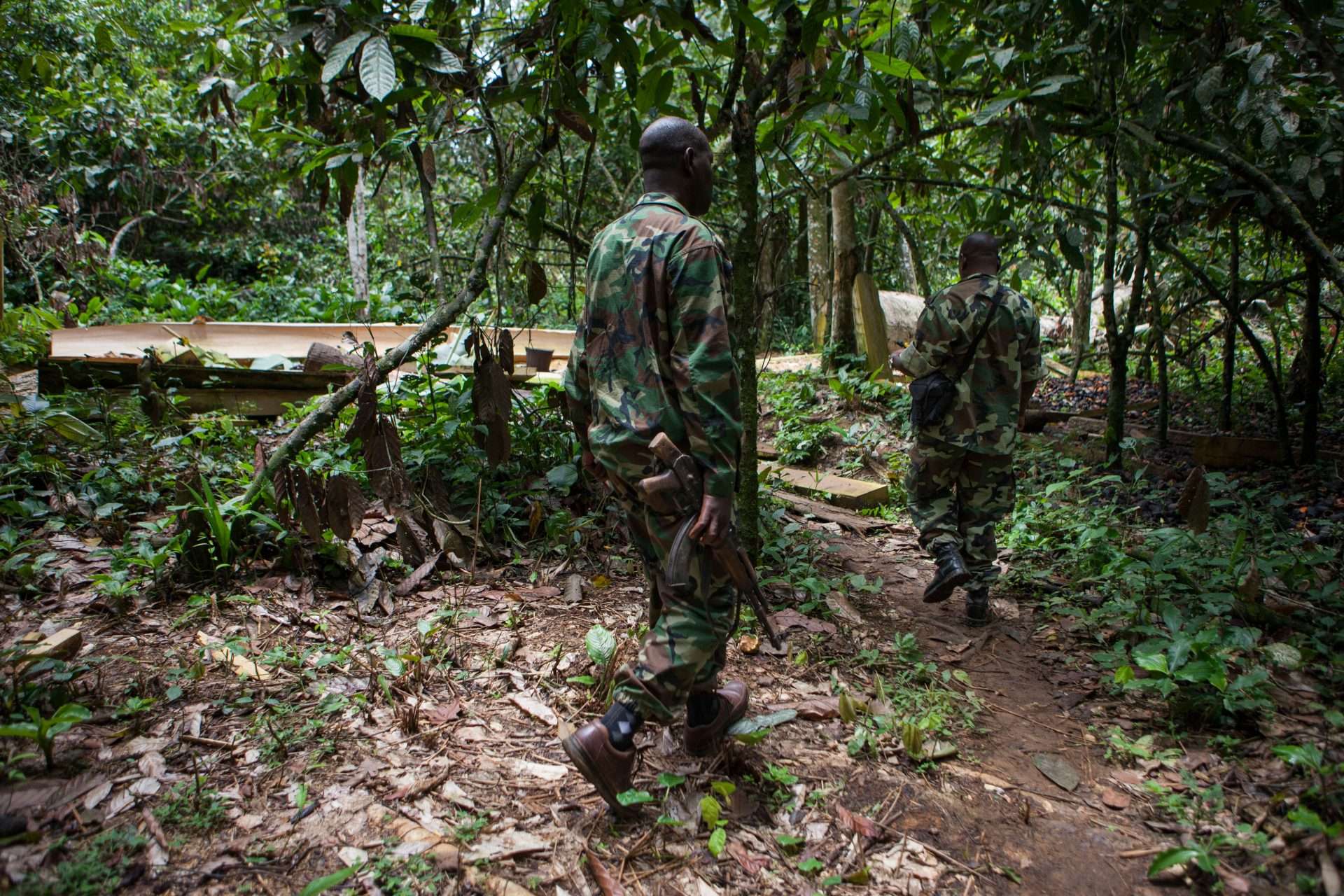
A patrol of eco-guards investigate illegal logging in the Congo Basin forest
Mike Goldwater, Alamy
‘How can we accept that entire communities are being destroyed in the search for lithium, cobalt or nickel? How can we tolerate carbon markets turning our forests into financial assets?’
Cardinal Fridolin Ambongo, Archbishop of Kinshasa, warned at the COP30 climate summit that the Congo Basin forest is critically endangered.
“The Congo Basin forest, the planet’s second largest lung, is under serious threat from massive deforestation, the rush for fossil fuels and critical minerals,” said Cardinal Ambongo.
COP30 ended in the Brazilian city of Belém on 22 November. Although a proposed roadmap to prevent deforestation did not make it into the final agreement, a historic pledge was made to recognise Indigenous land tenure rights over 395 million acres in tropical forest countries, including the Democratic Republic of Congo.
Cardinal Ambongo presented a 34-page letter from Global South bishops to the international community in the Blue Zone negotiations at COP30, alongside Brazilian Cardinal Jaime Spengler and Indian Cardinal Filipe Neri Ferrao, on 13 November.
The World Bank reports that the Congo Basin is the world’s largest net carbon sink and “a crucial buffer against climate change”, with an annual net carbon dioxide absorption six times larger than that of the Amazon rainforest.
According to the Centre for Global Development, the value of the carbon sequestration provided by the Congo Basin forest is estimated at least 55 billion dollars annually, equivalent to 36 per cent of the region’s GDP in 2021.
While the rate of forest loss in the Congo Basin pales in comparison with the Amazon, the growing global demand for minerals, including those deemed essential for the energy transition, is starting to leave its mark on the region’s forests.
An estimated 27 per cent of the region’s intact forests now overlap with mining permits, according to Earth Insight. New mines bring new roads and railways for transporting minerals, compounding the potential impact on surrounding ecosystems.
In particular, iron-ore mining threatens to inflict serious damage on the intact forest landscapes of the tri-border region that connect the basin countries of Gabon, Cameroon and the Republic of the Congo, where some of the region’s most important national parks, vital habitats for apes and forest elephants, can be found.
“This forest, which plays an important role in global climate balance, must be protected and preserved, as its degradation could have irreversible consequences for the planet,” said Cardinal Ambongo in Belém.
“But it is not only the Congo Basin that Africa should be worried about,” he continued, saying that a “climatically fragile environment” is now “a key characteristic of the African continent”.
“The situation in the Sahel region, where desertification is disrupting communities at an alarming rate, serves as a dramatic example of this environmental crisis,” he said.
Cardinal Ambongo said that the climate crisis in Africa extends beyond environmental degradation, fuelling forced migration and armed conflicts across the continent.
In the Democratic Republic of Congo and surrounding regions, the extraction of natural and mineral resources represents a structural cause of conflict, exacerbated by the global race for minerals needed for energy transition like cobalt, coltan, and lithium.
Cardinal Ambongo challenged world leaders: “How can we accept that, in the name of the energy transition, entire communities are being destroyed in the search for lithium, cobalt or nickel? How can we tolerate carbon markets turning our forests into financial assets, while our communities remain deprived of drinking water?”
Along with the other Global South bishops, Cardinal Ambongo called for “integral ecology” as a sustainable solution that addresses the root causes of the climate crisis. This approach, building on Pope Francis’ encyclical Laudato si’, seeks to correct the technocratic paradigm that has dominated climate negotiations for years by combining social justice, environmental sustainability, international solidarity, historical responsibility, and political urgency.
Cardinal Ambongo noted that, for the Church, the environmental crisis and the social crisis are inseparable: “It is one and the same crisis because, as the encyclical Laudato si’ says, ‘everything is connected’.”
COP30 – a global neighbourhood
Stay updated — add us as a preferred news source on Google:


Help us keep The Tablet’s voice independent, clear and far-reaching.
Founded in 1840, The Tablet is the leading independent English-language Catholic weekly, celebrated for great writing, astute analysis, brilliant arts and books reviews and trustworthy reporting from correspondents in Britain, Ireland, Rome and across the world.
Independent, high-quality journalism is at the heart of what we do. The Tablet does not have deep pockets and we are not funded by rich donors. If you appreciate our work please consider supporting The Tablet’s Development Fund. It only takes a moment and you can cancel at any time.
- Support with £5 per month
- Support with £10 per month
- Support with other amount.

MOST READ ARTICLES
-
1
Battling confession fatigue
-
2
Radio: Getting along with getting on
-
3
Church warns Zambian government against division after archbishop’s arrest
-
4
Catholic Social Teaching and universities
-
5
Bishops demand security investment to promote ‘common good’ in Nigeria
-
6
UK ‘must press for ceasefire’ as humanitarian crises unfold across Middle East
FROM THE EDITOR'S DESK