Catholic church in Devon reopens at twice the size it was to keep up with fast-growing congregation


St John’s Tiverton
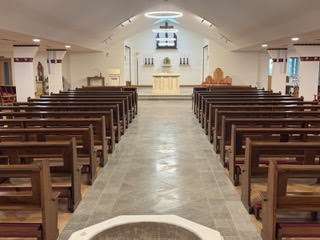
St John and St James Church in Tiverton reopened last Saturday after a rebuild that has nearly doubled its size.
The parish’s growth tracked migration into the region, such as people from Central and Eastern Europe, some of whom returned home after Brexit, but others who chose to stay permanently.
There has also been a large number from India and, more recently, arrivals from across Africa.
“A good number of parishioners work in the area’s hospitals and care sector, alongside food processing and other, often low-paid, jobs, largely staffed by immigrant workers,” said parish priest Canon Kristian Paver JCL. “A significant proportion of those are part of the Catholic community – people who aren’t rich by any means, but who work hard and are committed to providing for their families.”
Canon Paver said he now regularly blesses the homes of families, often Indian, who have bought property in the area after years of renting – a small but telling sign, he said, of families putting down roots rather than passing through. He said the parish has also seen a small but noticeable increase in parishioners in their twenties.
Some are newly initiated Catholics, and others are still searching but feel drawn to the Catholic Church, he added.
The area has also experienced a housing boom, part of a wider pattern of expansion across mid-Devon that has drawn commuters to nearby Exeter, Taunton and even Bristol and that meant the parish was running out of room.
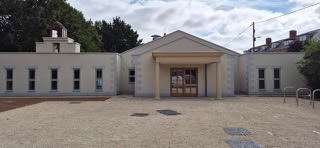
The church, a 1967 building originally constructed as a social centre, now seats up to 240, with additional capacity in the large narthex, and a new spire and bellcote marking it clearly as a place of worship from the road for the first time in its history.
Rather than demolishing the 1967 structure, the rebuild was designed to reuse and extend the existing building.
The finished building, which opened last Saturday with a Mass and dedication by Bishop of Plymouth, Nicholas Hudson, has achieved an A-rated energy performance certificate, the highest available, with heat pumps supplemented by photovoltaic panels on the community hall’s flat roof. Gas has been removed from the church building entirely, as part of the diocesan commitment to attempt to move away from the use of fossil fuels.
A rainwater harvesting system, fed by rainwater collected from the roof and stored within a 7000-litre tank located beneath the car park, supplies the church’s toilets and an outdoor tap for the gardens.
Local tradespeople and contractors were used throughout construction.
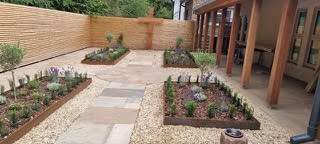
A Memorial Garden has created a space for reflection and remembrance, while a vegetable and herb garden is being established as part of the parish’s commitment to Laudato si’, Pope Francis’s 2015 encyclical on care for the environment.
Throughout the development, care has been taken to retain and reuse church heritage wherever possible. Existing fittings, including pews, the Rood, the Stations of the Cross, and statues from the original church of St John in Tiverton and from the previous St James, have been restored mainly by local craftsmen and reused wherever possible, alongside furnishings recovered from other churches, including a font from a former church within the diocese and two bells salvaged from churches further afield.
Parking includes EV charging points and cycle racks and there has been wildflower planting of bee and pollinator-friendly species and fruit trees.
“What strikes me most is not just the beautiful building, but the community that will fill it,” said Bishop Hudson, “families who have come from India, from Eastern Europe, from across Africa, alongside those whose families have worshipped here for generations. Along with the new church I recently dedicated in Gillingham in Dorset, it is a sign that the Diocese of Plymouth is growing and growing in a way that cares for our common home.”
Canon Paver said, “This is not a closed building open only to those who already belong to the Church. Everyone is welcome to come in and to experience the sacred space and grow in the faith journey. Likewise, it reminds us as a Catholic community that it is part of a Christian calling to go out into the world and take the faith to others.”
For nearly two years during construction, the congregation was hosted by the neighbouring Church of England parish of St Andrew’s. “There’s a desire that even when we move back to our own building, the links we have created with that community will continue,” said Canon Paver. “We want them to feel just as welcome to come to us as we have been welcome to come to them.”
Stay updated — add us as a preferred news source on Google:


Help us keep The Tablet’s voice independent, clear and far-reaching.
Founded in 1840, The Tablet is the leading independent English-language Catholic weekly, celebrated for great writing, astute analysis, brilliant arts and books reviews and trustworthy reporting from correspondents in Britain, Ireland, Rome and across the world.
Independent, high-quality journalism is at the heart of what we do. The Tablet does not have deep pockets and we are not funded by rich donors. If you appreciate our work please consider supporting The Tablet’s Development Fund. It only takes a moment and you can cancel at any time.
- Support with £5 per month
- Support with £10 per month
- Support with other amount.

MOST READ ARTICLES
-
1
Battling confession fatigue
-
2
Under endless skies
-
3
Nicaraguan bishops visit Rome as Ortega regime tightens grip
-
4
Vatican confirms Pope’s Latin America travel plans despite operation
-
5
Would the Church miss us?
-
6
Church from the 1950s receives £1 million government grant for new roof
FROM THE EDITOR'S DESK


