Bishop defends continuing positive ethos of Catholic education


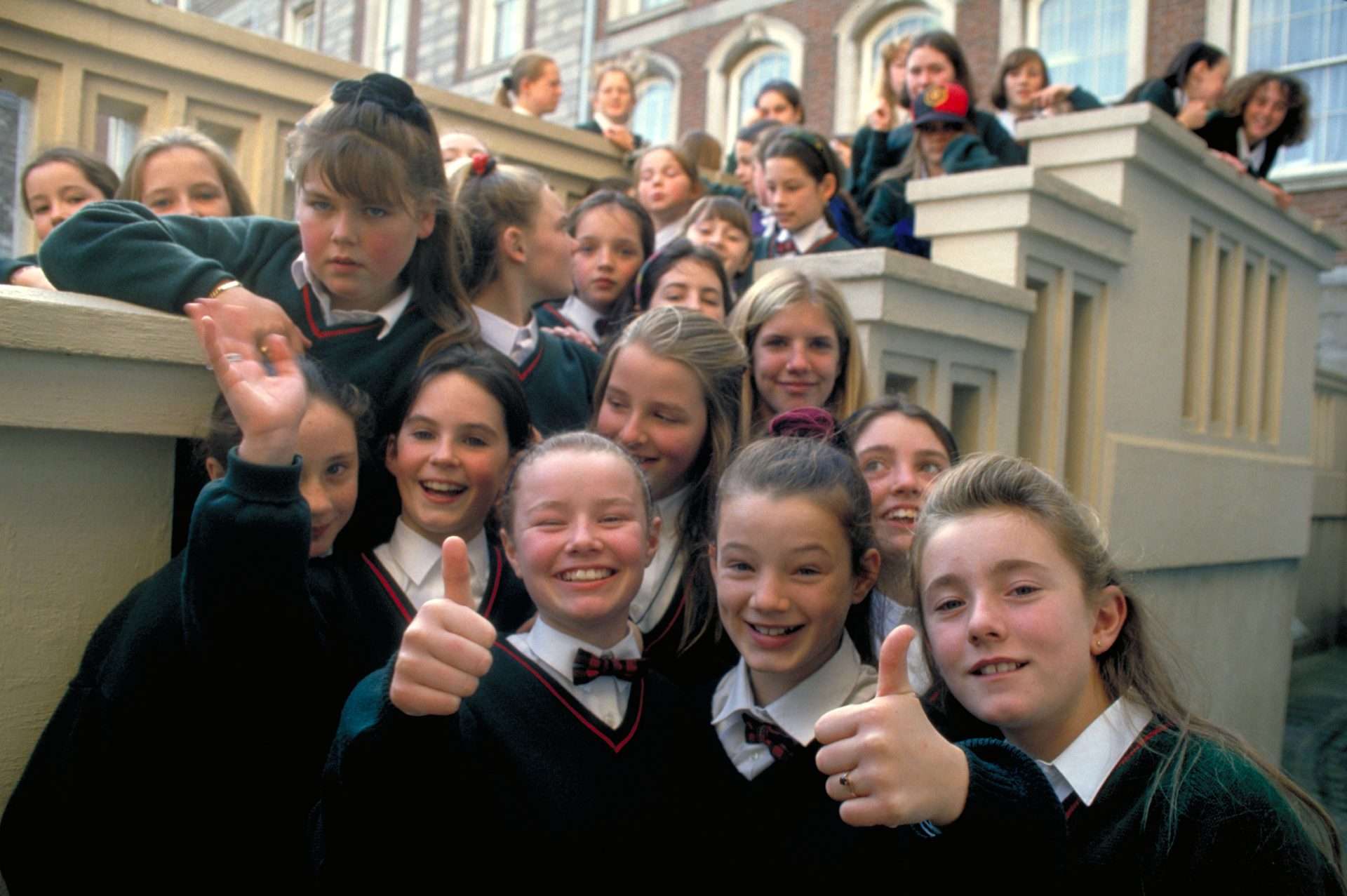
Stock photo from Alamy depicts a group of smiling school children on a field trip to the Royal Palace, Dublin.
MiraMira/Alamy
The Bishop of Meath has hit out at the “negative, ideologically driven and adversarial depiction of Catholic schools” in Ireland as ‘ill-informed and false’.
In an address to mark the golden jubilee of St Oliver Plunkett’s Primary School in Navan, Bishop Tom Deenihan said the results of the Department of Education’s survey on divesting indicate that the majority of parents in local communities wish to send their children to Catholic schools, and “that choice must be respected”.
He lamented the fact that the discourse in Ireland has not been on what schools such as St Oliver’s do; nor has it been on the education, support and care that they provide; or the fact that these are popular schools, are well supported and serve their community while being genuinely inclusive.
Rather the adversarial depiction of Catholic schools portrayed them as “grim places of indoctrination that children are forced to attend by Church and State”.
While many have known this narrative to be untrue, “various groups, supported by funding from ideological philanthropical entities, many from outside the State, continue to lobby politicians and media with a rather narrow, nuanced and distorted narrative,” he criticised.
That view, though it often accepted by society, was he warned, “pure revisionism and an unreflective absorption of a particular and, perhaps, fashionable narrative”.
Bishop Deenihan is a former General Secretary of the Catholic Primary School Management Association and Secretary of the Council for Education of the Irish Episcopal Conference.
Nevertheless, the Bishop did acknowledge that there were “atrocities” in religious-run education in the past. “We share that shame,” he said.
But he also highlighted that Catholic orders and congregations were providing education long before free education in Ireland and religious congregations were providing care for those who were sick too.
Looking at the current negative context for Catholic schools, he regretted that, “We are almost at the point where some would want us to hide the fact that we are either patron of, teaching in, on the Board of, working at or attending or attended local, Catholic primary and post-primary schools. That is what happens when narratives are repeated, unchecked and blindly accepted.”
According to the Bishop of Meath, “independent and reputable research has indicated that Catholic schools are the most inclusive, not just in terms of religion but in terms of ability, socio-economic background, ethnic background and nationality”.
He stressed that local communities know very well the work that their local Catholic primary schools do and, as a result, these schools are supported.
“It is important that the wider community see the work that this school, and so many others, is doing and can appreciate for themselves the happy, learning environment that has been created and is being sustained.”
“It is a school that welcomes all local students, cares for them, allows them to reach their full potential and caters for their many and varied needs.”
Referring to the publication of the findings of the survey on divesting earlier this month, which found that over 60 per cent of respondents favoured their school remaining under Catholic ethos, Bishop Deenihan said, “We have had the survey on divesting. We have achieved a result. Granted, it is not the result that some predicted or would have wished for. But democracy, maturity, pluralism, respecting parental choice, and even inclusion itself, demand that we accept the result of that survey.”
Noting that there was a 40 per cent response rate to the survey, and so 60 per cent of parents did not participate, Bishop Deenihan said, “one would have to deduce that there is a greater likelihood that most of these (the 60 per cent) would also be satisfied with the status quo. Those who want change are always more likely to vote.”
Of those who participated, over sixty per cent said they wished their local school to remain under Catholic ethos. “When one takes out those schools that overwhelmingly wish to change, and they exist in some areas, particularly in urban areas that have become multicultural, the percentage of those satisfied rises further for most local Catholic schools,” he said.
“That is not surprising. In fact, it is most surprising that our journalists and many of our commentators and politicians are surprised.” He also pledged that if there is a wish for divesting in any part of the Diocese of Meath when the more detailed local school results are published, he would, as patron, “happily engage with the Department of Education and Youth to initiate a closer examination of the wishes of parents and staff. If there is a wish for divesting, I would respect that and it would happen”.
Stay updated — add us as a preferred news source on Google:


Help us keep The Tablet’s voice independent, clear and far-reaching.
Founded in 1840, The Tablet is the leading independent English-language Catholic weekly, celebrated for great writing, astute analysis, brilliant arts and books reviews and trustworthy reporting from correspondents in Britain, Ireland, Rome and across the world.
Independent, high-quality journalism is at the heart of what we do. The Tablet does not have deep pockets and we are not funded by rich donors. If you appreciate our work please consider supporting The Tablet’s Development Fund. It only takes a moment and you can cancel at any time.
- Support with £5 per month
- Support with £10 per month
- Support with other amount.

MOST READ ARTICLES
-
1
Battling confession fatigue
-
2
Nicaraguan bishops visit Rome as Ortega regime tightens grip
-
3
Would the Church miss us?
-
4
Vatican confirms Pope’s Latin America travel plans despite operation
-
5
Restless statelessness
-
6
Church from the 1950s receives £1 million government grant for new roof
FROM THE EDITOR'S DESK


