Birmingham parishes to follow synodal model


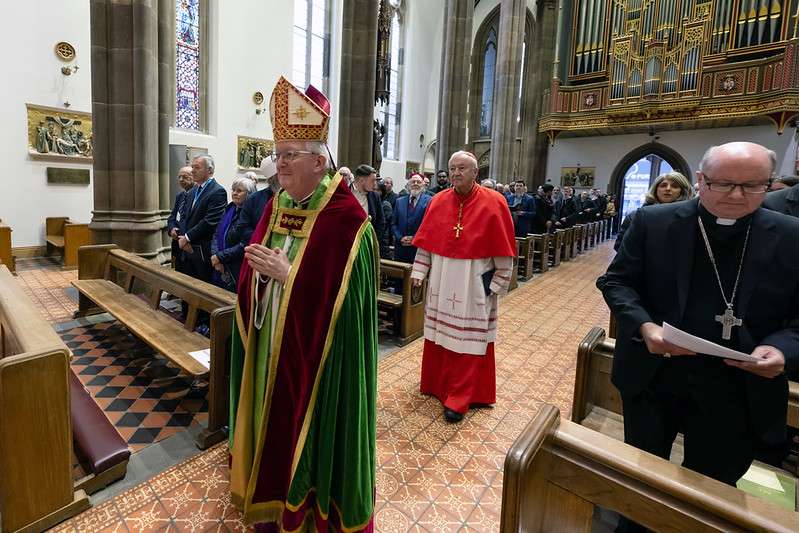
Archbishop Bernard Longley, with Cardinal Nichols last October at an event marking the sixtieth anniversary of the publication of Nostra Aetate
Mazur/cbcew.org.uk
The Archdiocese of Birmingham is implementing locally discerned plans to re-organise its 217 parishes based on the vision of the Synod over a five-year period.
A spokesman for the archdiocese emphasised to The Tablet there was no “one size fits all model”. “The archdiocese has effectively said to priests and deans, ‘You know your area. What’s right in terms of the most appropriate way to progress there?’”
Fifty-two Birmingham parishes are now part of informal clusters, where neighbouring priests work together but retain their own parish church. Archbishop Longley of Birmingham recently defined parish clusters as “a group of parishes with the potential to work together to share resources that is initially experimental with an interest of becoming one parish but it is not canonically fixed.”
“Plenty of our parishes are run by priests who are Religious. Within those contexts if the parishes are owned by the order there’s no expectation of them creating a new parish with diocesan parish”, added the spokesman.
In 2023, while the Synod on Synodality was taking place in Rome, Birmingham archdiocese conducted a consultation with priests, Religious and laity to discern the future structure of its parishes.
“The focus is on supporting vibrant and sustainable communities of faith, strengthening evangelisation and encouraging greater collaboration between clergy and lay people,” continued the spokesman.
He said the co-responsibility of the laity – a key theme of the Synod – had emerged in the process. “In one cluster which has now become a parish, it was the role of the laity to say to the parish priest, ‘We are working so well together, isn’t it actually time we became a parish?’”
“There is a growing appreciation of the fact that while the parish priest has a canonical role in the parish, much parish activity can be delegated. Deanery councils where priests and laity come together to identify the best way forward for formation, evangelisation and inevitably administration, are being encouraged”.
He explained: “The aspiration, ultimately, is that priests have the opportunity to undertake the ministry for which they were formed, rather than getting bogged down in matters which, in a properly collaborative parish, can be undertaken in conjunction with the laity”.
The number of parish deaneries in Birmingham has been reduced from 18 to 11, said the spokesman. He said a few Mass centres had closed while a small number of parishes had merged to create a larger parish.
Next year, Birmingham’s bishops will be visiting each deanery to discover how they are implementing the vision for re-organising the archdiocese, and see the progress parishes are making.
Meanwhile, the Diocese of Portsmouth is shutting two of the seven Catholic parishes in Jersey. St Mary and St Peter Church in St Helier and St Patrick in St Clement will both close down after the Sunday Mass on 12 July.
The measure was endorsed by the Bishop of Portsmouth, Philip Egan. A diocesan spokesman said the closures would allow the diocese “to focus our resources” to “better serve” the five remaining Catholic parishes on Jersey.
Stay updated — add us as a preferred news source on Google:


Help us keep The Tablet’s voice independent, clear and far-reaching.
Founded in 1840, The Tablet is the leading independent English-language Catholic weekly, celebrated for great writing, astute analysis, brilliant arts and books reviews and trustworthy reporting from correspondents in Britain, Ireland, Rome and across the world.
Independent, high-quality journalism is at the heart of what we do. The Tablet does not have deep pockets and we are not funded by rich donors. If you appreciate our work please consider supporting The Tablet’s Development Fund. It only takes a moment and you can cancel at any time.
- Support with £5 per month
- Support with £10 per month
- Support with other amount.