Bangladesh churches voice doubts about government plan to pay clergy


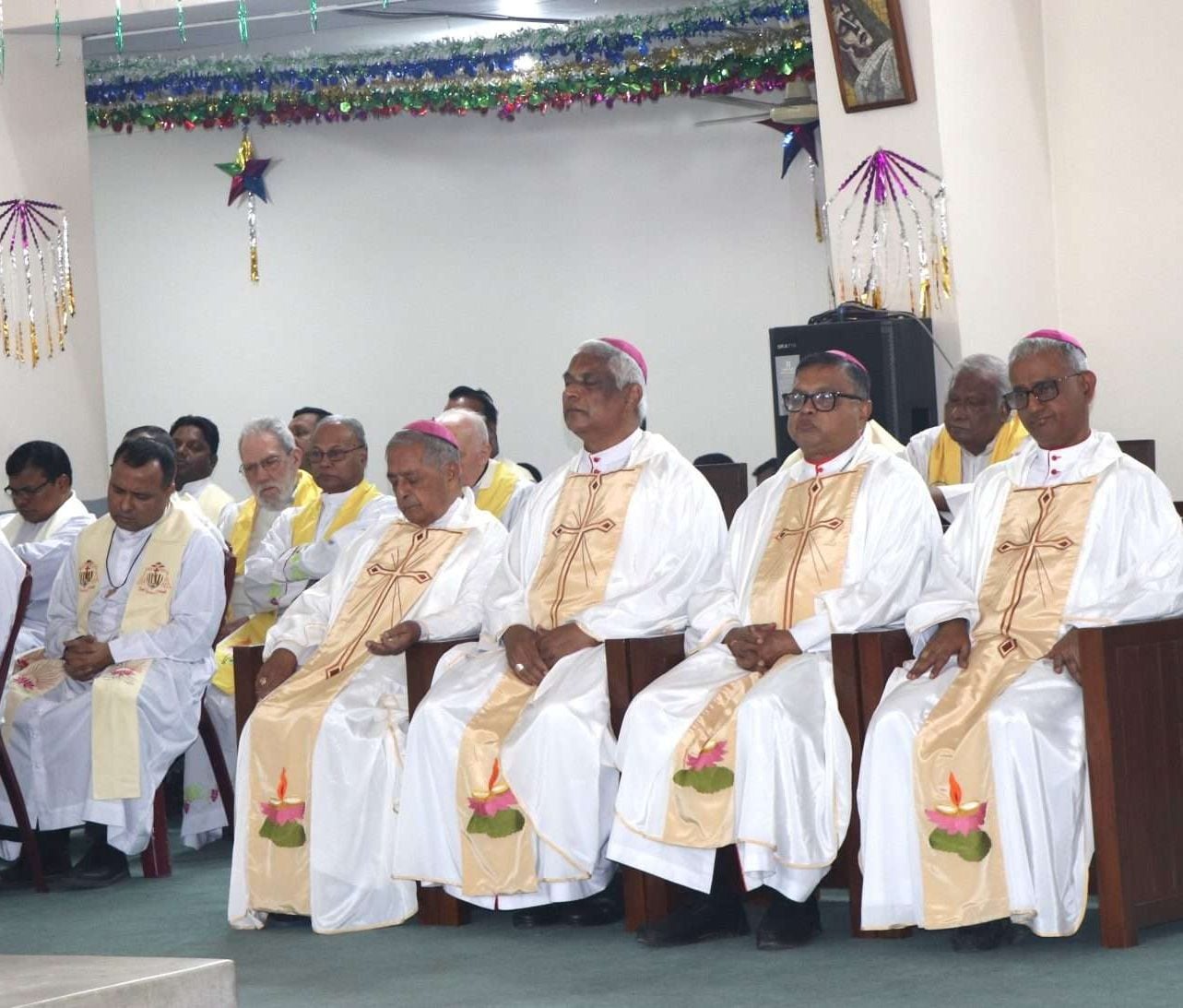
Catholic clergy attend Mass on 24 January at St Mary’s Cathedral, Dhaka
Sumon Corroya
‘We don’t want to lose our freedom,’ said Archbishop D’Cruze. ‘We are accountable to the faithful – we cannot be accountable to the government. The Catholic Church is an autonomous institution.’
Bangladesh will launch a pilot programme granting monthly honorariums to religious leaders before Eid ul Fitr, fulfilling an election pledge.
Announced on 8 March, it will support clergy in 6,500 worship places. Imams and priests will receive Tk 5,000 (£30) and muezzins and assistants Tk 3,000 (£18). The trial covers 4,908 mosques, 990 temples, 144 monasteries and 396 churches.
While many communities welcomed the government’s recognition of the economic hardships facing religious workers, the proposal sparked a significant debate within the nation’s Christian community – particularly among Catholic clergy, who firmly rejected the honorarium on theological and ecclesial grounds.
Speaking to The Tablet, the Archbishop of Dhaka Bejoy N. D’Cruze OMI, president of the Catholic Bishops’ Conference of Bangladesh, said the Catholic Church cannot accept government funding for clergy without compromising core principles of religious freedom and Church autonomy.
“We Catholics believe that the state and religion are not one, but separate,” he said. “We, the ordained fathers, sisters, brothers and bishops, are people who have renounced home and family.
“We serve the people. They will guide us and see to us. We want to live on the gifts of God and people. We want to remain in this attitude.”
Archbishop D’Cruze emphasised that financial transparency and accountability already form part of Catholic practice: “The total amount collected in the church is announced the following Sunday. Such an obligation rests on Catholic Christians.”
He noted that canon law forbids priests from serving as government employees and warned that receiving state funds could undermine the Church’s independence.
“We don’t want to lose our freedom,” he said. “We are accountable to the faithful – we cannot be accountable to the government. The Catholic Church is an autonomous institution.”
He also pointed to practical complications. In Bangladesh, Friday and Saturday are the weekly holidays, while Sunday is a working day. Yet Sunday remains the principal day of worship for Christians.
“If the priests take money from the government, and if the government calls a meeting on Sunday, it will be difficult for them to offer Holy Mass,” he said.
The archbishop recalled past instances where religious figures became entangled in political interests, citing the example of the former khatib of Baitul Mukarram Mosque who fled the country during a previous political crisis.
“There is a possibility of linking the priests with politics by giving government honorariums, which we priests and bishops cannot do,” he said.
Nevertheless, he emphasised that the Church welcomes government support – provided it is directed toward community needs rather than clergy salaries: “We want the government to work for the Christian community through the Christian Religious Welfare Trust, such as for education and health. The priests and pastors do not need money for their personal interests.”
He continued: “We Catholic bishops always criticise the government when necessary, but if we accept government grants, it will be difficult to speak out in the same way.”
The Revd Martha Das, general secretary of the National Christian Fellowship of Bangladesh, expressed a similar view.
“It is written in the Holy Bible that the suitability of pastors will come from their work,” she told The Tablet. “So we will not take any honorarium for pastors.”
She acknowledged the government’s goodwill: “This is the first time that any government has thought about the financial condition of religious leaders – we thank them for their generosity. But we will not take that money.”
Das also observed that Christian communities do need financial assistance, but for institutional development rather than personal remuneration.
“Land is needed for a new cemetery, the church and school walls are needed, repairs are needed. We want the government to give money to our churches for them. It can be given through the Christian Religious Fellowship Trust,” she said.
However, several Protestant churches – particularly those under the National Council of Churches in Bangladesh (NCCB) – have declared they will accept the honorarium.
The Revd David A. Das, NCCB secretary, told The Tablet that many churches lack the resources to pay their pastors adequately.
“There are twenty‑one churches under NCCB. There are more than 200,000 members. There are about 1,700 pastors. The financial condition of many of our churches is very bad. If they get this honorarium, the pastors will benefit a lot. The churches will also be strong – this is undoubtedly a good initiative by the government.”
The government is expected to finalise the first round of disbursements within the month. Whether the Christian community ultimately unifies around or rejects the programme remains to be seen, but the debate has already opened a broader national conversation on the boundaries between faith, poverty and the state.
Stay updated — add us as a preferred news source on Google:


Help us keep The Tablet’s voice independent, clear and far-reaching.
Founded in 1840, The Tablet is the leading independent English-language Catholic weekly, celebrated for great writing, astute analysis, brilliant arts and books reviews and trustworthy reporting from correspondents in Britain, Ireland, Rome and across the world.
Independent, high-quality journalism is at the heart of what we do. The Tablet does not have deep pockets and we are not funded by rich donors. If you appreciate our work please consider supporting The Tablet’s Development Fund. It only takes a moment and you can cancel at any time.
- Support with £5 per month
- Support with £10 per month
- Support with other amount.

MOST READ ARTICLES
-
1
Battling confession fatigue
-
2
Under endless skies
-
3
Nicaraguan bishops visit Rome as Ortega regime tightens grip
-
4
Vatican confirms Pope’s Latin America travel plans despite operation
-
5
Would the Church miss us?
-
6
Church from the 1950s receives £1 million government grant for new roof
FROM THE EDITOR'S DESK


