Archbishop says Ireland must continue to be the ‘land of welcomes’


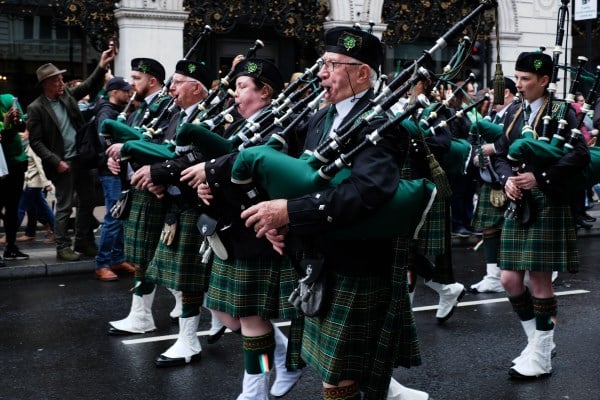
Irish players play bagpipes while marching the St Patrick's parade in London.
Laura Gaggero/Alamy Live News
The leader of the Irish Church appealed on St Patrick’s Day today for Ireland to live up to its reputation as “a land of welcomes”.
In his message for St Patrick’s Day, Archbishop Eamon Martin of Armagh urged people to consider whether Ireland can live up to its renown “as a country of warm-hearted and charitable citizens who are prepared to offer sanctuary to those who arrive in need”.
He said people’s thoughts and prayers on the national feast day naturally turn to our Irish emigrants abroad. Nearly 64,000 people left Ireland in the year to April 2023 – around half of them were Irish citizens.
“Some left Ireland many years ago and have set down roots in other countries. Others, including many thousands of our young people, have only recently gone in search of new places and opportunities. Wherever they are in the world, from Sydney to Toronto, from Manchester to Dubai, we wish them all a very happy Saint Patrick’s Day.”
Many Irish had also returned home during that period “bringing valuable new life skills”, the Primate of All Ireland said.
Noting that globally, millions of people are on the move, he said going and coming is a major feature of the modern world.
Some are voluntary migrants, seeking exciting new challenges and opportunities. “Others, sadly, are forced to leave their homes and families, displaced by war or economic hardship. Still others are cruelly deceived, captured and exploited by human traffickers.”
He called for “an honest and open conversation” about migration, both outwards and inwards on both sides of the border in Ireland.
“How can we truly become an island of belonging and hope where our own young people, health workers and teachers want to stay, and where others want to come and live among us? This important discussion will only move away from the extremes when we recognise legitimate anxieties and resolve to tackle together, at national and community level, the immense challenges of providing affordable homes and services for all.”
Archbishop Martin said St Patrick might well be considered a patron saint of migrants as he had written about enduring many hardships, hatred and insults in Ireland as a foreigner in his Confession.
“He certainly understands the predicament of the trafficked unaccompanied minor; the exploited labourer; the escaping refugee; the immigrant, the emigrant; the expat; the student or missionary abroad.
“Today, as we think of Irish emigrants who sometimes struggled to gain acceptance in foreign lands, we also turn our hearts to the many newcomers who have arrived among us.”
Noting that Pope Francis often speaks about migrants and refugees in terms of welcoming, protecting, promoting and integrating them, Archbishop Martin said these are the very hallmarks of the kind of society that we would want for our own young people and families who travel to other countries, either willingly or out of necessity.
Other bishops in Ireland on Sunday highlighted concerns over the treatment and attitudes towards asylum seekers and migrants in their homilies for St Patrick’s Day.
In Limerick, Bishop Brendan Leahy warned that Ireland cannot be allowed to become a place where “the warm fire of hospitality is being replaced by raging fires of division, distrust and disdain”.
In his homily at Sarsfield Barracks in Limerick, Bishop Leahy said the Feast Day provides a golden opportunity each year to reflect on emigration and immigration.
St Patrick, he said, is a figure to help us reflect on migration in both its difficult aspects and its positive possibilities. We can’t forget, he said, that some of our people abroad experience hardship.
“The migrant St Patrick puts before us the question: how are we today treating those who have migrated to our land? Some came here out of choice. Others have come escaping from war, persecution, or exploitation. For the most part they are ordinary human beings like us, many indeed very talented, people who reached good careers before they had to flee,” he said.
While the majority of people in Ireland are open and welcoming, he underlined that there are those who are stirring tensions, triggering riots, murmurings, and social media campaigns.
“As a result, migrants who for many years were made very welcome here, might now feel Ireland is becoming inhospitable, far from a place of a thousand welcomes; a place where the warm fire of hospitality is being replaced by raging fires of division, distrust and disdain stoked by a few who can so easily gain a hold on the many. Instead of welcoming and protecting, promoting and integrating refugees we witness outbursts of racism and violence, hatred and misinformation.”
Bishop Leahy also commended parishes, small faith communities and community initiatives that promote encounter with people new to Ireland.
In Dublin, Archbishop Dermot Farrell noted that many legends have grown up around St Patrick and that it is important to balance the national narratives by Patrick’s own words, as these reveal Patrick, Ireland’s apostle, and what inspired him.
He was “a person of faith and zeal, a person of deep inner life and resourcefulness, whose life followed unforeseen paths; someone whose suffering was great, and was not diminished by it, and who became a successful missionary, learning the language of his adopted people and returning to them in service and hope”.
Archbishop Farrell highlighted that the shock and brutality of Patrick’s treatment at the hands of the Irish, did not turn him in on himself, and in his liberation from Ireland, he did not close off his past.
“He did not shut out the deeper need of his captors, but managed to hear their cry, ‘the cry of the poor’ in a true sense. Patrick’s view of the world is not a fortress view, his worldview is a view that brings him to encounter people as they are.”
In Elphin, Bishop Kevin Doran said it was almost impossible to speak about St Patrick the missionary without making reference to the question of immigration and the various different ways in which people come into our country today.
“Remember that, before he came as a missionary bishop, Patrick was trafficked into Ireland and exploited for his labour.”
“Human trafficking, including the trafficking of children is an huge problem in the world today. As a young man in a strange country, Patrick worked hard under very difficult conditions. Yet, through prayer, he found in his heart a deep desire to contribute to the good of the country and of the people among he found himself.”
Referring to the refugee crisis as “an enormous scar on humanity which needs to be healed”, the Bishop of Elphin said that for all sorts of reasons, people are uprooted from their homes and their families and many millions of them are left stateless and homeless.
Noting that the official United Nations definition of a refugee is a person who “owing to well-founded fear of being persecuted for reasons of race, religion, nationality, membership of a particular social group or political opinion, is outside the country of his or her nationality and is unable or, owing to such fear, is unwilling to avail himself or herself of the protection of that country”, Bishop Doran said this definition is woefully inadequate.
“It does not include victims of war or natural disaster, or people who are displaced in their own country. Neither does it include people who leave their own country due to poverty or lack of opportunity, as generation after generation of Irish people have done.”
He added, “Like England, Australia, Canada and the United States, to which Irish emigrants, legal and illegal, have contributed so much, we here in Ireland have much to be grateful for in recent years, because of those who have come here both as economic migrants and as refugees.”
Bishop Paul McAleenan paid tribute to the “remarkable contribution” of the Irish diaspora to the Church in England and Wales and to British life and society, citing it as an example of the achievements of immigration and integration.
In a letter to MPs for St Patrick’s Day, the auxiliary bishop of Westminster, who was born in Belfast and trained for the priesthood at an Irish seminary, recalled the large-scale immigration of Irish people to Britain from the 19th century onwards.
Their contribution should be highlighted “as our public and political debate around issues like immigration and integration so often descends into a zero-sum game of fear, suspicion and prejudice,” he wrote.
Stay updated — add us as a preferred news source on Google:


Help us keep The Tablet’s voice independent, clear and far-reaching.
Founded in 1840, The Tablet is the leading independent English-language Catholic weekly, celebrated for great writing, astute analysis, brilliant arts and books reviews and trustworthy reporting from correspondents in Britain, Ireland, Rome and across the world.
Independent, high-quality journalism is at the heart of what we do. The Tablet does not have deep pockets and we are not funded by rich donors. If you appreciate our work please consider supporting The Tablet’s Development Fund. It only takes a moment and you can cancel at any time.
- Support with £5 per month
- Support with £10 per month
- Support with other amount.

MOST READ ARTICLES
-
1
Under endless skies
-
2
Leo pleas for besieged Ukrainian town in call with Putin
-
3
Battling confession fatigue
-
4
Restless statelessness
-
5
Pope Leo thanks staff at Mass in Gemelli Hospital
-
6
Study finds German dioceses failed to guard against spiritual abuse in lay groups
FROM THE EDITOR'S DESK


