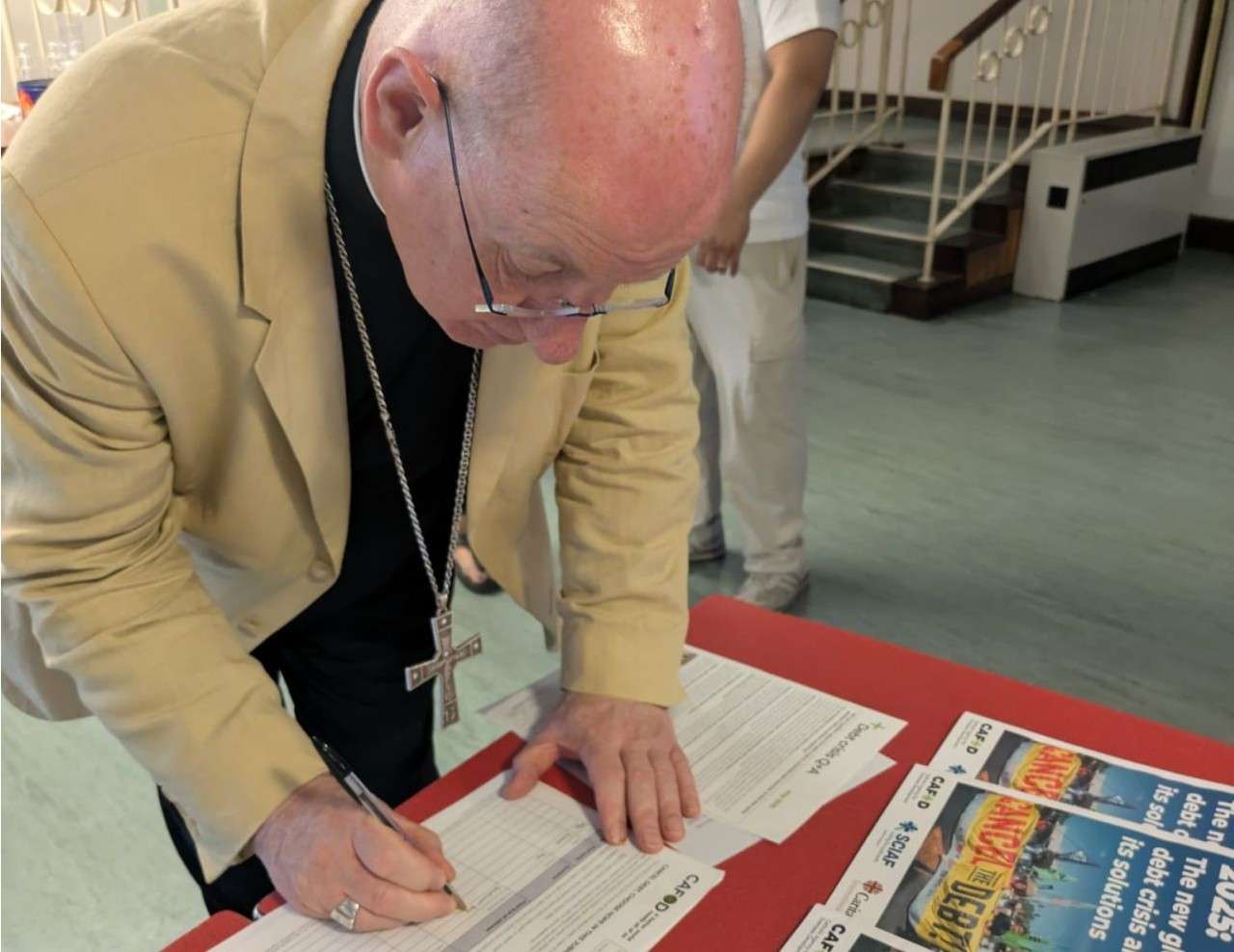
Archbishop of Westminster supports Cafod’s petition for debt justice


Cafod
The petition calls on the UK government to pass a law to require private lenders to participate in debt relief on the same terms as other lenders, to prevent them making a profit off countries’ poverty.
Archbishop of Westminster Richard Moth has added his name to a petition started by Cafod, which has gathered more than 12,000 signatures so far, calling for action on the global debt crisis.
Low-income countries have been facing increasingly unsustainable debt since the 2008 financial crisis, which private lenders such as banks, hedge funds and traders used as an opportunity to lend to them at disproportionately high interest rates for profit.
The petition also urges the government to use the UK’s G20 presidency to bring governments together to fix the broken global debt system and guarantee “fast, fair and effective” debt relief for countries in crisis.
If debt repayments were capped at 10 per cent of a country’s income, the money saved could provide clean water to 11 million people, basic sanitation to 23 million and pay for an extra 3 million children to go to school, according to Cafod.
The UK will host the G20 in 2027, which Cafod said is a “crucial” gathering of the world’s 20 most powerful economies, which together have the power to fix the global debt system.
“Low-income countries are being pushed into a deepening debt crisis, forced to pay ever higher interest rates to wealthy lenders,” the petition said. “Money that should be spent on healthcare and education is flowing out of countries that can least afford it.
“Governments across the Global South have an impossible choice between serving their people or paying their creditors. Every day this continues, millions are suffering the effects.”
Cafod said that in some cases, countries have already paid their debts once, but are forced to pay the original debt many times over due to high interest rates.
Archbishops spotlight ‘crushing weight of unjust debt’ amid Commonwealth Games
Africa’s debt crisis: seeds of hope
The high costs of cuts in overseas aid
Stay updated — add us as a preferred news source on Google:


Help us keep The Tablet’s voice independent, clear and far-reaching.
Founded in 1840, The Tablet is the leading independent English-language Catholic weekly, celebrated for great writing, astute analysis, brilliant arts and books reviews and trustworthy reporting from correspondents in Britain, Ireland, Rome and across the world.
Independent, high-quality journalism is at the heart of what we do. The Tablet does not have deep pockets and we are not funded by rich donors. If you appreciate our work please consider supporting The Tablet’s Development Fund. It only takes a moment and you can cancel at any time.
- Support with £5 per month
- Support with £10 per month
- Support with other amount.

MOST READ ARTICLES
-
1
Battling confession fatigue
-
2
Nicaraguan bishops visit Rome as Ortega regime tightens grip
-
3
Would the Church miss us?
-
4
Vatican confirms Pope’s Latin America travel plans despite operation
-
5
Word from the Cloisters
-
6
Church from the 1950s receives £1 million government grant for new roof
FROM THE EDITOR'S DESK


