Archbishop of Westminster says bishops gave strong backing to Pope Leo over call for peace


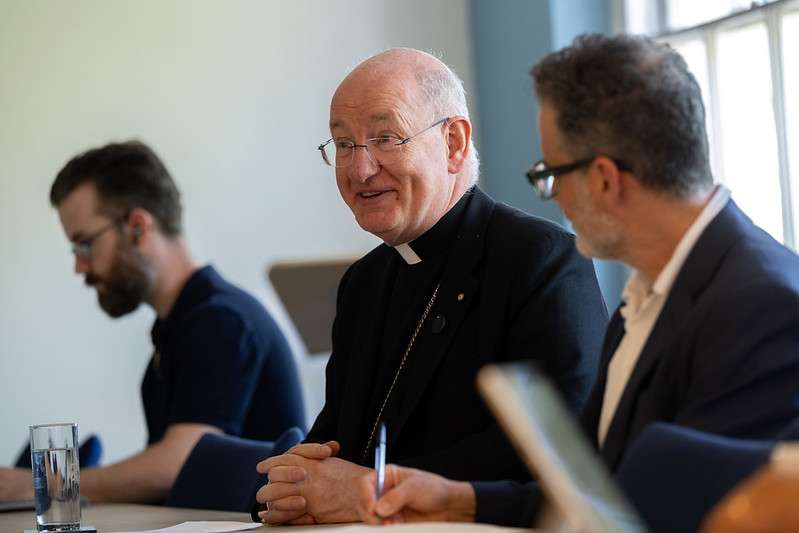
© Mazur/cbcew.org.uk
Archbishop Richard Moth did not refer directly to the criticisms by US President Donald Trump but said it had been ‘very important’ for the bishops of England and Wales to add their voice to that of the Pope.
Archbishop Moth was speaking in Westminster after returning to London from Rome, where the Catholic Bishops’ Conference of England and Wales met for one day in plenary when they drew up a statement on peace.
Archbishop Moth, speaking at a press conference at Westminster today after returning to London, said it was “very important” for the bishops to “add our own voice” to the Pope’s strong call for peace and reconciliation across the world, and to support Pope Leo.
At the plenary, the bishops elected Archbishop Moth as president of the bishops’ conference, succeeding Cardinal Vincent Nichols. The plenary was followed by a week of ongoing formation that concluded last Thursday and took place at Convento Palazzola, the Venerable English College’s villa and retreat house outside Rome.
In a statement after his election at president, Archbishop Moth said: “We look at the challenges in the world around us and that very often shapes our priorities. But it’s not just about being reactive, it’s about having a real consciousness that the gospel message is an eternal message, the fact of God’s love for us all, that’s something unchanging, and it’s about bringing that message into the world.
“For me, ‘mission’ is very much a priority: a mission grounded in prayer and our celebration of the liturgy, and a mission that enables us to bring the light of the Gospel and the peace of Christ to the world in which we live.”
The bishops expressed solidarity with Pope Leo XIV “in his sustained witness and unshakeable commitment to the Gospel of Peace”. They called upon all the faithful to join them in “redoubling our prayers and advocacy for peace and justice”. They said: “We embrace our responsibility to act as bridge-builders and peacemakers. We pray that leaders of all peoples at war open their minds and hearts to the dialogue and encounter necessary to attain a peace that disarms and endures.”
Speaking at today’s press conference about accompanying Archbishop of Canterbury Sarah Mullally to see Pope Leo XIV in the Vatican on Monday morning, he said that they had both been installed around the same time, and she spoke at his while he did a reading at hers.
Churches must strive for unity, says Leo at first meeting with Mullally
‘Fan faith into flame’: Richard Moth installed as Archbishop of Westminster
Archbishop Sarah Mullally makes history as she is installed as first female Archbishop of Canterbury
They are also both presidents of the ecumenical body Churches Together in England. He said it was a good opportunity for him to meet Pope Leo again, and for the first time since he became Pope. “I think it was a very good expression of the work that we seek to do together. There was very clear recognition on the part of the Holy Father and in what Archbishop Sarah had to say of the obstacles and the differences that there are and the obstacles that need to be got over in terms of the unity for which Christ prayed. All those things were acknowledged.”
He added that in spite of the obstacles, “the wonderful thing to see there was the openness of the conversation” and the desire to continue the conversation and build a relationship. He said that he, Archbishop Mullally and leaders of other faiths shared a concern for the common good.
He also stated that there had “definitely” been a rise in numbers of people seeking to become Catholic. “It is certainly the case, and all the bishops of England and Wales would say this… what we are experiencing, and this is definite, is a rise in the number of baptisms and receptions across England and Wales, this year and last.” He said precise numbers were not available yet but in Westminster alone, there were 790 people received at the Rite of Election just before Easter.
Issues expected to come up in the future include ethical concerns around artificial intelligence, as well as life issues such as further attempts that are likely in Parliament to legislate for assisted suicide.
Asked a question on the traditional Latin Mass, he said that his practice in Arundel and Brighton was to look at pastoral need, and where it existed, make sure there was provision.
Top of his priorities is the Church’s mission. “If we don’t pray we can do nothing. Everything has to come from that foundation.” On Catholic schools, he said there was a falling demographic and declining birth rate in many parts of the country and there were now fewer over-subscribed Catholic schools than there used to be. Others still looked to Catholic schools because of a sense of family, of communities where children were well looked after and, in many cases, excellent results.
Stay updated — add us as a preferred news source on Google:


Help us keep The Tablet’s voice independent, clear and far-reaching.
Founded in 1840, The Tablet is the leading independent English-language Catholic weekly, celebrated for great writing, astute analysis, brilliant arts and books reviews and trustworthy reporting from correspondents in Britain, Ireland, Rome and across the world.
Independent, high-quality journalism is at the heart of what we do. The Tablet does not have deep pockets and we are not funded by rich donors. If you appreciate our work please consider supporting The Tablet’s Development Fund. It only takes a moment and you can cancel at any time.
- Support with £5 per month
- Support with £10 per month
- Support with other amount.

MOST READ ARTICLES
-
1
Would the Church miss us?
-
2
Nicaraguan bishops visit Rome as Ortega regime tightens grip
-
3
Church from the 1950s receives £1 million government grant for new roof
-
4
Pope Leo thanks staff at Mass in Gemelli Hospital
-
5
Henri Nouwen: Christ’s acrobat
-
6
The technological paradigm, AI and the human person
FROM THE EDITOR'S DESK


