Archbishop Mullally prays for reparative justice on site of transatlantic slave trade


Lambeth Palace
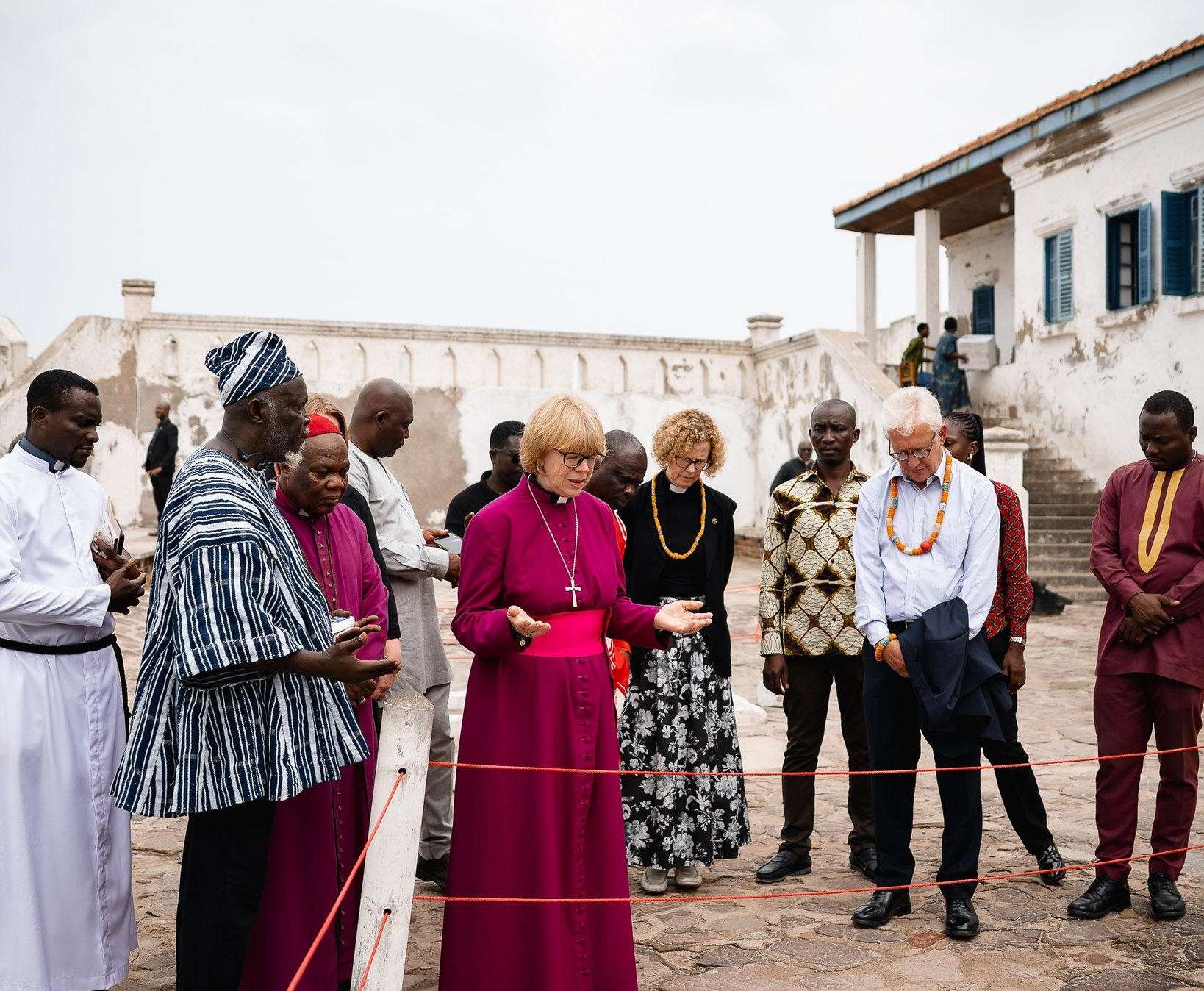
Archbishop of Canterbury Sarah Mullally has reiterated her commitment to reparations for the transatlantic slave trade, during a visit to the dungeons where enslaved people were imprisoned in Ghana.
Archbishop Mullally is making her first pastoral visit to Africa since her installation. She completed her visit to Ghana today and travelled to Yaounde, beginning a five-day visit to Cameroon.
While in Ghana, she visited Cape Coast Castle, where enslaved Africans were held before being transported to the Americas on British slave ships.
She visited the underground dungeons where prisoners were kept, and walked through and prayed in front of the Door of No Return, which enslaved people would pass before boarding the ships.
“You can’t help but be deeply moved by the horrific conditions that people were kept in and the way that they were treated,” she said. “It completely throws you off balance and brings home the evil that was transatlantic slavery.”
Archbishop Mullally said the chapel above the dungeons was a “stark illustration of the way the Church was involved in the slave trade”.
“Part of the Christian belief in repentance is about action, so we are putting in place action to support those communities that feel the legacy of the slave trade,” she continued.
“I pray not only in lament for the Church’s involvement in the slave trade, but also for hope – hope that the God of healing can bring justice and reconciliation to all who are still impacted by its legacy.
“In the name of Jesus Christ, who came to set people free, I pray that we have the courage to continue our journey of repentance, and to strive for a world in which all of God’s children are treated with dignity.”
Archbishop Mullally also broke soil for a new pilgrim hostel, run by the Anglican Church of Ghana, that will welcome descendants of enslaved people visiting Ghana to learn about their heritage and visit the slave sites.
The Church of England remains committed to Project Spire, the plan to put £100m into reparative justice for historical links to slavery, although it is reportedly facing a legal challenge.
The Queen Anne’s Bounty, a church endowment fund founded 1704, invested in the South Sea Company, which transported more than 34,000 enslaved people across the Atlantic.
The £100m set aside by the Church Commissioners would be put into an “impact investment fund to invest in a better and fairer future for all, ensuring that communities affected by historic transatlantic chattel slavery, are fairly considered and addressed”.
This could include grant funding for projects focused on improving opportunities for communities adversely impacted by historical slavery, such as startups for social and environmental goals as well as a financial return.
Arriving in Cameroon today, Archbishop Mullally said, “In a time of terrible conflicts around the world, and suffering here in Cameroon, I come with the message of the Gospel.
“This is always a message of peace. It is always about the infinite value of every person made in God’s image. And it is always about the hope we have in Christ, who rose from the dead to bring us new life.”
Stay updated — add us as a preferred news source on Google:


Help us keep The Tablet’s voice independent, clear and far-reaching.
Founded in 1840, The Tablet is the leading independent English-language Catholic weekly, celebrated for great writing, astute analysis, brilliant arts and books reviews and trustworthy reporting from correspondents in Britain, Ireland, Rome and across the world.
Independent, high-quality journalism is at the heart of what we do. The Tablet does not have deep pockets and we are not funded by rich donors. If you appreciate our work please consider supporting The Tablet’s Development Fund. It only takes a moment and you can cancel at any time.
- Support with £5 per month
- Support with £10 per month
- Support with other amount.

MOST READ ARTICLES
-
1
Battling confession fatigue
-
2
Nicaraguan bishops visit Rome as Ortega regime tightens grip
-
3
Would the Church miss us?
-
4
Vatican confirms Pope’s Latin America travel plans despite operation
-
5
Restless statelessness
-
6
Church from the 1950s receives £1 million government grant for new roof
FROM THE EDITOR'S DESK


