Migrants are not illegal


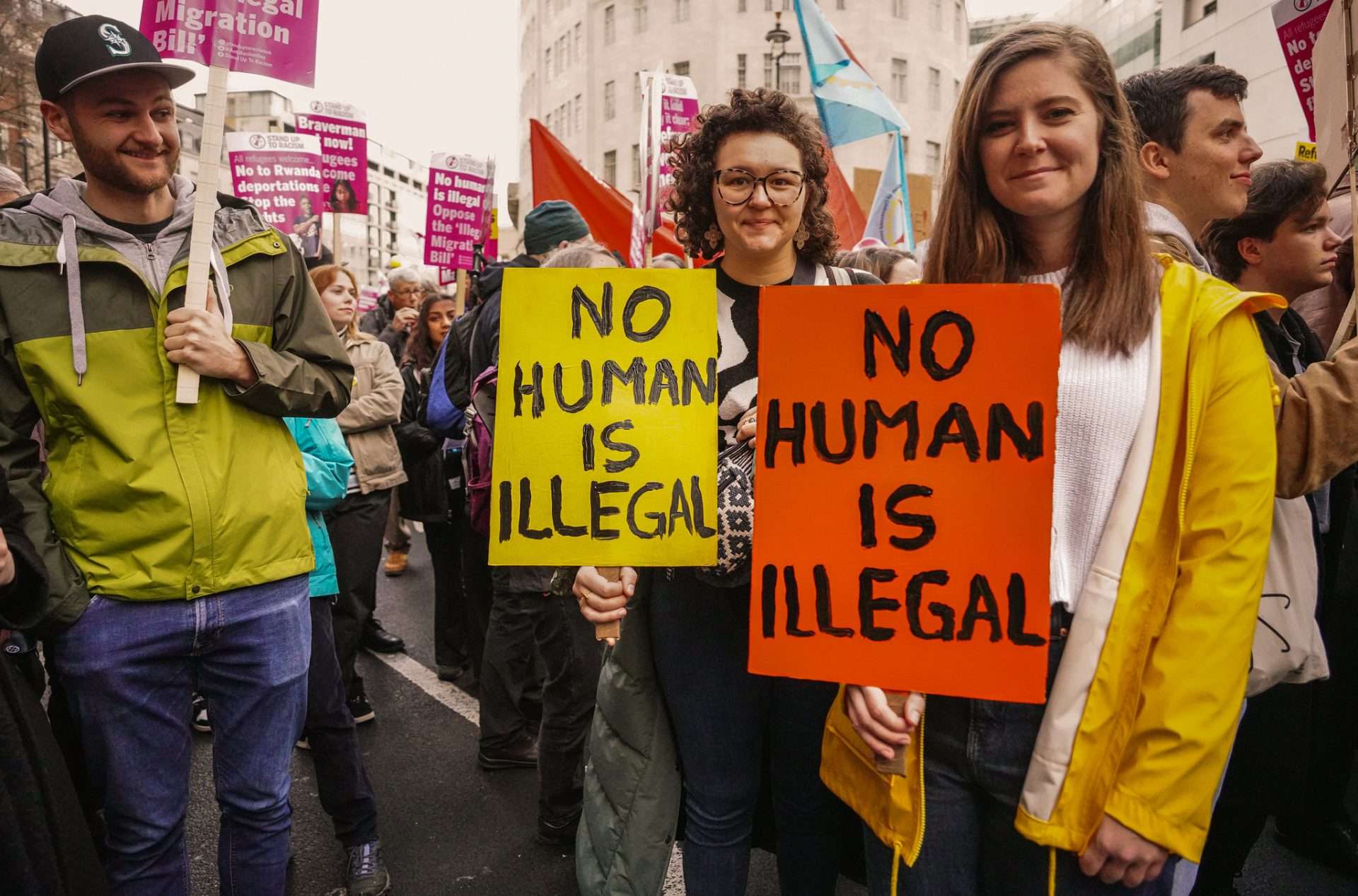
Demonstrators at a march against racism in London carry placards saying "No human is illegal".
Photograph by Alisdare Hickson
Letters to the Editor of The Tablet
In the present immigration debate, blazing in many parts of the world, there is one key, descriptive term, demanding attention. It is the use of “illegal” referring to migration and migrants. Basically, the norm accepted by the United Nations, NGOs and the Church is that we do not use “illegal” to describe migrants (“Shabana Mahmood makes a start”, Editorial, 22 November).
The basic reason is that persons are neither legal nor illegal, nor is migration in itself illegal. Illegal refers to criminal activity that is used to take advantage of migrants or that migrants themselves may use to attain their purposeful goal.
How we properly describe migration is as being regular or irregular (meaning to follow regular, safe and orderly pathways of migration, as upheld in the Global Compact on Migration).
Likewise, we properly describe migrants as being documented or undocumented (meaning to have the rightly recognised authorisation and documentation).
The use of correct language is important, for the term “illegal” is loaded with meaning. Its use risks the migration debate descending into victimising and criminalising migrants simply for seeking a new home or new beginning.
The other great danger in using this term is that the whole debate falls apart, becoming personal and emotive, going nowhere.
In the days of Pope Benedict XVI, I was in Rome for an international symposium on migration. I remember so clearly hearing him telling us that migration is a human right. I then recalled moral philosophy on human rights, which gave the other side – with rights come responsibility.
(Fr) John Murray OSA
Director of National Catholic Mission on Migration, Caritas Thailand
I was heartened to see the issue of human trafficking highlighted and to hear about the invaluable work being done by people like Sr Imelda Poole and organisations such as the Medaille Trust (“Trafficking of humans has reached a new evil”, 15 November).
While everything possible needs to be done to combat this “horror”, on both national and international levels, it is also important to remember that safe houses like Bakhita House, run by Caritas Westminster, are doing invaluable work with women who have been trafficked.
I am fortunate enough to have been a volunteer at Bakhita House for many years and seen how the lives women from across the world who stay here are being turned around.
Despite the increasing difficulties that women who don’t want to return to their home country now face, the staff work untiringly to support women to move on and make a fresh start.
John Bateson
London SW9
History of Nicaea
I was fascinated to read Sara Parvis’s theologian’s account of the period after Nicaea (“What really happened after Nicaea”, 22 November). The historian sees it through a different lens.
The Council unleashed what historians have concluded was the worst violence in the entire history of the Roman Empire. It is estimated that 30,000 Christians were killed by other Christians, supposedly in defence of orthodoxy.
No wonder Constantine tried to “reverse” Nicaea. In the 360s CE the Emperor Julian famously concluded “even wild beasts are less savage to men than Christians are to each other”.
Athanasius of Alexandria was illegally made bishop while under age by barricading the basilica against the recognised electors. He persecuted his Christian rivals by allying with Jews and pagans. He openly ignored the Nicaean canons when it suited him, for example in persecuting the Miletians.
The myth of the saintly Church Fathers is an invention of the ninth century. It came after the clerics of the Carolingian court had redacted and mistranslated what documents had not already been lost or destroyed. Nothing then survived that did not support a brutally authoritarian regime of Church and state.
Patristics has plenty to teach us about Roman urban feuds and early medieval statecraft. But followers of Jesus should be very cautious about accepting these “saints” at face value.
(Dr) Jon Rosebank
Oxford
Synodal unity
Austen Ivereigh (“Leo’s road map for the Church”, 15 November) finds the silence on synodality from parish clergy and bishops to be painful and perplexing, and echoes a recent Vatican request that those who are resistant or hesitant open themselves to the Holy Spirit and listen to their own resistance.
Those charged with fostering synodality should also listen to their concerns. Synodality as a term referring to a constitutive element of the whole Church (not just for the whole Church) is an innovation. It requires simple and clear explanation especially when it is used at the highest levels.
How does it fit in with what has gone before? What is it? And what is it not? Despite long church documents, perhaps it is owing to a lack of simplicity and clarity that hesitancy and resistance remain.
God’s style, to borrow Ivereigh’s nice expression, seems to be to set up institutions which are ordinary and then, at times, makes use of the extraordinary.
The ordinary and extraordinary outreach of God is to the one end – that the People of God stay together, live in communion. They come together in symphony. Some of the proponents of synodality play discordant notes which jar.
If the substance of synodality is gathering, listening, urging, accompanying, exhorting – and forming, then many parish priests do this already. They live among the people they serve and, if allowed to stay in a parish, come to know their joys and sorrows and needs.
So perhaps synodality is not a new knowledge to be proposed or feared but an organic development, consistent with what has gone before. In our parish, we are embarking on the next stage.
(Rev.) William Massie
Our Lady of Lourdes & St Peter Chanel, Hull
The article by Austen Ivereigh on Leo’s way is one of the most illuminating descriptions of the background and meaning of the synodal process. And the linkage between the document of Aparecida and Evangelii Gaudium does indeed underscore that the world Church is no longer a European or western-sculpted institution.
About 50 years ago Walbert Bühlmann predicted this development in The Coming of the Third Church. Few believed it at the time, but the synodal process is confirmation of it.
Another revolution, as Ivereigh noted, was when the marker was laid down at the Second Vatican Council, not by the Curia, but by the bishops and the theologians of France and Germany.
But here Ivereigh made an omission. It was also our Catholic Church in the Netherlands which strongly influenced the documents of the Council.
Professor Schillebeeckx, Cardinal Alfrink and other theologians and bishops could carry through their vision of an open, future-oriented Church. As the French theologian Yves Congar said, nobody was so well organised and prepared as the Dutch church leaders and theologians.
Jos J. van Gennip
The Hague, Netherlands
Not a victim
Sixty-nine years ago, as a lad of 14, I was sexually assaulted by a man. Having no wish to relive the experience by recounting it to my mother and the police, I chose to say nothing. Though I did not realise it until I was much older this decision released me from ever being a prisoner of the past.
I never completely forgot this incident, but until the moral panic of “satanic abuse” in 2000, it rarely if ever came to mind. During the past quarter century, I have increasingly questioned whether calling someone a victim or a survivor is helpful, or whether it merely reinforces their memory of the abuse.
As a society we seem to have lost sight of the fact that the only person to blame for these vile deeds is the perpetrator. We demand accountability and when the perpetrator is dead, we cast around for some third party or organisation to blame.
I refuse to be seen as a “victim” or a “survivor”; in the past 69 years I have lived a happy and constructive life. When I am no longer on this Earth I will be remembered and judged for what I did to other people, not for what they did to me.
NAME AND ADDRESS SUPPLIED
Meynell’s universe
Alex Wong’s article on Alice Meynell (“The yet unanswered question”, 22 November) wonders to what extent she is remembered today.
Some years ago, I met Guy Consolmagno, well known to Tablet readers for his columns on astronomy. Knowing his interest in the possibility of life on other planets, I mentioned that my great grandmother, a Victorian poet, had written on such a theme.
“Alice Meynell, Christ in the Universe,” he replied, “I quote it in almost all my lectures.”
Oliver Hawkins
Arundell, West Sussex
Michael Keaveney
It was refreshing to read the stories of two ordinary people (Word from the Cloisters, 22 November). It was particularly poignant to be reminded of Fr Michael Keaveney so soon after the news of his death. He was an informal chaplain to Magee College when we were students there in the early 1970s, when the university was still called the New University of Ulster.
We have fond memories of a trip with him and a couple of friends to see the Armada cannon as well as more spiritual activities.
Angela and Roger Batham
York
Blame game
All praise to Tom Grufferty (Letters, 22 November) for pointing out that it is not the people who have left the Church, but that it’s the Church which has left the people. Rather than blaming ”secular society” for being “unchurched”, the cry is for institutional self reflection, not societal blaming.
Human consciousness is continually evolving; sadly, the institutional Church continues to be stuck in consciousness catch-up mode from within the walls of its dogmatic prison.
Kevin Gallagher
Fareham, Hampshire
Choral response
I am so glad that Isabelle Grey’s critical review of The Choral (“What lies beneath”, 8 November) didn’t put me off seeing it at the cinema with a friend. We both found it profoundly moving and the music wonderful.
Neither of us found the final scenes “hackneyed”, quite the opposite. We felt those scenes simply touched on the vulnerability and inexperience of the young recruits.
Maggie Organ
Haywards Heath, West Sussex
The mighty Forest
Having been partly responsible for Sr Liz Dodd’s education in all things football in Nottingham, I suspect that the reference to “Notts Forest” in her column (22 November) was a slip of an editor’s pen.
In the Catholic and red parts of the area, to misname us and confuse the mighty Nottingham Forest with neighbouring Notts County borders on the unforgivable. Sr Liz has already apologised and been forgiven.
(Fr) Joe Wheat
(Forest season ticket holder), Nottingham
Login
Please login to comment
0 Comments
Oldest

Help us keep The Tablet’s voice independent, clear and far-reaching.
Founded in 1840, The Tablet is the leading independent English-language Catholic weekly, celebrated for great writing, astute analysis, brilliant arts and books reviews and trustworthy reporting from correspondents in Britain, Ireland, Rome and across the world.
Independent, high-quality journalism is at the heart of what we do. The Tablet does not have deep pockets and we are not funded by rich donors. If you appreciate our work please consider supporting The Tablet’s Development Fund. It only takes a moment and you can cancel at any time.
- Support with £5 per month
- Support with £10 per month
- Support with other amount.

MOST READ ARTICLES
-
1
Battling confession fatigue
-
2
Radio: Getting along with getting on
-
3
Church warns Zambian government against division after archbishop’s arrest
-
4
Catholic Social Teaching and universities
-
5
Bishops demand security investment to promote ‘common good’ in Nigeria
-
6
UK ‘must press for ceasefire’ as humanitarian crises unfold across Middle East
FROM THE EDITOR'S DESK


