Letters to the Editor


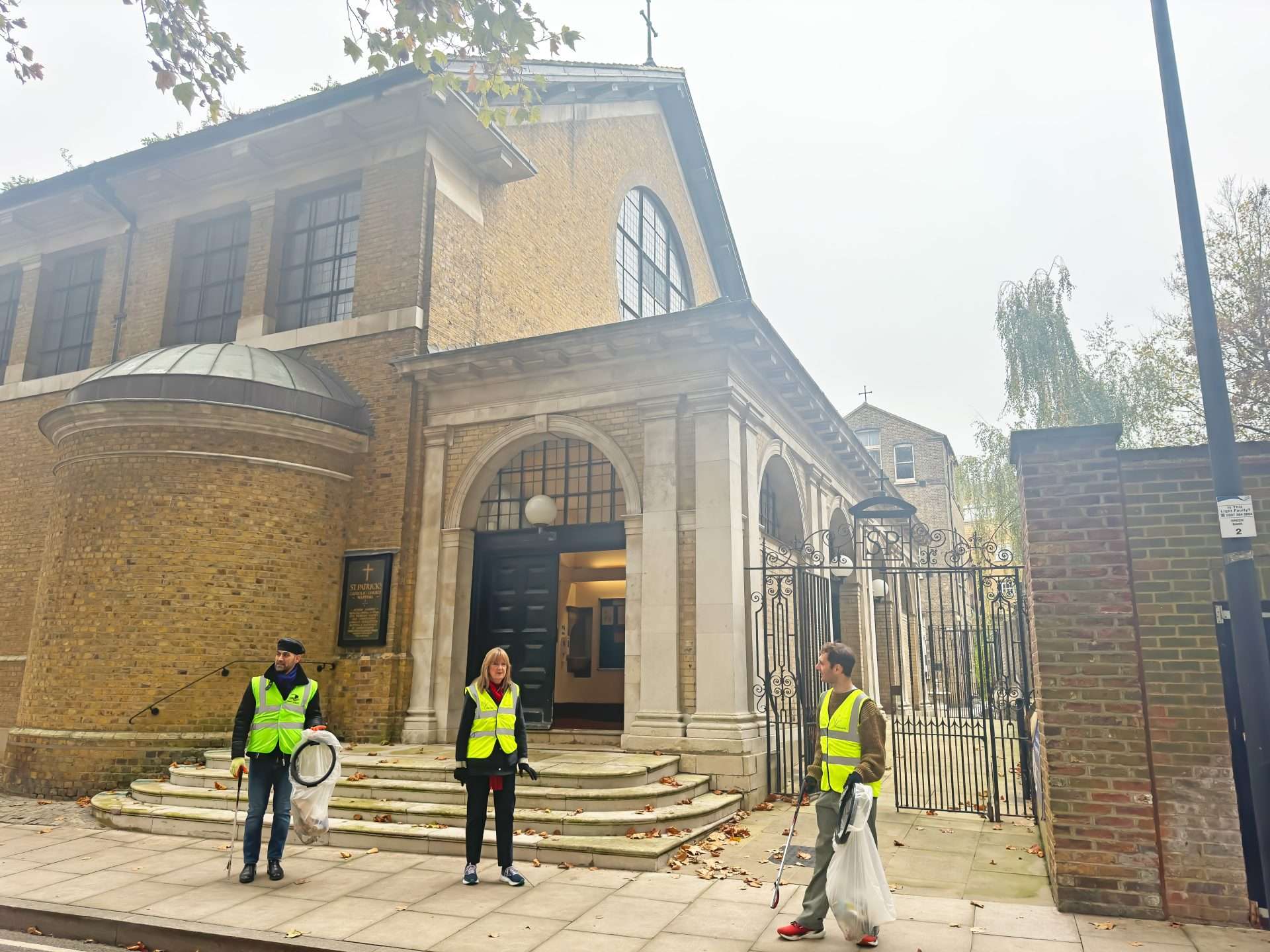
Litter pickers outside an open Catholic church in Wapping, east London
Ruth Gledhill
Topic of the week – how to keep our churches open
Canon Gerard Flynn’s response (Letters, 22 March) to Philip Moore’s appeal for advice in the face of vandalism in our churches (Letters, 15 March) was well-meant and optimistic, but unrealistic. While Gerard is concerned with a single church, Philip refers to many churches up and down the country where the question of security is of prime importance.
More serious than either correspondent appears to realise is the fact that, while both refer to locking the church after daylight hours, Pope Francis states categorically that our churches should never be locked (Evangelii Gaudium 47). The instruction to leave our churches open 24 hours a day is a big ask, but being a papal precept, it requires our attention. Maybe a compromise could be reached.
Here at Saint Saviour’s, West Wight, fulfilling the Pope’s instruction while recognising that conditions vary from parish to parish such a compromise has been put forward.
A suggestion has been made for the construction of a lockable plate-glass screen immediately beneath the choir-loft, cutting off porch and church entrance area from nave and sanctuary, fulfilling papal instruction regarding the open church, while offering, even under locked conditions, full view of sanctuary, altar and tabernacle.
Incidentally, screening off the church entrance would form a foyer with many advantages, such as providing space for catechetical classes, children’s liturgy, prayer groups etc. – to say nothing of cutting down the heating bills.
Jim Malia
Totland Bay, Isle of Wight
Philip Moore’s letter recalled my own experiences of short visits to my secondary school chapel where it was always possible to have quietness for reflection in the otherwise boisterous environment of an all-boys’ school.
At primary and intermediate schools we were always encouraged to pop into the parish church (usually empty) for a quick prayer on the way home. I still remember one occasion when, not wanting to waste time, I knelt on the kneeler attached to the back of the last row of pews.
Shortly afterwards I was startled to receive a hefty kick on my backside and hear the sound of a running exit behind me, with just a glimpse of the culprit. I was outraged, not just at the indignity but also the inappropriateness of such behaviour.
I recounted this episode to my mother, who just laughed. She obviously understood the lengths to which some girls would go to attract the attention of an 11-year-old boy.
Recently on a visit to the city, I stopped at a church for a quick prayer only to find it locked in mid-afternoon. Yes, keeping churches open most of the day may invite some vandalism, but it might be minimised by more frequent visits of children and adults seeking a quiet word with the Lord. Worth a trial?
(Dr) Anthony Marsland
Brisbane, Queensland, Australia
Elect the bishops
Those of us who have followed The Tablet for decades are aware that there are two Churches. One the Church of the living body of Christ present in prayer, in communion and in service to all. The other a necessary evil: namely the organisation that oversees and supports our communities of Faith, the guardian of orthodoxy in an ever-changing world.
Your pages are full of stories of the heroic witness of those deeply engaged in the living witnessing Church that is evident wherever two or three are gathered in prayer, where communities assemble in communion and lives are given in service. Sadly, the letters page is dominated by the cries of pain resulting from the mismanagement of Church organisations and the many abuses of clerical office.
The essential problem appears to be the medieval hierarchical structure of the secular Church. Lord Acton famously observed that power has a tendency to corrupt, meaning that those in office are removed from the realities of the people they govern and the ever-changing circumstances of the world.
There is an alternative model, that identified by St Benedict in his guidance on the management of his communities. Abbots are elected by a community after careful consideration of the circumstances in which they are attempting to carry out God’s will. The election is for a fixed period, after which the community meets, without the abbot, to consider how well they are fulfilling God’s direction.
If all is as it should be, the abbot is reinstated for another term. If circumstances require a change of leadership, that will follow discussions and prayer.
Historically, bishops were elected, as popes still are, but the Church which emerged from the collapse of the western Roman Empire would not entrust election to the converted barbarians, and we are still living with the consequences of that 16 centuries later. Can it be accepted that it is time we moved on?
Tiernan Peter MacNamara
Thirsk, North Yorkshire
Synodal Church
Perhaps I am unfortunate, but can Austen Ivereigh (“Semper reformanda”, 22 March), or any Tablet contributor or reader provide any concrete instance of synodality being implemented in the UK?
Kate Keefe wrote in The Tablet a while ago: “The Synod process, originally so welcomed, does not seem to have changed the way we approach anything.”
I fear that is the experience of most Catholics. Indeed, many face worse issues. For example, in some parishes the priest is committed to overturning the second Vatican Council. In such circumstances what can we do to make the synodal Church a reality?
Stephen Donaghy
Ipswich, suffolk
Royal art on tour
Reading Fernando Cervantes (“The Grammar of Angels’’, Books, 15 March), which began with a reference to Raphael’s frescoes in the Vatican, I could not but think of the large collections of great artists kept by the royal family in their properties.
Windsor Castle is an example. Its collection of paintings by Europe’s artists is simply astonishing. Our kings and queens have had the wealth and time required to create it.
But why should they have those paintings locked away from the public? Wouldn’t it be a good thing if every now and then they took a number off their walls and arranged for them to be put on show in Manchester or Birmingham, Newcastle, Glasgow or Cardiff?
Share out the enjoyment, make them available for viewing by the rest of the country and no longer just themselves? Why not?
Michael Knowles
Congleton, Cheshire
No confidence
Reviewing the Hennessy-Blick booklet Could It Happen Here? (“A vision to dizzy and appal”, 29 March), Oliver Letwin argues that a written constitution would enable a prime minister who refused to budge following a vote of no confidence to be removed.
Current trends in the United States, however, suggest that this is not necessarily the case. Donald Trump is running what can only be described as dictatorship by executive order. He has already ignored judicial rulings and got away with it.
With his power to appoint the heads of law enforcement agencies, and with Congress controlled by supine Republicans, he could simply (for example) sign an executive order reducing the status of the Supreme Court to that of an advisory body only.
Unless members of his party in Congress begin to grow a spine, it is difficult to see how proper democracy can be restored peacefully, despite a written constitution which has survived for nearly 250 years.
Alan Pavelin
Chislehurst, Kent
Disability cuts
Julia Langdon (“Where there is no vision, the people perish”, 22 March) is correct that the prime minister has shown statesmanship on the world’s stage, but his domestic stance leaves a lot to be desired.
She is spot on, too, that the malaise set in with the removal of the winter fuel allowance, a necessary measure but enacted in soulless haste and seemingly not repented, but added to all the other punitive cuts and reforms. A Labour government should not pillory the sick and disabled and make them scared witless.
Yes, there is “dignity of work”, but it is also true that the disabled should not have their innate dignity taken away from them and their lives made harder as a result.
Judith Daniels
Great Yarmouth, Norfolk
Assisted dying
I am a lay chaplain with the palliative care team at a major hospital. I agree with Katherine Pettus (Letters, 15 March) regarding palliative sedation. Many palliative patients are in hospital for pain management; once this is achieved and they are stabilised, many return home, or to a care home or hospice and live comfortably, sometimes for weeks or months.
Palliative sedation is not euthanasia, or assisted dying; yes, patients will die eventually, but they will die with dignity and not in unbearable pain.
Holly Ball
Hereford, Herefordshire
Clear win for radio
Adrian Chiles (Extra time, 22 March) lists a pecking order of ways to watch sport but admits: “The game can be special wherever you are.”
Perhaps he is right, but he could not have spent his time tidying his garden or developing a relationship with a staghorn sumac tree other than by listening to the radio. This is its beauty, as in no other way can one follow a match and do something else simultaneously. Radio definitely is king.
John Fryer
New Mills, Derbyshire
Feminist money
Ruth Wood (Letters, 22 March) is correct to state that the decision-makers of the Church are deaf to the pleas of women to be welcomed into the ministerial priesthood, leaving us with few options to prompt a rethink. She diagnoses a deafness to the promptings of the Spirit.
A ploy adopted by the Roman Catholic feminists in the late 1970s created some waves. They produced “funny money” to put in the plate. On one side was the quote from Vatican II, Gaudium et Spes 29: “Every type of discrimination based on sex is to be overcome and eradicated as contrary to God’s intent”; and beside it was the statement: “I am transferring my contribution to the feminist cause until the Church implements this statement.”
I believe there still is a copy in the archives of the Bank of England, which gave its imprimatur as a non-forgery. Such economic action could function as a deaf aid to enable the authorities to better hear those promptings of the Spirit.
Dr Jacqueline Field-Bibb
London N21
Gilbey’s chaplaincy
Surely the question within which Alfred Gilbey should have framed his teaching is, “What does Christ want the Church to be like?” (Letters, 15 March). Until we have “found our souls” none can answer this question, so the Church needs to be teaching people how to live in a non-transactional relationship with God.
Walking them through the Victorian penny catechism, as Mgr Gilbey does in his book We Believe, clearly no longer works.
(Dr) Stephen Pearce
Ludlow, Shropshire
Login
Please login to comment
0 Comments
Oldest

Help us keep The Tablet’s voice independent, clear and far-reaching.
Founded in 1840, The Tablet is the leading independent English-language Catholic weekly, celebrated for great writing, astute analysis, brilliant arts and books reviews and trustworthy reporting from correspondents in Britain, Ireland, Rome and across the world.
Independent, high-quality journalism is at the heart of what we do. The Tablet does not have deep pockets and we are not funded by rich donors. If you appreciate our work please consider supporting The Tablet’s Development Fund. It only takes a moment and you can cancel at any time.
- Support with £5 per month
- Support with £10 per month
- Support with other amount.

MOST READ ARTICLES
-
1
Would the Church miss us?
-
2
Nicaraguan bishops visit Rome as Ortega regime tightens grip
-
3
Church from the 1950s receives £1 million government grant for new roof
-
4
Pope Leo thanks staff at Mass in Gemelli Hospital
-
5
Henri Nouwen: Christ’s acrobat
-
6
Under endless skies
FROM THE EDITOR'S DESK


