Church rebuffs women once again


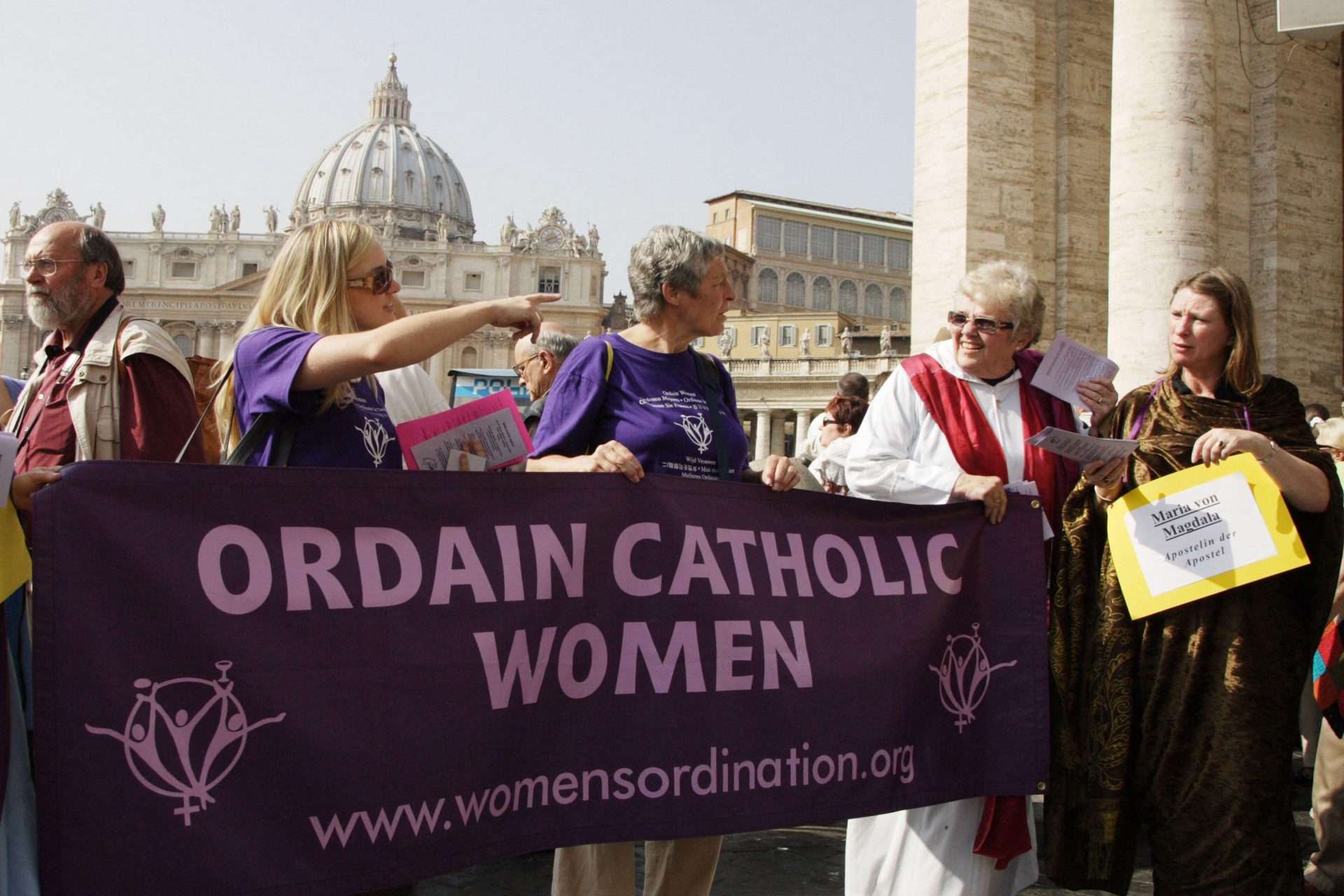
Women demonstrating in favour of female ordination at the Vatican in 2008.
ZUMA Press, Inc. / Alamy
Letters to the Editor of The Tablet
Pope Francis, at a meeting of the International Theological Commission in November 2023, called on theologians to “demasculinise the Church”. The Synthesis Report, “A Synodal Church in Mission” (October 2023), the official outcome of the first session of the 16th General Assembly of the Synod of Bishops, observed that “clericalism, a chauvinist mentality and inappropriate expressions of authority continue to scar the face of the Church” and acknowledged that many women present at the Synod had spoken of a “Church that wounds”.
The second Study Commission on the Female Diaconate, whose final report was made public on 5 December, has deepened these wounds. The movement for a permanent female diaconate has, once again, been kicked into the long grass.
For the commission to conclude that current theology and tradition do not support ordaining women as deacons not only ignores the overwhelming historical evidence of women deacons, and therefore tradition, it is a profound setback to those women who are called to any degree of sacramental ministry.
This decision does the Church no favours. A Church which sees women and men “together as protagonists, without subordination, exclusion and competition” (the 2023 Synthesis Report again) is one that thrives because she is, quite simply, a reflection of God’s creation of men and women as equal image-bearers and a testament to the central message of 1 Corinthians 12:11, that spiritual gifting, not gender, qualifies individuals for ministry.
Rhiannon Parry Thompson
Chichester, West Sussex
The Christian witness of women throughout the centuries has culminated in Sarah Mullally’s appointment as Archbishop of Canterbury. In contrast, the recently released Petrocchi Commission’s report for the Catholic Church, could not “formulate a definitive judgment” on the “hypothesis” of a female diaconate.
Dickens might have savagely parodied the cold reasoning and patronising, misogynistic conclusions of the report and its use of Latinate language. How different from the profound simplicity of Jesus.
How can the Catholic Church fulfil its role as the living expression of the Gospel in all cultures and all times if it ignores the signs of our own time, belittles the spiritual self-offering of contemporary women and squanders their goodwill?
Sad to say, many women gifted with spiritual leadership have long since left the Catholic Church.
Pamela Perry
Oxford
The No from the Pontifical Commission to investigate the Women’s Diaconate again delivers the correct answer for Rome and the conservative hierarchy. It is a grievous response; another failure on the well-trod path of those unable to grasp the potential and hope of Vatican II.
Courageously, the initial commission (1971-73) saw hope in the diaconal evidence of women in the New Testament scripture and suggested a Yes.
Fortunately for John Paul II and Benedict XVI, the two subsequent commissions arrived at the correct answer of No by using weak theological argumentation. Strangely the findings and research of the fourth commission (2016-18) remain unpublished. Veni Sancte Spiritus. We need transparency.
Kate Nugent Bell
Lyall Bay, New Zealand
BBC’s responsibility
Clifford Longley, indignant at the BBC’s decision to delete a line from a distinguished Dutch historian’s Reith lecture, concludes that this “act of abject cowardice” represents a betrayal and a restriction of our Human Rights Act (article 10) “freedom [to] receive … information and ideas” (“One likes to think of the BBC as the final redoubt in the battle for truth”, 6 December).
The line cut from a broadcast (though not from the transcript) was Rutger Bregman’s opinion that Donald Trump is “the most openly corrupt president in American history”.
Longley recounts an early news editor telling him: “The readers want to know what happened, not what you think about it” – a lesson “not just in impartiality, but in putting aside one’s subjective interpretation”. But he then demands that the BBC broadcast Bregman’s opinion on Trump’s presidency, a subjective interpretation about a serving foreign leader.
How is this betrayal? It’s the impartiality that the BBC’s Royal Charter legally requires on contested political matters. His charge of cowardice ignores institutional responsibility. The corporation is funded by a compulsory licence fee and answers to licence payers, regulators and Parliament.
The phrase was removed after legal advice warned of defamation liability. Gambling public money to broadcast one historian’s opinion isn’t journalistic courage—it’s reckless disregard for the BBC’s obligations to those who fund it.
Longley’s article 10 argument is spurious. Article 10 protects against state censorship, not editorial judgment by a publicly funded broadcaster managing institutional risk. The BBC hasn’t silenced Bregman—his full lecture is in print.
John Bransby
Twickenham, Greater London
Interchurch marriage
Your editorial (“The open wound can be healed”, 6 December) recommends using the principles of “receptive ecumenism” when engaging in ecumenical dialogue. This attitude of respect and openness to learn from other traditions is fundamental in an interchurch marriage.
Those of us called into such relationships quickly appreciate the gift of unity in diversity, bonded in love, with which we are blessed. My husband is an Anglican priest; we have been married, and members of the Association of Interchurch Families, for over 40 years.
As Christians, united by the sacraments of both our common baptism and also matrimony, we have been made “one flesh”, and offered a special degree and quality of unity.
Although there is no blueprint, interchurch couples and families create a domestic church where differences are appreciated as riches, and diversity is a treasure to be guarded. Indeed, in his letter In Unitate Fidei Pope Leo notes: “Unity without multiplicity is tyranny, multiplicity without unity is fragmentation.”
Interchurch families rejoice in our “multiplicity”, hoping that this might be appreciated as a positive contribution, rather than a problem to be solved or a challenge to be avoided.
Kathy Pope
St Austell, Cornwall
Response to Nicaea
Dr Jon Rosebank (Letters, 29 November) does me too much honour in calling me a theologian: my PhD is in ecclesiastical history.
As one historian to another, could he give a reference for his statistic of 30,000 Christian deaths caused by “what historians have concluded was the worst violence in the entire history of the Roman empire” in the context of the Council of Nicaea? As a fourth-century CE specialist, I’m not aware any evidence for either side of that claim.
Dr Rosebank is right to note the importance of the emperor Julian’s evidence, but it tells in favour of Athanasius, and against Eusebius of Nicomedia, who claimed that Athanasius was illegally made a bishop while underage (in fact, Athanasius probably had no idea how old he was, which is why the charges were dropped).
Eusebius of Nicomedia was Julian’s tutor in Christianity as in other matters, and Julian’s hatred for him was key to Julian’s rejection of Christianity.
Sara Parvis
University of Edinburgh
Thomas McMahon
We welcomed your obituary of Bishop Thomas McMahon (6 December) but noticed a perhaps unrecognised facet of his life was missing: for 33 years (1992 to 2025) McMahon was, with Lord Alton, an active patron of the Epiphany Trust, helping us to raise considerable funds for the support of disabled and disadvantaged people in the UK and abroad, for young leaders formation globally, and for refugees.
Memorably, after the Kosovan war, Bishop Thomas travelled with the trust to refugee camps in Albania, meeting Salesians working there. A fruit of this visit was a beautifully designed book on which we worked with Bishop Thomas of child refugee art from the camps.
(Prof.) Francis Davis, William Hampson OBE DL
Southampton
Storm over Orage
I must protest at Christopher Howse’s excoriation of A.R. Orage, who he calls “a rather absurd figure”. This absurd figure, among other accomplishments, published The New Age journal, which, according to a Brown University press release, “helped to shape modernism in literature and the arts from 1907 to 1922”, attracting contributors such as Shaw, Belloc and Chesterton.
His grasp of economics was second to none. The eminent Catholic economist Dr Frances Hutchinson writes of his importance in challenging traditional economic thinking by championing guild socialism and the social credit movement.
Orage’s final BBC address in the “Poverty in Plenty” series in 1934, The Fear of Leisure, attracted audiences across Europe. He died in his sleep that night.
(Dr) John Carlisle
Sheffield
Missing blogs
A lovely article about Stanbrook Abbey, its history and some of the wonderful women who lived, prayed and worked there (“Dames, scholars, artists and friends”, 6 December).
One dame whose impact and influence was probably greater than most was the extraordinary Dame Catherine Wybourne, aka The Digital Nun, whose daily blogs were read by hundreds of thousands.
They were sharply incisive, grounded in a deep understanding of scripture and theology, and with a clear understanding of national and personal issues which her readers grappled with. And she was also very funny. It would be wonderful if her blogs were published. Sadly, they have disappeared from the internet after her death three years ago.
Jane Lawson
London SE7
Lunch at Ashdown
It was a joy to read Joanna Moorhead’s article about the Ashdown Park Hotel and the Harry Clarke windows in the church there, now a wedding venue (“Cloistered opulence”, 22 November). We prayed under the gaze of those stunning windows throughout my novitiate in the early 1960s.
It was also my privilege to be invited to the Ashdown Park Hotel on several happy occasions before Covid, to explain the Christian meaning of Harry Clarke’s genius to the Ladies’ Luncheon Club.
However, Notre Dame did not sell Ashdown Park to the US International University. It sold to a previous buyer in 1969, who sold on to the university. It was then that the church was deconsecrated.
(Sr) Magdalen Lawler SND
London SE1
Old profs
Your publication of a letter by my old friend Bill Sheils (6 December) happily demonstrates that The Guardian doesn’t have a monopoly on the correspondence of professores emeriti.
Michael Walsh
London N4
Login
Please login to comment
0 Comments
Oldest

Help us keep The Tablet’s voice independent, clear and far-reaching.
Founded in 1840, The Tablet is the leading independent English-language Catholic weekly, celebrated for great writing, astute analysis, brilliant arts and books reviews and trustworthy reporting from correspondents in Britain, Ireland, Rome and across the world.
Independent, high-quality journalism is at the heart of what we do. The Tablet does not have deep pockets and we are not funded by rich donors. If you appreciate our work please consider supporting The Tablet’s Development Fund. It only takes a moment and you can cancel at any time.
- Support with £5 per month
- Support with £10 per month
- Support with other amount.

MOST READ ARTICLES
-
1
The Tablet poem
-
2
A craving for beauty
-
3
Battling confession fatigue
-
4
Massachusetts abuse report finds over 1,000 victims in three dioceses
-
5
Bishops demand security investment to promote ‘common good’ in Nigeria
-
6
Woman religious becomes first female president of Pontifical Mission Societies
FROM THE EDITOR'S DESK


