The curious rise of converts to Judaism


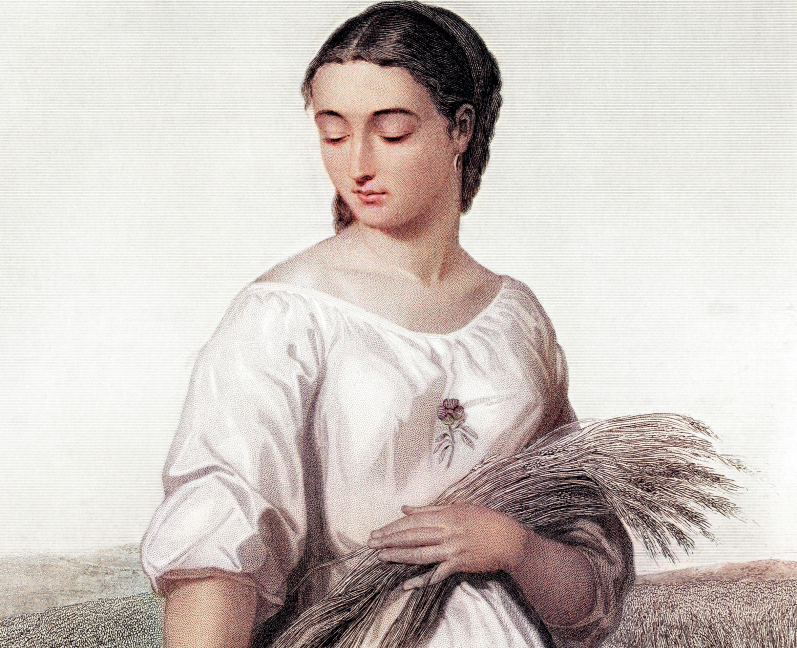
Ruth, the ‘archetypal convert’
Alamy
The dramatic increase in attacks on Jewish people since the war in Gaza has coincided with a surprising surge in conversions to Judaism
Something strange is going on in Judaism … But first, some background. The Bible presents Abraham as the first religious missionary: according to Genesis 12:5, when God told him to pack his bags and leave Haran, he took with him “the souls they had gotten in Haran”. Although this could refer to the servants he had acquired, Jewish tradition has viewed the verse as referring to people whom he had converted to his new faith. Much of the rest of the Bible is peppered with attempts to wean Abraham’s descendants away from idolatry. This was partly due to abhorrence at the practices that often accompanied it, such as child sacrifices and sacred prostitutes, but also to a conviction that monotheism was the only truth.
This is highlighted by the fact that the greatest heroine in the Hebrew Bible in Jewish eyes is not Abraham’s wife Sarah or Moses’ sister Miriam, who led the Israelite women in song, but Ruth. It is she, a Moabite, who uttered the immortal words, “Your people shall be my people and your God my God” (Ruth 1:16) and she has been held up ever since as the archetypal convert.
Judaism’s missionary zeal continued until New Testament times, with Matthew pointing out that Pharisees will “cross land and sea just to make a single convert” (23:15). It was only when Constantine made conversion to Judaism illegal, punishable by death, that missionary activity ceased. This was reinforced theologically by the rabbis ruling that Christianity counted as ethical monotheism (as they did similarly with Islam later) and so there was no need to convert their adherents. This tolerant attitude to Christians and Muslims was extended to people of all other faiths as far back as the fifth century, when the rabbis declared in the Talmud (the rabbinic commentary on the Bible) that “the righteous of all nations have a place in the world to come”.
In other words, the rabbis taught, there are many ways to God, and it does not matter which one you take so long as you arrive there. This attitude has been maintained till today, although we do accept those who seek to become Jewish of their own accord. But given the fact that Jews have often been repressed or persecuted there has been little incentive to convert to Judaism, save for the few who marry someone Jewish and want to unify the household religiously.
Following the Holocaust there was a lull in antisemitism for many decades, but levels of abuse and attack on Jewish people have risen greatly in recent years and increased dramatically since the Gaza War. It is astonishing, therefore, that there has been a surge in conversions to Judaism lately: 78 adults converted to Judaism in the UK in 2020, whereas in 2024 it was 134, an increase of over 50 per cent. We are not seeking conversions. Why are these people putting themselves on the front line?
The answer seems to lie in the coincidence of three entirely separate causes. One is that religious education in schools went multi faith some decades ago, and children who might never have been introduced to Judaism in the past now visit synagogues. Those who had a positive encounter, and then in later life felt the need for a faith, are now turning to it. Covid is another factor. Among the many who yearned for some spiritual help in lock down and investigated different faiths online, some felt that Judaism appealed to them. Equally influential has been the sharp rise in people taking DNA tests. Most are taken for fun or to search for roots, but many have shown up a previously unknown Jewish great- (or great-great-) grandparent. For some, this is just an historical detail, but for others it has been a previously unknown heritage to be explored and adopted.
These three factors have boosted the more traditional routes to Judaism (as they have to other religions): the influence of friends, the reading of sacred books, marrying into the faith, the active search for religious options, and an unexpected religious experience. Some of these paths are regarded as more pious than others, but I would dispute that, for it does not matter how one is introduced to a faith, it is the reaction one has at that point that counts: being nonplussed by it or feeling embraced by it.
Whatever faith to which people convert, the key question is whether their new allegiance is maintained or if they drop out. Three factors can affect a convert’s long-term commitment to their new faith community. The first is that although there is often a sense of elation at the time of converting, there can also be a sense of loss when the conversion class or period of instruction or initiation ends, and the close relationships one has built up with other converts or with the teacher drop away. Second is the reaction of relatives: will they welcome the fact that the person has found a spiritual niche, or will they see it as a betrayal of the tradition in which they were brought up, and as a rejection of their family? A hostile response to conversion can cause much heartache and even second thoughts.
Much also depends on the reception that the convert finds in the synagogue they join. In theory, existing members should be delighted to see a new face – what a compli ment to their faith! – but in practice this is not always the case. Jews can sometimes be suspicious of someone not born Jewish, who, in a faith so full of rituals and ceremonies, will not have an instinctive knowledge of what should be done, when and how. In some cases, those who are slow to embrace the newcomer feel threatened by the convert’s enthusiasm, while they may also resent the fact the convert might know more about the faith than they do, having learnt about it as mature adults and not just imbibed it as children.
What about the reverse scenario, those born Jewish who abandon Judaism? A large percentage of Jews who have lost their faith still identify as Jewish, for it is as much a culture as it is a religion. Synagogues are used to having members who pay an annual subscription even though they are atheists and agnostics – they are Jewish atheists and Jewish agnostics! Those Jews who seek an alternative route to God occasionally convert to Christianity, but the vast majority go to Buddhism. They feel it offers the inner light they reckon Judaism lacks. It has become such a well-trodden path that they are known by the affectionate generic name they have given themselves – the JuBu’s, or JewBu’s. Although I am sorry that Judaism did not provide the spiritual answers they needed, in keeping with Jewish ethos I do not feel possessive. I am glad that they have found a religious home somewhere – the ideal for all of us.
Rabbi Dr Jonathan Romain is convenor of the Rabbinic Court of Great Britain, which supervises conversions nationally.
Login
Please login to comment
0 Comments
Oldest

Help us keep The Tablet’s voice independent, clear and far-reaching.
Founded in 1840, The Tablet is the leading independent English-language Catholic weekly, celebrated for great writing, astute analysis, brilliant arts and books reviews and trustworthy reporting from correspondents in Britain, Ireland, Rome and across the world.
Independent, high-quality journalism is at the heart of what we do. The Tablet does not have deep pockets and we are not funded by rich donors. If you appreciate our work please consider supporting The Tablet’s Development Fund. It only takes a moment and you can cancel at any time.
- Support with £5 per month
- Support with £10 per month
- Support with other amount.

MOST READ ARTICLES
-
1
Battling confession fatigue
-
2
Nicaraguan bishops visit Rome as Ortega regime tightens grip
-
3
Would the Church miss us?
-
4
Vatican confirms Pope’s Latin America travel plans despite operation
-
5
Restless statelessness
-
6
Church from the 1950s receives £1 million government grant for new roof
FROM THE EDITOR'S DESK


