College of Cardinals – England’s own


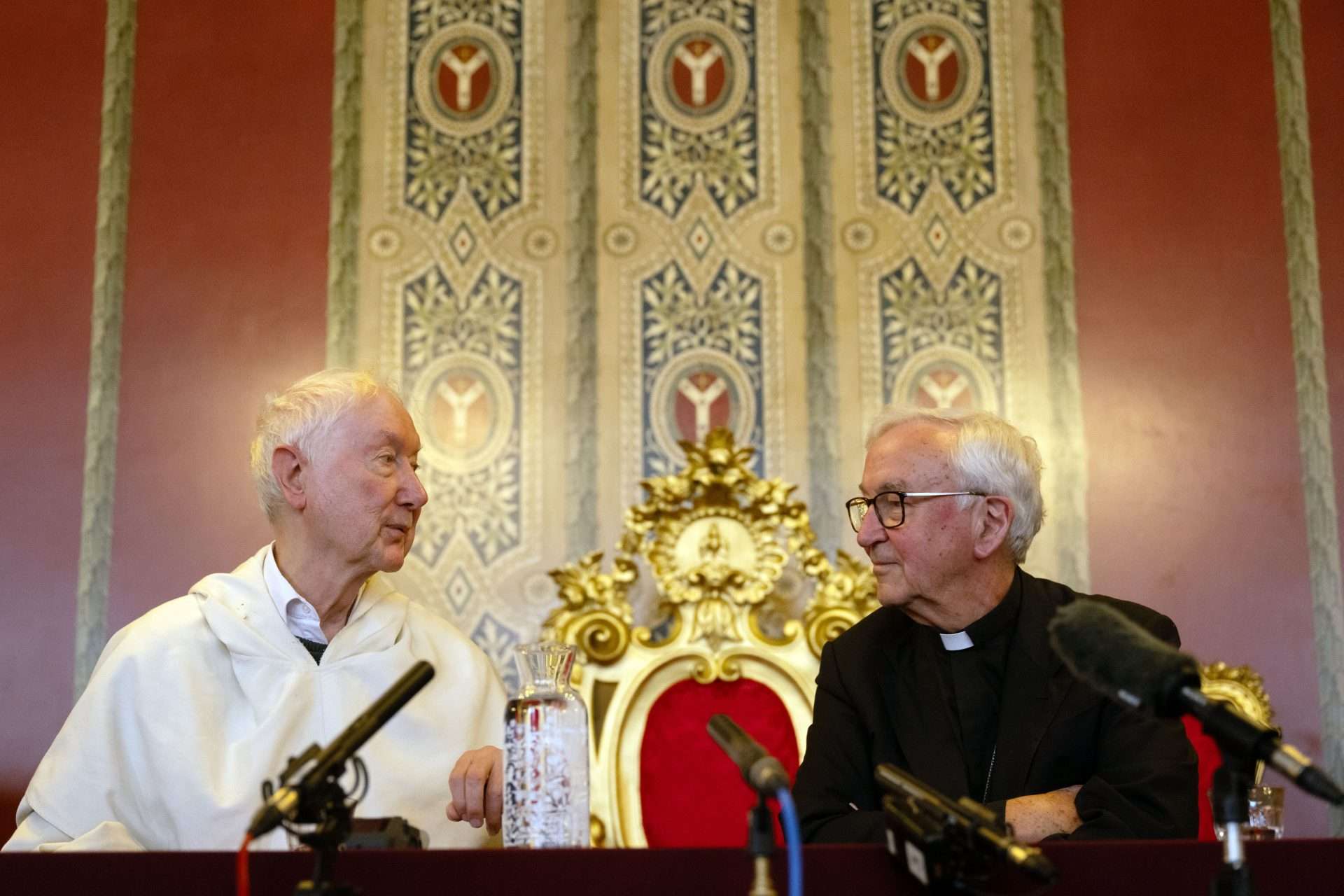
Cardinal Timothy Radcliffe OP and Cardinal Vincent Nichols speaking in London after the death of Pope Francis.
Catholic Church in England and Wales / Mazur
Few conclaves in history have featured so large an English presence as this year’s. What will they bring to the deliberations, and to the vote for the next pope?
Vincent Nichols, 79, the Archbishop of Westminster since 2009 and a cardinal since 2014, has led the Church in England and Wales through a particularly rocky period. A forceful president of the bishops’ conference and a capable and sometimes combative media performer, he has maintained strong relationships with the Church of England and other faith groups, in particular Islam.
Views differ over his effectiveness as a political operator and as the administrator of a large archdiocese. In its final report, the Independent Inquiry into Child Sexual Abuse (IICSA) was critical of his leadership, suggesting that at times he put the protection of the Church’s reputation before compassion towards abuse victims. As president of the Santa Marta Group, Nichols created partnerships between women Religious, priests and bishops, police chiefs and government officials from over 30 countries around the world that have pioneered new approaches to the eradication of human trafficking and modern slavery.
Born in Crosby, Liverpool, on 8 November 1945, the second child in a family of three boys, both his parents were teachers in Catholic schools. Nichols – still widely known as “Vin” – was educated at St Mary’s College, Crosby, a grammar school run by the Christian Brothers. He studied for the priesthood at the English College in Rome from 1963 to 1970, where he played trumpet in a jazz group and impressed at rugby, football and cricket. After ordination in 1969 he studied for an MA at Manchester University between 1970 and 1971. His thesis on St John Fisher was published many years later; he acknowledged in a new introduction that it was written at speed and had been overtaken by later scholarship, it was nevertheless admired by Eamon Duffy.
In 1971 Fr Nichols was appointed assistant priest and school chaplain in Wigan. In 1984, at the instigation of the Archbishop of Liverpool, Derek Worlock, whose protégé he had become, he was appointed general secretary of the Bishops’ Conference of England and Wales. Here he became indispensable to the Archbishop of Westminster, Cardinal Basil Hume. As Hume’s right-hand man and fixer, his fluency in Italian was especially useful and he would regularly accompany the cardinal to Rome. At the age of 46, in 1992, he was appointed a Westminster auxiliary. Considered among the favourites to succeed Hume in Westminster – and almost certainly Hume’s own preferred choice – instead he became Archbishop of Birmingham in 2000, where he served for nine years, burnishing his reputation as a champion of the poor and vulnerable, and someone combining competence, energy, articulacy and middle-of-the-road theology and spirituality.
Nichols’ willingness to defend the Church’s interests in the public square with stubborn determination and an occasional brusqueness has, inevitably, been attributed to his Merseyside roots. There have always been grumbles that Nichols was “ambitious”. When Clifford Longley asked him about this, Nichols explained that he could have spent the rest of his life as a Liverpool parish priest, “moaning like the rest of them about the people in London who were held to blame for Liverpool’s problems, both spiritual and economic. Or I could go south and see if there was something I could do about it, on their behalf.”
Nichols loves reading and – a passionate Liverpool supporter – watching football. Sometimes considered insensitive to those who do not share his ability to master a brief and come to a quick decision, he himself has acknowledged that he sometimes lost sight of the needs of survivors of abuse. Known to prefer a quiet evening at home to dining out, he is kind, good company, a more than decent cook, a generous host, and a man of prayer.
Arthur Roche, 75, was one of Pope Francis’ most trusted collaborators, and the highest-ranking English-born priest to work in the Curia since Cardinal Rafael Merry del Val served as Secretary of State from 1903 to 2014.
Before the death of Francis, as prefect of the Dicastery for Divine Worship and the Discipline of the Sacraments he was at the centre of the so-called “liturgy wars”. He is a reviled figure for many traditionalists, who see him as the brutal enforcer of restrictions on the use of the pre-Vatican Council rite of the Mass. He was created a cardinal in 2022.
Roche’s great-grandfather came from Ireland to Yorkshire to work on the railways, while his mother’s family came from an English Catholic and Protestant background. He was born on 6 March 1950 in Batley Carr, Yorkshire, the youngest child of the late Arthur and Frances Roche; his elder brother, Brian died at an early age, killed while on military service in the Far East, while his married sister, Margaret, lives in West Yorkshire. He attended St Joseph’s Primary School, Batley Carr, St John Fisher High School, Dewsbury and Christleton Hall, near Chester.
One of his childhood memories is of his maternal grandfather, who was sick in bed at the time, being received into the Church by John Heenan, who was then Bishop of Leeds and would later be Cardinal Archbishop of Westminster. At the age of 19, Roche entered the seminary in Valladolid, Spain. After ordination in 1975 he served as curate in the parish of Holy Rood, Barnsley; in 1978 he was appointed secretary to Bishop Gordon Wheeler, and in 1982 was responsible for organising the visit to York racecourse that was one of the highlights of John Paul II’s visit to Britain. He served in Leeds Cathedral, then as parish priest of St Wilfrid’s, Leeds before becoming spiritual director of the English College, Rome, which he has described as one of the most “privileged” roles he’s held. In 1996, Cardinal Basil Hume appointed him general secretary of the Bishops’ Conference of England and Wales. He was appointed auxiliary bishop in Westminster in 2001 and became Bishop of Leeds in 2004.
In July 2002, Roche had been elected chairman of the International Commission on English in the Liturgy, where he oversaw the translation of the Roman Missal into English. There remains intense debate over the quality of the texts introduced in September 2011. The following year he was asked by Benedict XVI to serve as secretary, or number two, in the congregation, now dicastery, for Divine Worship and the Discipline of the Sacraments. In May 2021 he succeeded Cardinal Robert Sarah as its prefect; two months later, Pope Francis released the motu proprio Traditionis Custodes, tightening the restrictions on the celebration of the pre-conciliar liturgy, the “Tridentine Mass”. Pope Francis considered that, after 60 years, the time had come for Latin Catholics to be unified around one Roman rite, and for the various alternatives to be gradually but firmly discontinued.
Roche was given the task of overseeing the implementation of Traditionis Custodes across the Church, which has required gentle cajoling, patient listening and sometimes the firm turning of some of the screws at his disposal. Christopher Lamb described the Yorkshireman “as the opening batsman of the liturgy team: able to defend his wicket in the face of a furious fast-bowling attack, while steadily accumulating runs and striking the odd boundary.”
“I wasn’t expecting to be appointed prefect,” Roche told Lamb in an interview for The Tablet in February 2022, but, “as a priest, you put your life into somebody else’s hands.” He said he enjoyed working for Francis, whom he described as “a great inspiration” and “both the Holy Father and a brother bishop”. Roche has always stressed that the Pope’s intention was to “bring unity” to the Church, and to end the suggestion that there are two different Churches with two different liturgies. He dismissed the idea that the next pope would – or could – take the Church in a different direction. “To stand against Peter is an astonishing act, full of hubris,” he wrote in a follow-up email after the interview with The Tablet. The belief “that things will change under a new pontificate is not only misplaced but reveals an enormous ignorance about the mandate given to the entire Church by the Second Vatican Council”.
Roche enjoys what are known in Yorkshire as “meals out”; his interests also include gardening, walking, travel and painting. In 2024, Bishop Robert Barron’s Word on Fire ministry published a book based on Roche’s retreat talks, The Gardens of God, in which he wrote, “We should really try to face God rather than succumb to self-reflection. In reality, it is more important to think ‘Whose am I?’ than ‘Who am I?’”
Timothy Radclife, 79, is probably the most influential English cleric of his generation. Master of the Dominican Order from 1992 to 2001 (the only member of the English province to have held the post since the order’s foundation in 1216), he is the author of several bestselling books, and one of the most popular preachers across the globe, reminding listeners inside and outside the Church that Catholicism is not just a compendium of doctrines and a moral code designed to keep us in order, but a vibrant, joyful way of life. He was invited by Pope Francis to lead three-day preparatory retreats for participants in the two sessions of the Synod on Synodality in Rome in 2023 and 2024 and in December last year he was created a cardinal, though the Pope agreed to his request that he be dispensed from having to wear a cardinal’s customary outfit.
The fourth of six children, he was born on 22 August 1945 into an English recusant family. A powerful influence was a great-uncle, Dom John Lane Fox OSB, a monk of Fort Augustus, and a chaplain in the Irish Guards in the First World War who was awarded an MC. “Every night he went into no man’s land to retrieve the wounded, or to bury the dead. He lost an eye, and the fingers of one hand, but he emerged joyful and free. His joy came from his faith. I came to see that it overflowed from his life with God,” Radcliffe has written. His parents were devout, but “never pious”, and the Radcliffe children – five boys and a girl – were brought up in an atmosphere of good humour, which Timothy carried into priestly life: “A really good confession,” he once wrote, “usually ends in laughter.”
After prep school at Worth Abbey School in Sussex, he moved on to Downside. He studied theology at St John’s College, Oxford, and in Paris under Yves Congar. He joined the Dominican Order in 1965. After ordination in 1971 he served as chaplain to the University of London and Imperial College before teaching at the order’s Blackfriars base in Oxford. A Fellow then Prior of Blackfriars, he was elected Prior Provincial of England in 1988. In 1992, he was elected Master of the Dominican Order. Travelling frenetically to look after his brethren in 107 countries, he realised he could only make proper time for prayer by getting up well before daybreak – a discipline he still observes. In 1999 he was among those considered for the succession to Basil Hume as Archbishop of Westminster, but his fearless defence of his brother Dominicans for various reputed contraventions of good order – disciplinary and doctrinal – had earned him enemies during his years in Rome.
After completing his term as Master, Radcliffe took a sabbatical year, before returning to live at Blackfriars. A voracious reader, his sermons are threaded through with magpie treasures from numerous other saints – Teresa of Avila, Catherine of Siena, John Henry Newman – and from popular culture. His books became bestsellers, particularly I Call You Friends, Seven Last Words and What Is the Point of Being a Christian?, which won the 2007 Michael Ramsey Prize for theological writing. He told Maggie Fergusson in an interview for The Tablet last year, “If only we could see that all commandments are invitations to friendship, in some way or other. They’re not saying, ‘This is what you’re allowed to do’, or ‘This is what you’re forbidden to do’. They’re saying, ‘If you want to grow in love, try this.’”
Radcliffe has described the scandal of the sexual abuse of children as “the worse crisis for Christianity since the Reformation”. He believes it has its roots in clerical control and self-importance. He told Fergusson, “I think that much abusive sex is about power: power gone wrong. So freeing the Church from abuse is about learning how to live as priests and Religious who have no need to manipulate people, who have no need to have power.” The Church, he said, “must do more than simply ensure that people are safe. We have to be touched by the pain of the abused. They have to become the centre. It’s the only way.”
In a piece in L’Osservatore Romano last year he looked back more than 30 years on being part of a team of priests providing Masses for gay and lesbian Catholics in London. “Gay people do not need a special liturgy,” he writes, “they need a community in which they are sure of a warm welcome.” His passionate advocacy for the inclusion of LGBT+ Catholics in the Church has marked him out for the familiar attack that such language “sows confusion”, coming not only from familiar quarters in the Church, especially in the US, but from voices closer to home.
In 2021, Radcliffe was diagnosed with cancer of the jaw, and underwent a 17-hour operation. Although his cancer is currently inactive, he has described it as like “living with a hand grenade in his mouth”. “Illness chipped away at the identity I had created and opened the door to a deeper one that was a gift to be discovered,” he wrote in The Tablet in January 2022. His consultant told him that the survival rate for his operation was 60 per cent after five years. “I might live for much longer or less, but surely the summons is to live now. There is no other preparation for eternal life. Who are the people whose forgiveness I must seek? Who are those whom I love but have never told them? What are the acts of kindness that I must do today? There is no time to lose.”
Michael Louis Fitzgerald, 87, one of the Catholic Church’s leading authorities on Islam and Christian-Muslim relations, is over the age to be able to join the electors in the Sistine Chapel on 7 May but he has been taking a full part in the general congregations. “The point of these meetings of all the cardinals is to see what sort of leader the Church needs at this moment,” he told Ruth Gledhill in February, shortly before Pope Francis became gravely ill. “I would think that people of my age have some reflections on the Church worth sharing.”
A priest of the Missionaries of Africa (the White Fathers) who rose through the ranks of the Vatican hierarchy to become president of the Pontifical Council for Interreligious Dialogue (PCID) before being appointed apostolic nuncio to Egypt and delegate to the Arab League, Fitzgerald is sharply critical of Israel’s actions in Gaza. He is an enthusiast for synodality, and sympathetic to the case for women deacons. He told Ruth Gledhill that he believed Francis’ successor “should be someone who will continue in the mould of Pope Francis, aligned with the direction that he has been moving the Church, and paying attention to certain dimensions of the Church which had tended to be forgotten”. Francis had tried to “bring the Second Vatican Council to fulfilment – but there is much more to be done”.
Born in Walsall in August 1937, Fitzgerald was one of four children – two girls and two boys – of parents who had moved to the West Midlands from County Cork. He entered the White Fathers’ junior seminary at the age of 13. After making his novitiate in the Netherlands, he pursued his theological studies from 1957 to 1961 in the seminary in Carthage, Tunisia, where his lifelong interest in Islam and affection for the Muslim world began. After ordination in February 1961, he studied theology at the Pontifical Gregorian University in Rome during the Second Vatican Council. After completing his doctorate in 1965, the year the Council finished, he returned to London to study Arabic at the School of Oriental and African Studies. After just a year teaching at the Institute of Arabic and Islamic Studies (PISAI) in Rome, he was appointed lecturer in religious studies at the University of Makerere in Kampala, Uganda, before returning to PISAI, serving from 1972 to 1978 as its director. After two years serving in a parish in Sudan, he had a six-year stint as a member of the General Council of the White Fathers in Rome.
In 1987, Fitzgerald was appointed Secretary of the Secretariat for non-Christians, which became the Pontifical Council for Interreligious Dialogue a year later. He became a bishop in 1991 and when, in 2002, John Paul II named him as successor to Cardinal Francis Arinze as president, he became an archbishop. He and the Polish Pope worked well together and under his leadership of the PCID relations between the Church and leaders across the Muslim world were transformed. In February 2006, less than a year after Benedict XVI succeeded John Paul, he was appointed as apostolic nuncio in Egypt and delegate to the League of Arab States. The move was described by some at the time as a demotion or an exile, but it came to be seen as a return to the front line of Christian-Muslim relations.
On his retirement in 2012, Fitzgerald settled in the community of the Missionaries of Africa at St Anne’s in Jerusalem, before returning to England in December 2018, more than 50 years after leaving it, to live in the parish of St Vincent de Paul, Liverpool. He was created cardinal by Pope Francis in 2019, and now lives in the community’s base in Ealing, west London.
Humble, kind, informal, with a wry sense of humour, Michael Fitzgerald is not someone it would be easy to make an enemy of for long. He was willing to suggest to The Tablet the person he thought the cardinals should consider as a successor to Francis: Luis Antonio Tagle of Manila. “He’s a good theologian, he has pastoral gifts and wide administrative experience.”
Cardinals Farrell and Radcliffe are bookies’ favourites
Who will be the next pope? We profile the conclave – from Arborelius to Zuppi
Login
Please login to comment
0 Comments
Oldest

Help us keep The Tablet’s voice independent, clear and far-reaching.
Founded in 1840, The Tablet is the leading independent English-language Catholic weekly, celebrated for great writing, astute analysis, brilliant arts and books reviews and trustworthy reporting from correspondents in Britain, Ireland, Rome and across the world.
Independent, high-quality journalism is at the heart of what we do. The Tablet does not have deep pockets and we are not funded by rich donors. If you appreciate our work please consider supporting The Tablet’s Development Fund. It only takes a moment and you can cancel at any time.
- Support with £5 per month
- Support with £10 per month
- Support with other amount.



