When water is everywhere – but there really is not a drop to drink


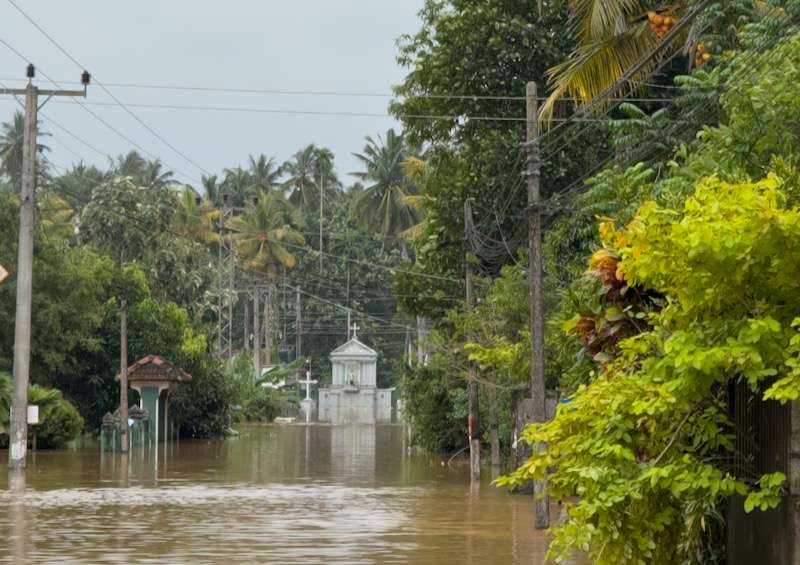
‘There’s everything in the psalms: raging torrents and still waters. Water for the psalmist is never neutral; it is often a source of danger, though always necessary to life as well. Too much water is as dangerous as too little.’ Photograph shows a Catholic church at the end of a flooded street outside the UK after heavy rain last year.
Ruth Gledhill
In the run-up to Christmas, like regrettably many people even in the UK, we had problems with our water supply. We didn’t have the appalling floods that several towns have had, with rivers bursting their banks and heading up the high street. That must be so much worse, with all the cleaning up to be done after. Our water supply just stopped, and we simply had no water coming out of any tap, for days on end.
And there was no warning. We’ve lived in countries where the water supply is regularly interrupted, and we can cope with that; you always fill the kettle before you go to bed, and if you expect a longer shut-off, you also fill the bath, to use for flushing loos and washing. It’s just one of those things about living in some exotic places. But this time and here at home, there was no information to warn us that the water supply was about to stop. When we went to bed, everything was normal; when we got up, the taps didn’t work.
To begin with, you expect it not to last for very long. After all, people need water all the time, so being without it is an emergency, and the water company (you think) will be doing everything possible to get it back on. You check the bottled water that you stashed away the last time there was a relatively brief interruption to the supply. If it’s out-of-date, you can use it to fill the loo cisterns, which feels incredibly extravagant, but makes sense. You remain calm and terribly British. In fact the interruption to our supply lasted for nearly two weeks.
Everything became very complicated, especially all the things you do without thinking. We had rain water, indeed for the first week or so of empty taps, it never seemed to stop raining, so we set up ways of collecting it, and then I boiled ten litres or so of it first thing every morning. We had my biggest saucepan permanently on the hob acting as a temporary makeshift copper. Raw rain water was fine for flushing the loos and washing people or vegetables; we cooked with and drank only bottled, and we could fill hot water bottles with boiled rain water. Then we got a supply back, after about a week or so, only it had to be boiled before you could drink it or even wash things with it. I put big labels on every container, and we stuck to drinking bottled while we had some, but you needed to think every time about which water you were using, and how much was left. You could rinse fruit and vegetables, for example, in the water that came out of the hot water bottles, because it was boiled rain water. But it was all very complicated, time-consuming, and made you realise how much we take for granted, and indeed how much water we simply waste. Probably very good for us, but it was a particularly busy time to be trying to organise it!
But the difficulties of our water situation made us realise how lucky we are usually. We live in a town, so like most British people nowadays, we don’t have easy access to a lake or river. Humans have always settled near sources of water, because the need for water is so fundamental, but once the town reaches a critical mass, a system to deliver water to houses not actually on the riverbank is a priority, something to be very grateful for where it exists, as otherwise water has to be fetched, and it’s usually women doing the fetching. After a few days, our water company set up collection points for bottled water. We could drive to them; some people couldn’t. Some people in particularly difficult circumstances had water delivered. Water is amazingly heavy, even in small quantities, so many people were glad of their neighbours’ help, even just to carry a couple of bottles up the stairs. People used prams, pushchairs and little carts to fetch it home. I collected one batch of 6×2 litres by hand, with my trusty shopping trolley, and was very grateful that my husband could drive to fetch the next lot when needed.
It was heartwarming to see the goodwill and kindness of people reactivated in a way I haven’t seen since Covid, with everyone chatting in the street about their circumstances and what had been heard most recently on the grapevine. People helped each other, fetched water for neighbours, and pooled the scanty information. There was a topic for general discussion which wasn’t the weather, but everyone had something to contribute, and even the shy British are happy to talk when there’s a general topic.
It was uncanny to realise how many water references there seemed to be in the readings for Mass during Advent. I imagine it’s actually just the consequence of being sensitised to them, but when you’re doling out mean jugfuls of boiled rainwater to the family for it to wash in, you really respond to the visions in Isaiah of abundant available water (Isaiah Chapter 41, source of some weekday Advent First Readings, has rivers, fountains, lakes and watersprings, all supplied by the goodness of God). Yes indeed, the poor and the needy ask for water and there is none; their tongue is parched with thirst (v.17). Similar references come up all the time, and I don’t notice them enough, because we are so lucky usually to have water literally on tap.
The Psalms are packed with water references, and I notice those because I try to reflect them in the settings I compose for any given psalm. Different sources of water are mentioned: springs, lakes, rushing torrents, still waters, wells and pumps, and you can play with all of them in the music. Sometimes different translations give you the excuse to do it in the same psalm : I enjoyed differentiating between the springs of salvation, which just bubble up, and the wells of salvation, which have to be pumped or have the water lifted up out of them. Psalm 46/45 in the Canadian Lectionary has streams, where the US Lectionary has rivers, so the music is different. But there’s everything in the psalms: raging torrents and still waters. Water for the psalmist is never neutral; it is often a source of danger, though always necessary to life as well. Too much water is as dangerous as too little, but that was not our concern to begin with when our taps ran dry, we were just desperate for a supply, and it was difficult not to drop into biblical language, not to make reference to a dry weary land without water (Ps 63/62), living like rebels in a parched land (Ps 68/67). And of course in the New Testament, there are all the references where Jesus talks about supplying water and people never feeling thirsty again. I now feel that most of the time we don’t realise how powerful an image that is, in a place where water is hard to come by.
Just before Christmas, we got our supply back, after a period of needing to boil whatever came out of the taps to make it safe. Now we don’t even need to boil it, but I am thinking more carefully than I usually do about Mary in that stable or cave in Bethlehem. There wouldn’t have been water on tap; at best there would have been big vessels full of water for the animals, but that water would have been very cold, and possibly not very clean. Obviously this is true for many, even most, people in the world today, but it makes you realise why the places with natural hot springs, like Bath, must have seemed so magical and even holy.
As always, the more I think about the mother of God, the more I am struck by how brave and how impressive she is. But you have to read it all between the lines, because she is only there in the narrative background. This year is the year of Matthew in the Lectionary; in his Gospel, Mary does not even speak. But when you consider her circumstances, far from home and family, in labour with a mysterious baby, nowhere to settle comfortably or sleep in peace, St Teresa of Avila’s comment about the drawback of being God’s friend seems to me to be strongly applicable.
There’s a few more details about Mary in Luke; Mark refers to her only as ‘his mother’, and not often. It is clear, though, that she was around until the end of Jesus’ life (and after), and I would respectfully suggest that her lack of the limelight in the four gospels, all written a long time after the events by four men, perhaps reflects the status of women in that patriarchal society rather than their importance or relevance, and that this might be true of some other women as well, whom Mark mentions in passing (Chapter 15:40) as having been around and helping, during Jesus’ public career, and then later, in the early Church. Like our water supply, they were taken for granted; but maybe people would have noticed if they hadn’t been there, doing whatever they could to help.
Kate Keefe composes musical settings for the Mass and writes about the psalms. You can follow her on Facebook, Twitter, LinkedIn and Instagram.
Login
Please login to comment
0 Comments
Oldest

Help us keep The Tablet’s voice independent, clear and far-reaching.
Founded in 1840, The Tablet is the leading independent English-language Catholic weekly, celebrated for great writing, astute analysis, brilliant arts and books reviews and trustworthy reporting from correspondents in Britain, Ireland, Rome and across the world.
Independent, high-quality journalism is at the heart of what we do. The Tablet does not have deep pockets and we are not funded by rich donors. If you appreciate our work please consider supporting The Tablet’s Development Fund. It only takes a moment and you can cancel at any time.
- Support with £5 per month
- Support with £10 per month
- Support with other amount.

MOST READ ARTICLES
-
1
Pope Leo diagnosed with lung cancer after operation
-
2
The Tablet Lecture 2026: Keeping the dream of peace alive
-
3
Battling confession fatigue
-
4
Vatican confirms Pope’s Latin America travel plans despite operation
-
5
Archbishop bars Catholics from firing squad for US military execution
-
6
Under endless skies
FROM THE EDITOR'S DESK


