We need to give young people more than anxiety about the climate crisis


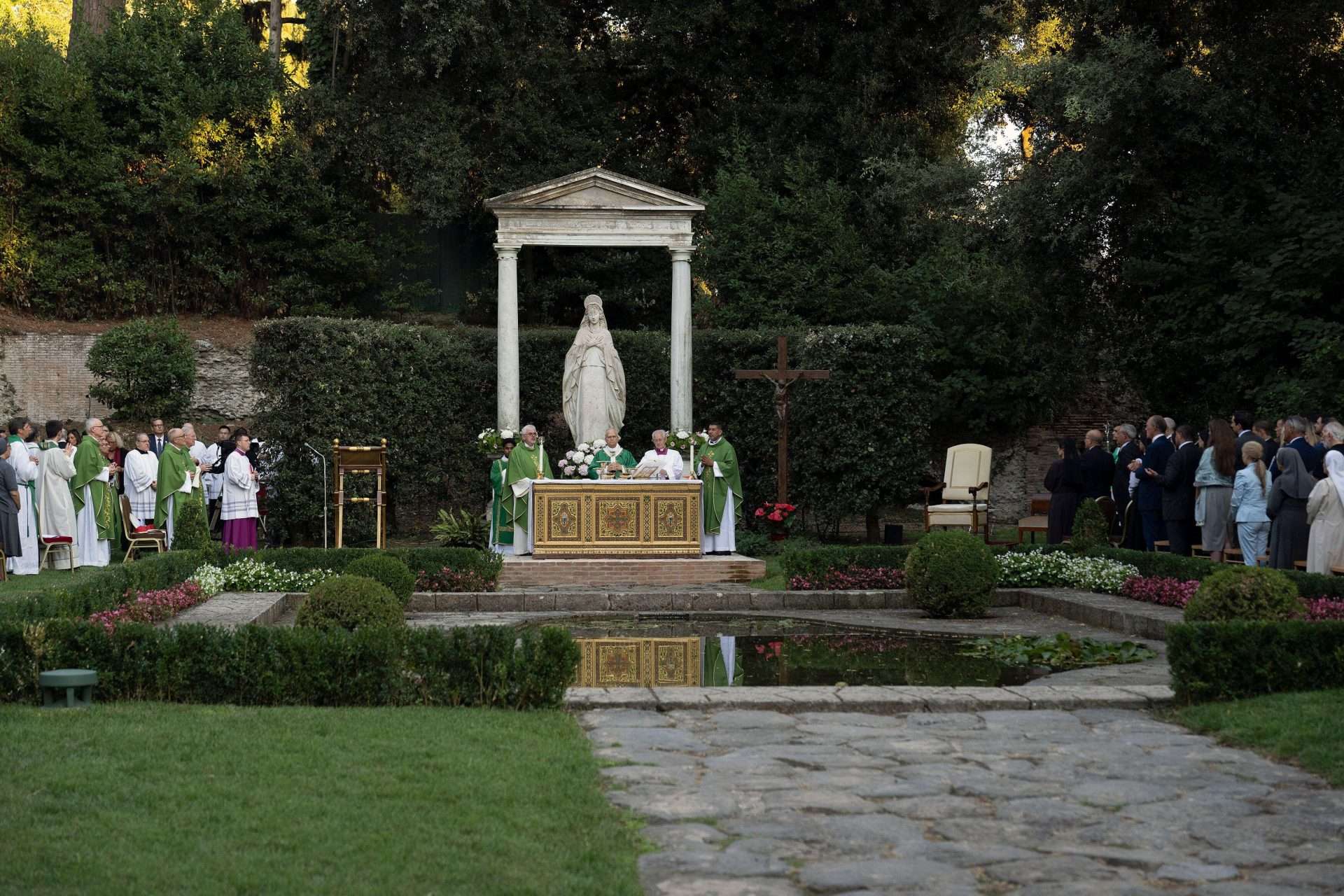
Pope Leo XIV celebrates Holy Mass for Care of Creation at the Laudato Si Village in the Apostolic Gardens in Castel Gandolfo, near Rome, Italy on September 1, 2026. The Pope celebrates the mass marking the annual World Day of Prayer for the Care of Creati
Alamy
As Catholics around the world mark the Season of Creation, schools have an important opportunity to consider how we talk to young people about the ecological crisis.
The need for this conversation is clear. A recent survey found that 87 per cent of students across schools in England are worried about the future because of climate change.
This statistic can be read as a challenge for educators. How can teachers honestly discuss the disastrous consequences of the ecological crisis in their classrooms, without, at the same time, exacerbating students’ climate anxiety?
The answer is not to shield young people from the reality of the crisis, nor the difficult emotions it provokes. Instead, we need to help pupils understand that while they have a responsibility to care for our common home, they are not responsible for solving the ecological crisis alone.
This is one of the insights we have explored through the Laudato Si’ Champions Project’s at St Mary’s University, which has found, that the Catholic Church’s teaching on the environment can be a useful resource for helping educators address the above challenge.
In his encyclical Laudato Si’, Pope Francis discusses the idea of“differentiated responsibilities”, which can be summarised as follows: while we all share the duty to care for creation, there is a difference between distinct actors’ obligations. For example, when it comes to addressing the ecological crisis, individuals don’t have the same responsibilities as communities, and the expectations placed on developing countries should not be the same as those placed on developed countries.
Focus groups with students in Catholic schools in England have revealed that the idea of “differentiated responsibilities” helped students navigate their climate worry. Pupils expected different things of themselves, their teachers, schools, local churches, and governments. Consequently, for young people, to successfully address climate change, every actor must do their distinctpart.
This mattered for two reasons.
First, it helped students avoid feeling overwhelmed by the scale of the environmental crisis. They understood that they don’t have to do everything; some steps to mitigate the adverse effects of climate change had to be taken by schools or governments.
Second, it made their own environmental responsibilities achievable. Students frequently discussed clearing up litter in school. Against the background of a global issue, this might seem like a small action, but it had a visible impact on pupils’ immediate environment. Because they didn’t have to do everything, students felt that their actions matter.
This is not to say that young people who participated in the focus groups didn’t experience negative emotions about the ecological crisis. However, their climate worry was less a result of their own powerlessness, and more a response to the failure of other actors – including teachers and peers – to meet their respective environmental obligations. In the words of one student: “I feel quite frustrated that most people know what’s going on with the environment, but they still don’t bother to actually help it… I feel quite mad that they know what’s going to happen, but they’re just sitting around all day.”
That frustration is important. As multiple studies have shown, acknowledging students’ negative emotions plays an important role in environmental education, because it can encourage hopeful attitudes and pro-environmental actions. As Pope Francis remarked, “Young people demand change. They wonder how anyone can claim to be building a better future without thinking of the environmental crisis and the sufferings of the excluded.”
This is where Catholic education has something distinctive to offer.
Laudato Si’ places care for creation within a much wider understanding of our relationship with one another and with the world around us. Ecological questions are not simply questions of science or individual behaviour. They are also questions of justice, responsibility, community and how we choose to live together.
The Season of Creation, currently under way, offers a great opportunity to enable young people to explore these questions and to express their climate worry.
However, transforming students’ anxiety into agency in a classroom is not always easy. Busy school life and the attainment pressures often make it difficult to try out new approaches to climate-change education.
This was one of the reasons we developed the Laudato Si’ Champions toolkit: to make it easier for Catholic educators to bring these ideas into the classroom.
The free toolkit includes six ready-made sessions on Catholicism and ecology. Piloted with 225 students in the Diocese of Salford, the toolkit is now being used by almost 300 organisations across 37 countries.
Pope Leo XIV described education as “an act of hope and a passion” which “manifests the promise we see in the future of humanity.” The response shown to the toolkit has demonstrated that there is an appetite for resources that helps educators move beyond simply telling young people that the ecological crisis is serious. We want to help students understand what Catholic teaching says about our relationship with creation, what responsibilities they have, and how they can make a difference: to encourage hope for the future among students.
The Season of Creation offers a natural moment to begin that conversation, but should not end when the season does.
If we want young people to care for our common home, we need to give them more than reasons to worry about its future. We need to give them knowledge to understand the crisis, the hope to believe that change is possible, and the confidence to recognise the part they can play.
So, how can we give students more than anxiety for the climate crisis? It is to give them hope and assurance that they do not have to solve everything, but they do have a part to play.
Dr Jakub Kowalewski is Senior Laudato Si’ Research Fellow at St Mary’s University.
Login
Please login to comment
0 Comments
Oldest

Help us keep The Tablet’s voice independent, clear and far-reaching.
Founded in 1840, The Tablet is the leading independent English-language Catholic weekly, celebrated for great writing, astute analysis, brilliant arts and books reviews and trustworthy reporting from correspondents in Britain, Ireland, Rome and across the world.
Independent, high-quality journalism is at the heart of what we do. The Tablet does not have deep pockets and we are not funded by rich donors. If you appreciate our work please consider supporting The Tablet’s Development Fund. It only takes a moment and you can cancel at any time.
- Support with £5 per month
- Support with £10 per month
- Support with other amount.

MOST READ ARTICLES
-
1
German bishops commit to global Synod process despite delay to reforms
-
2
The Tablet poem
-
3
Battling confession fatigue
-
4
Bangladesh Christians ask president to help ease missionary visa restrictions
-
5
Catholic Social Teaching and universities
-
6
Nigerian first lady suffered death threat for practising Christian faith
FROM THE EDITOR'S DESK


