The pope who didn’t really emulate St Francis (at least on one significant matter)


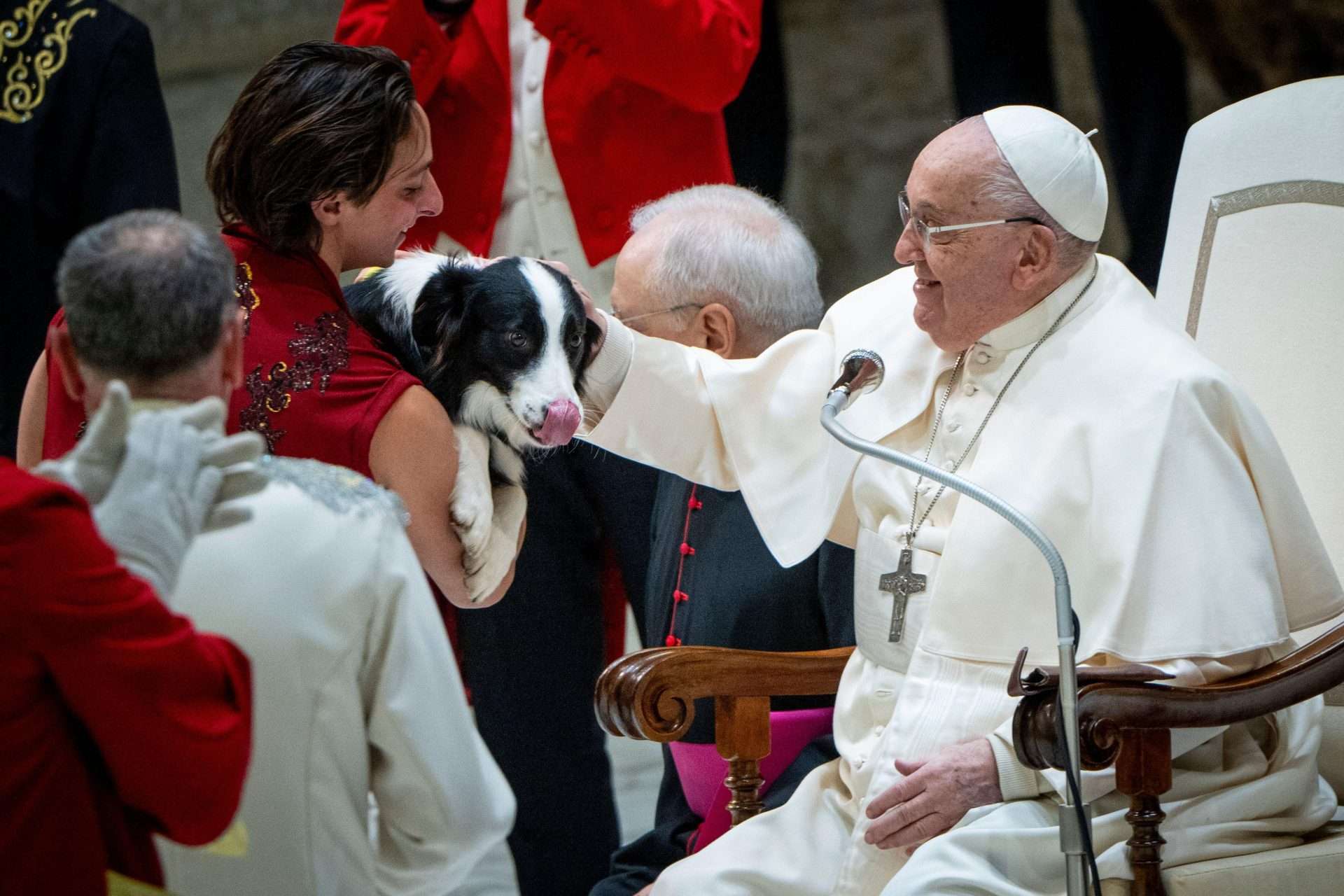
The artists of the “Rony Roller Circus” perform for Pope Francis during his traditional Wednesday General Audience, January 2025
OPA Images Limited/Alamy Live News
In the days since his death, Pope Francis has been rightly praised as a pope of mercy, peace, and ecological awareness. But amid the tributes, one question remains unasked: where, in his vision of creation, were the animals?
I, like so many others, mourn the death of Pope Francis. Francis. The pope who chose the name of il povero as a sign of solidarity with the poor and the voiceless of the world. While the mainstream media, online and in print, secular and sacred, is busy lauding this pope from the “end of the world”, appropriately praising him for his commitment as a peacemaker, a reconciler, a man of mercy and closeness, there has been little comment about his environmental credentials. Yes, he was a simple man, it would seem, who, as we are constantly told in a kind of repetitive journalistic earworm, shunned the glittering and dazzling symbols of the papal office in order to choose a humbler lifestyle, but he was, it appears, also a pope who, like so many before him, overlooked and failed to extend his compassion to many billions of his flock here on earth. He rarely mentioned them, and even more rarely appeared to have a passing regard for them. Of whom can I be speaking? I mean those essential parts of God’s creation with whom we share this fragile planet: non-human animals. Here is a shepherd who called us to live with the smell of the sheep but who, in fact, had little interest in actual sheep, the living, sentient beings who are part of God’s gift to the world.
But what of Laudato Si’, many will cry? The ground-breaking 2015 encyclical was, in its way, revolutionary and challenging, but — be honest now — when did you last hear it mentioned or referenced? When was it last preached in a homily, or included in your parish synodal way conversations? Like so many of the encyclicals, beautiful as it is, it will now be gathering dust on the shelves of the archives in the Vatican, and will, no doubt, be quietly forgotten.
Of course, in truth, that document, as far as animals are concerned, doesn’t go far enough, anyway. It is, as you might expect, a thoroughly anthropocentric reflection. After all, is it not the work of the Church and the gospel to convert human beings? Those, apparently, who are dignified with reason and with eternal souls, in a way that the rest of creation isn’t? Sure. But the planet is patently not ours alone. And, frankly, if animals don’t have souls and humans do, there needs to be more work done in truly seeing how essential animals are to the ecosystem and to authentic human thriving. If we are uniquely the ones with reason and with dominion, surely there is a huge responsibility on us to care for those who do not have such qualities. It would be a dereliction of duty to do otherwise. Animals are not here by accident, I suggest. They are here because God wills that they should be. Their very existence gives him glory (see the CCC). God is the creator of non-human animals too.
Laudato Si’ references some of this in passing but remains heavily weighted towards humanity and human dominion of the planet. Pope Francis, for all his commitment to the little ones, for all his talk of mercy and compassion, of being close to the poor, had very little regard, it would seem, for the animals who are here with us as part of God’s redemptive plan.
St Francis is often considered an animal lover (that apparently oh-so-English virtue!). In fact, as Franciscans will quickly tell us, he is so much more than that — he was a radical theologian who called on human beings to convert the whole earth with the good news, using words if we must. His famous Canticle of the Creatures doesn’t even mention animals, it is true. He is so much more than the cutesy, amiable animal-regarding preacher which the popular view would have. It would seem, however, that, taking the Canticle as something of a template, we can learn that it is the whole of creation that exists for the glory of God and, as such, requires care and attention. Maybe it was the vision of this extraordinary saint that gave the compliers of our liturgies such rich material on which to draw. We hear proclaimed again and again, in Eucharistic Prayer III (one example among many): “You are indeed holy, O Lord, and all you have created rightly gives you praise, for through your son our Lord Jesus Christ, by the power and working of the holy spirit, you give life to all things and make them holy…”.
We cannot get away from the truth that the way Christians (and others) treat animals, called into being by God and filled with the potential for holiness, as commodities and playthings, with little genuine regard for their welfare and their ‘rights’, is destroying our planet. Factory farming is, as is now universally acknowledged, a huge contributor to global warming, and billions of land animals die every year in hideous, blood-soaked slaughterhouses. There’s no kind way of doing an unkind thing — even (or perhaps especially) for Christians. Is an awareness of animals and their true worth something to which the Church should be looking? Christians led the way and did it eventually, for example, for human slavery. What about the holocaust that is the (often unnecessary) mass destruction of animal life across the entire planet?
We cannot have it both ways: on the one hand declaring that we are stewards of creation who care about the environment and, at the same time, continue to cause chaos and discord with the wanton (albeit often hidden) cruelty that we show to animals. Why can I love my dogs, but turn a blind eye to the mindless cruelty inflicted on sheep, cows, pigs, and (especially) chickens?
If only Pope Francis had used his authority and huge charismatic influence to speak up for the voiceless in this context, to call the Church to a more merciful, compassionate, gospel-facing relationship with the environment, to show genuine concern to unseen and unheard majorities which are the animals of this planet… If only…
Now, of course it can never be. God rest his soul — but I won’t hold my breath concerning his successor.
Fr Terry Martin is a priest of the Diocese of Arundel & Brighton. He is the author of “Animals in Heaven? A Catholic Pastoral Response to Questions about Animals”, 2024, Wipf & Stock.
Login
Please login to comment
0 Comments
Oldest

Help us keep The Tablet’s voice independent, clear and far-reaching.
Founded in 1840, The Tablet is the leading independent English-language Catholic weekly, celebrated for great writing, astute analysis, brilliant arts and books reviews and trustworthy reporting from correspondents in Britain, Ireland, Rome and across the world.
Independent, high-quality journalism is at the heart of what we do. The Tablet does not have deep pockets and we are not funded by rich donors. If you appreciate our work please consider supporting The Tablet’s Development Fund. It only takes a moment and you can cancel at any time.
- Support with £5 per month
- Support with £10 per month
- Support with other amount.

MOST READ ARTICLES
-
1
The Tablet poem
-
2
A craving for beauty
-
3
Battling confession fatigue
-
4
Massachusetts abuse report finds over 1,000 victims in three dioceses
-
5
Bishops demand security investment to promote ‘common good’ in Nigeria
-
6
Woman religious becomes first female president of Pontifical Mission Societies
FROM THE EDITOR'S DESK