The mixed joys of not joining in


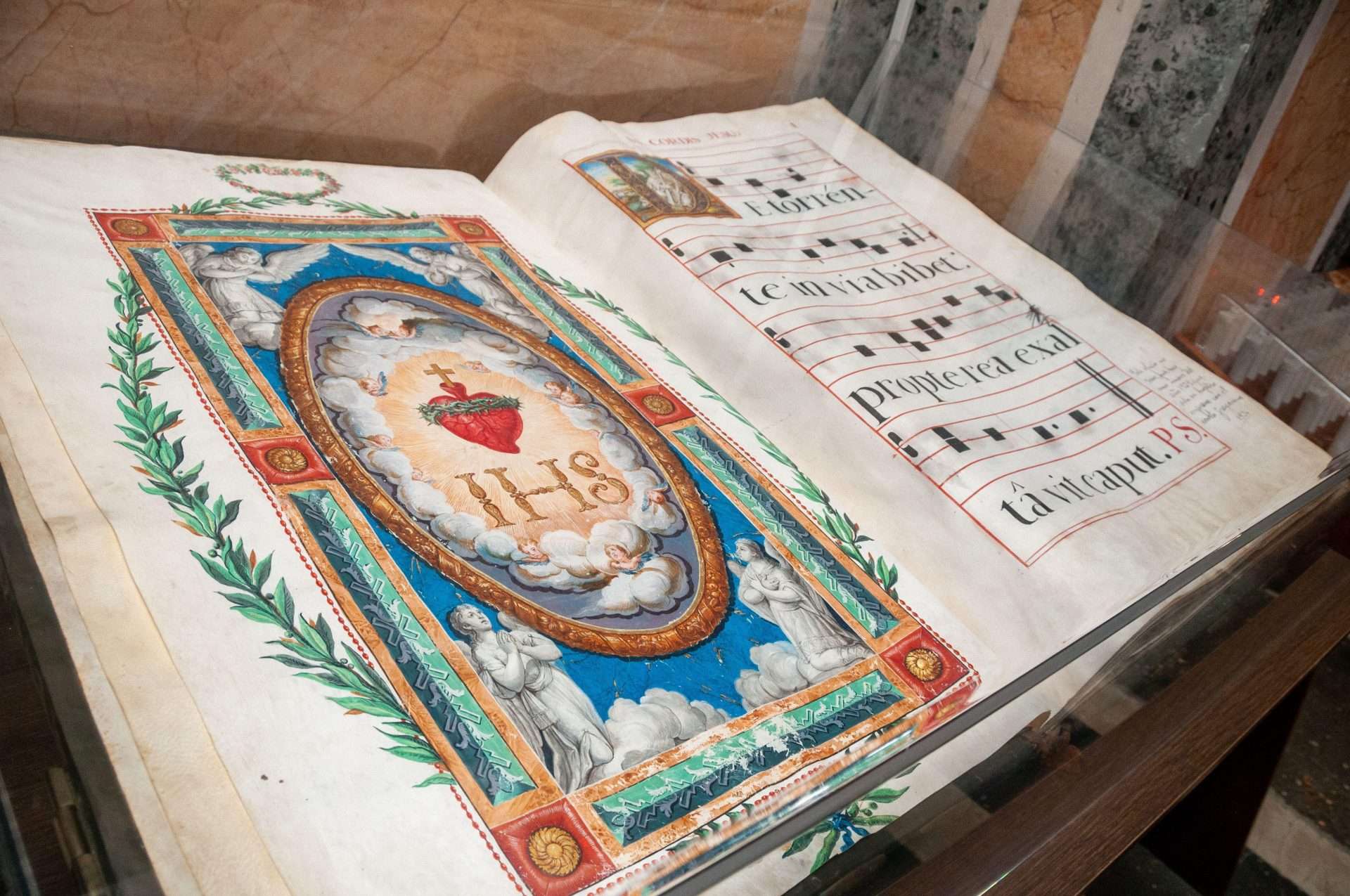
Illuminated manuscript (or choir book) displayed in the Basilica of the Sacred Heart of Jesus - Basílica del Sagrado Corazón de Jesús, Valencia, Spain
Marco Maraviglia, Alamy
The choir summer holiday is coming to an end, and I am really pleased.
Not because I like having to spend time and energy on organising and delivering the music, not because I am looking forward to seeing the choir members back again, not because I am looking forward to making music together and creating something beautiful to the glory of God, though all of these things are true, but because I have been feeling increasingly uncomfortable at Mass on Sunday mornings.
We all know priests are in short supply currently, and this is especially true in the summer months, when they are as entitled to holidays as anyone else. This year our parish reduced its number of Sundays Masses for the summer, and instructed the choirs to take a holiday until September. I actually rather like a spoken Mass for a change, it gives me a different angle of focus. Then one of the church music groups decided that since they were mostly still around, they could do ad hoc music at the one remaining Mass. I’m sure that their motivation was just to improve the service for the Lord and for everyone else, but it’s a style of music with which I am very uncomfortable. I do happen to know all these hymns, they were new and regarded as exciting when I was a student nearly fifty years ago, but I don’t think they have all worn well; or more accurately, some people love them and find them prayerful and helpful, but not all of us do.
Of course you can go to Mass and not join in with any of the music, but it feels very odd. Of course it’s possible to join in with only the spoken bits, and it’s strange to remember how much the Church’s position on this sort of thing has changed considerably even in my lifetime, though I admit my parish in the rural midlands was slower to catch on to liturgical reform than many others. When I was little, Mass (in Latin) was a spectacle at which we were present but we were not contributors in any meaningful way. You weren’t even meant to know what was going on away up on the high altar for quite a lot of it, and one of the excitements of being given a grown-up Missal for your First Communion was being able to read the words and translation of the bits referred to as “secretum” which only Father and the ancient altar boy away at the altar were even allowed to hear. No wonder so many people recited the Rosary all through Mass; it meant they felt at least peripherally involved.
Then we went into English (slowly and a bit late in my bit of Staffordshire), and we were expected to do parts of the Mass as dialogue, which felt truly revolutionary. Some of the rosaries were put away during Mass. The singing we did was either in Latin, Credo III and Missa de angelis, or Victorian hymns, often by Fr Faber and J H Newman, and many whose provenance was simply given as “trad”, which included several Mary hymns. With the coming of English Mass words, there was a whole new flowering of hymns and large numbers of American guitar-style hymns came into our hymn books, although we still sang them with organ accompaniment, which sometimes works. It took quite a bit longer for the authorities to allow us to use the (excellent) Protestant and Anglican hymns which I only learned when moonlighting in an Anglican choir for sheer love of the music. We sang Newman’s hymns out of The Dream of Gerontius (1865, Praise to the Holiest, Firmly I believe and truly) while I was at school, but I didn’t learn Lead, kindly Light (written in 1833) until years later, as it was not included in Catholic hymn books because it was written before his conversion. I am glad to say that it is in our current one.
Some of the hymns I sang as a student have stood the test of time, some I now prefer not to join in with, for a variety of reasons. Sometimes they are too sentimental, sometimes embarrassing, sometimes incoherent or inane; I have a low tolerance for empty repetition, and I don’t like singing first-person words of God that have been made up recently. It’s interesting how careful the Bible writers were about this, the number of times when they insist “It is the LORD who speaks”, but you need to be very sure of your ground, and not vapid, that just doesn’t seem to be God’s style. The words of hymns are very important to me; I don’t like to sing them as though they don’t matter. So is it ever all right not to join in, when you are at a communal event? I’m not talking about ostentatiously walking out or even tutting, just not lending your voice to a prayer or a song?
It’s a bit tricky when you are known to be a choir leader and have quite a loud voice, because people might notice when you don’t join in. After all, at our regular Masses, I spend a lot of time and effort encouraging people to do so; we practise before Mass, we make sure people have copies, I sometimes conduct everybody, not just the choir, and I am sure that I must irritate some of the congregation exceedingly. I know some people won’t want to join in, and that is fine, I can think of many good reasons for not joining in, and I don’t want to be hypocritical when I don’t join in myself.
It’s very important to be aware of what the congregation is doing. It’s easy with something like the Responsorial Psalm to hear whether they are singing back to you. We have only a few men in our little choir so if I get a warm deep sound, I know it’s the congregation. There are some hymns that I know are beloved (Guide me, O thou great Redeemer, for example, which almost everyone sings with gusto), and we try to extend our repertoire gently and slowly so that everyone stays interested and still invested. I stick with the hymn book as much as possible because it’s less noisy and messy than odd sheets of paper, but I am sorry that this means we can’t use some hymns that I love (God moves in a mysterious way is my example here) because it isn’t in the book. To my amazement, neither is the National Anthem, which seems bizarre. We still use some Latin but we make sure that we teach it to the congregation so that everyone can join in if they want to.
I don’t like using a microphone; I think it puts a distance between you and the congregation, and many people seem to use them almost to impose or bully. People need to be able to hear themselves, and amplification can ruin that. They don’t like to feel exposed, so they won’t sing unless there’s a certain layer of sound already present, but that’s precisely what the choir at a parish Mass is for, and accompaniment is very helpful too, either from an organ, a keyboard or even a solo instrument. Organs are the big guns of musical support, but it’s not always possible to find an organist. The most important thing is that the congregation should be aware that we want them to join in, and I am careful actually to say this at least once every week. I try to notice whether people are engaged or not, because it is so important. They should never feel irrelevant or uninvolved; we are all there to do this liturgy together.
Our congregation nearly all joins in, and sometimes they even smile at me. I choose the hymns carefully, and we sing a very eclectic mixture of old and new, but they are all good ones which earn their place in the line-up. The words are extremely important, usually linked to the readings or themes of Mass for that day. The GIRM guidelines for celebrating Mass are clear: we are meant to be using the correct forms of the Mass words, so we do; even though I often don’t care for the words of the new translations, we keep to them exactly. If we are supposed to be helping to lead the liturgy, we have to lead it in the correct direction, and not astray.
If there’s some music that you really don’t want to sing, of course I understand and accept it, because I do this myself, and it makes me realise how important it is to watch and observe the congregation’s reactions, to get any feedback that you can and to encourage people to express opinions or suggest favourite hymns. The only excuse I won’t accept for not joining in is saying that you can’t sing. Everyone at church can sing, it’s just how in tune they are that varies, and if you are singing to praise God, I’m sure he’s pleased whatever noise you make. As the old saying has it, if he gave you a good voice, sing to praise him; if he didn’t, sing to get your own back. All people that on earth do dwell / sing to the Lord with cheerful voice: no auditions for the heavenly choir, but you may opt out if you don’t like a particular hymn.
Kate Keefe composes musical settings for the Mass and writes about the psalms. You can follow her on Facebook, Twitter, LinkedIn and Instagram.
Login
Please login to comment
0 Comments
Oldest

Help us keep The Tablet’s voice independent, clear and far-reaching.
Founded in 1840, The Tablet is the leading independent English-language Catholic weekly, celebrated for great writing, astute analysis, brilliant arts and books reviews and trustworthy reporting from correspondents in Britain, Ireland, Rome and across the world.
Independent, high-quality journalism is at the heart of what we do. The Tablet does not have deep pockets and we are not funded by rich donors. If you appreciate our work please consider supporting The Tablet’s Development Fund. It only takes a moment and you can cancel at any time.
- Support with £5 per month
- Support with £10 per month
- Support with other amount.

MOST READ ARTICLES
-
1
The Tablet poem
-
2
Battling confession fatigue
-
3
Pope Leo announces operation to remove growth in lung
-
4
Catholic Social Teaching and universities
-
5
Nigerian first lady suffered death threat for practising Christian faith
-
6
Refugees admire ‘talent’ and ‘understanding of the topic’ of young competition winners
FROM THE EDITOR'S DESK


