The lives of Somerset churches – Redland Church, Bristol


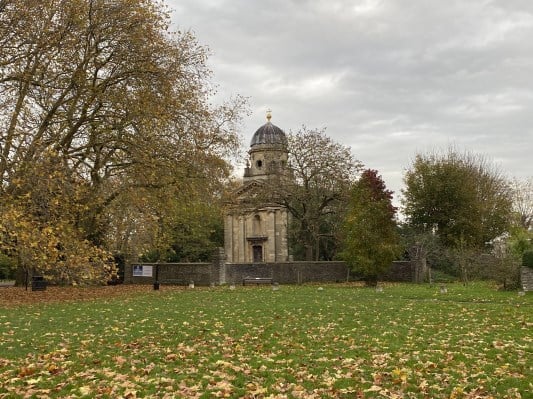
Redland Church, Bristol.
All photos by James Rogerson
It’s a freezing cold day in December as I walk up the hill to Redland Green in Bristol, a triangular space of grass bordered by paths with a view of central and south Bristol. On the north side of the green there is an avenue of plane trees, their neat lines directing my attention to the beautiful proportions of the Georgian chapel behind at the end of the road. Piles of their leaves are collected into drifts along the pavements. A lady lets me through the iron gates past forlorn Victorian graves. Nearest the gate there is a statue of an almost human sized angel in a creased robe, one hand held aloft and her face downcast. She seems that much sadder for the tinge of green moss that covers her wings and her skin and the brown leaves that surround her.
Redland Church – originally known as Redland Chapel – was built as a private chapel to Redland Court which is half a mile down the hill from here. Both were paid for by John Cossins, a wealthy London grocer who decided to retire to Bristol from London. The chapel was designed by local architect, John Strahan, although the building wasn’t finished until seven years after Strahan’s death with the first service taking place on 5 October 1743. It is still regarded as one of Bristol’s finest Georgian buildings. The Court was turned into Redland High School for Girls in 1885 and in the last few years the court has been converted into luxury flats. Redland Chapel did not become Redland parish Church until 1943.
Inside the church I am greeted in the hall by two busts that face each other over the entrance hall or vestibule. They are John and William Innys, the brothers of John Cossins’ wife, Martha. They are dressed in informal shirts, open at the neck and their expressionless faces are turned to the side, John looking into the interior of the church. I wonder at all the services and congregations he has looked at for the last 280 years. These busts were originally at the Court but were moved here in 1762. They are beautifully sculpted and they were created by the one of the greatest sculptors of his generation, the Flemish artist Michael Rybrack. According to the Oxford Reference website for “most of the 1720s and 1730s he was the leading sculptor in the country.” He also designed the statue of Sir Isaac Newton in Westminster Abbey.

On the large doors on the way into the church there is a simple wooden sign saying ‘Inn’ and inside a nativity scene has been set up against the backdrop of the grand eastern end of the building where there is a large copy of The Lamentation by Agostino Caracci whose original is in the State Hermitage Museum in St Petersburg. There is a striking contrast of the nativity scene with the Georgian grandeur behind it.
This isn’t set up for a service but for Redland’s Christmas, the through the keyhole experience where primary school students explore different zones around the chapel and in the new church across the road, each one telling its own part of the nativity story such as the shepherds’ field, Joseph’s workshop and the stable/manger.

Rubbing my hands to get the feeling back into them I leave the splendour of the chapel and make the one minute walk across the avenue of plane trees into the new Redland church, a one storey building that was built in 2016 between the vicarage and Redland Green Tennis Club.

The new church looks like an unassuming modern community centre with glass frontage. In the main space there are a group of people busy preparing for the Christmas through the keyhole displays. In another room there are a few women with grey hair and yoga mats chatting. It is comfortable and warm in the office and the feeling is starting to come back into my hands.
The vicar, the Revd Will Fairbairn, is 34 and dressed in a sweatshirt and skinny jeans. He couldn’t be more different from the stereotypical image of a vicar from the past. He is originally from Bristol and has been vicar here since 2020 and started during the first lockdown at the start of the Covid pandemic.

He tells me Redland has two services every Sunday and tried to diversify the appeal of the church here: “We’ve changed our services musically and stylistically. We’ve shifted one of the services to be different but the afternoon service is more traditional but still low church and evangelical”, adding “We don’t robe on a Sunday. For both services on a Sunday we would see over 150 people each week.” These numbers are gargantuan compare to the rural churches I’ve been visiting.
He also stresses the importance of Redland church as a community hub. “The building is partly a church but partly a community space”, Will says. “This gets for used for lots of different things such as exercise classes, orchestras, parenting classes and Alcoholics Anonymous groups. We’ve also been running a Ukraine refugee welcome hub, after school clubs, and a fun day.”

I can sense the busyness of the place. This is a church that is more than just somewhere to worship. The old chapel is still used for an afternoon service between March and the end of October but Will points out that when it’s cold it just makes sense to use the heated new building.
“The chapel is Grade 1 listed so it’s challenging to make any alterations and it’s expensive. It’s beautiful but it serves one purpose and doesn’t serve any others.
“We are supported by a charitable trust so that exists solely to maintain the old church and the vicarage.”
I wonder if Will has an opinion about the different challenges facing urban and rural churches. He tells me that as rural churches are normally the only place of worship in that community, “they’ve got to try and be something for everyone.” The problem Will think is that “They have to hit the middle of the road but there are plenty of people who don’t connect with the middle of the road.”
He continues: “A successful rural church isn’t going to be the same size as a successful urban church because of the percentage of population they’re serving but they have the same model: they have a historic building and an ordained minister. What happens in the rural context is that if you have 20 people attending one church then one minister can be looking after 10 churches and so while you’re looking after the same number of people you also have the administrative burden of looking after 10 listed buildings.” I think of Revds Kenneth in Dunster and Scott in Curry Rivel, both having to take on new parishes. Before Christmas I had also visited another retired church vicar who had come out of retirement in his eighties to help his local minister take services for this reason.

Will agrees that the future for rural churches looks bleak and at some point difficult decisions will have to be made. “The debate is do you consolidate and shut three and keep two open or do you find a way to keep them all going? Inevitably this debate is passionate because people don’t want their thing to change or close.”
I can’t help but think that the decline in rural churches is a symptom of a decline in the worshipping population and in turn indicates that the church just isn’t so relevant to people today but Will disagrees: “There are so many things we take for granted in western society, like equal rights. The reason we have these is because they’ve been shaped by a Christian framework. We’re starting to see more turmoil in the world and people are starting to ask ‘Where can I get answers to my questions?’ I believe the answers to these questions is Jesus. I think that has an enduring relevance.”
My visit to Redland has been eye-opening especially in highlighting the differences between the rural and urban church, not least in terms of congregation size. It’s also interesting to hear a young urban vicar voicing the same concerns about the rural church as I seem to hear everywhere I go, namely how rural churches – their congregations and buildings – will survive in the future. It begs the rather depressing question of how soon will it before we start seeing many churches being abandoned? And what is to be done to preserve the future of the 16,000 Church of England buildings that are such a distinctive part of our landscape?
Organisations such as The Churches Conservation Trust and Friends of Friendless Churches do an amazing job in saving many churches in peril but judging by what the ministers that I speak to are saying the challenge facing church buildings may require a greater fix. Surely soon there has to be a national debate about how to preserve these great symbols and treasures of our past.

Login
Please login to comment
0 Comments
Oldest

Help us keep The Tablet’s voice independent, clear and far-reaching.
Founded in 1840, The Tablet is the leading independent English-language Catholic weekly, celebrated for great writing, astute analysis, brilliant arts and books reviews and trustworthy reporting from correspondents in Britain, Ireland, Rome and across the world.
Independent, high-quality journalism is at the heart of what we do. The Tablet does not have deep pockets and we are not funded by rich donors. If you appreciate our work please consider supporting The Tablet’s Development Fund. It only takes a moment and you can cancel at any time.
- Support with £5 per month
- Support with £10 per month
- Support with other amount.

MOST READ ARTICLES
-
1
The Tablet poem
-
2
Battling confession fatigue
-
3
A craving for beauty
-
4
Massachusetts abuse report finds over 1,000 victims in three dioceses
-
5
Woman religious becomes first female president of Pontifical Mission Societies
-
6
Bishops demand security investment to promote ‘common good’ in Nigeria
FROM THE EDITOR'S DESK