Opening your door


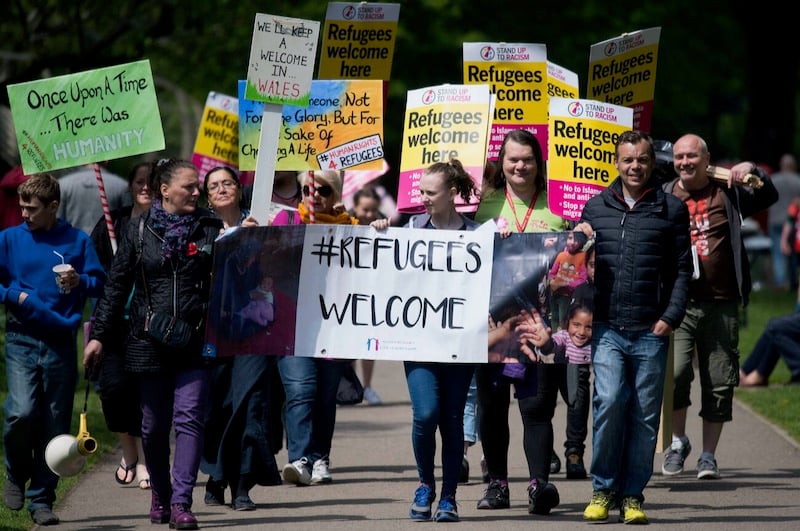
March in support of refugees in Cardiff, South Wales.
Matthew Horwood / Alamy
A practical and personal way to support refugees
Like so many others, I feel helpless and horrified by the tides of people in countries around the world who have been forced to leave their homes because of war or persecution.
Any of us could be refugees in different circumstances, and I believe that those who arrive here seeking sanctuary should be met with compassion and support.
Since 2021 I have been volunteering and working with a small charity, Refugees at Home, which connects people with a spare room to refugees and asylum seekers in desperate need of somewhere to stay.
Offering to share your home with a stranger is a remarkable act of trust, but through my work with the charity I have met many people across the country who have done just that.
I don’t have a spare room myself, but I wanted to find out what it is like to welcome a stranger from another country into your home, and what motivates people to do so. So I have been speaking to members of the Catholic community about their experiences hosting, and asking their advice for others who may be thinking of doing the same.
You get just as much as you give
I spoke first to Dermot and Sojung, who live in Bournemouth. They say that their decision to host refugees was partly inspired by their own backgrounds. Dermot told me, “We are both from different countries [Dermot is from Ireland and Sojung is originally from South Korea], and it took us some time to feel at home here in the UK. I suppose, as immigrants ourselves, we could identify to some degree.”
So far, the pair have welcomed guests from Iran, Syria, and Afghanistan. Some of the stays have been for just a few days; the longest has been for nine weeks. “Our first guest was a middle-aged lady from Iran, who had fled the country because her neighbours found out that her family is Christian. For her, it was amazing that she could come to church with us and freely attend services here.
“We spent a lot of time talking together, and she showed us how to cook Iranian food. Actually, food has been quite a thing for a few of our guests: it’s a very good way of getting to know each other, sharing cuisines, sharing food, sharing ideas.”
Understandably, the couple had their doubts about hosting at first: “Ultimately, you are taking a stranger into your home and that of course is daunting, because it’s your personal space, where you retreat to.
“But you can slowly dip your toe in – just host for a few days at first – and once you embrace it, you notice that a lot of those fears were unfounded. You actually learn a lot from the other person: you learn about their culture, you share food, and understand their lives a bit. They are absolutely not a burden upon you – in fact, in our experience, you get just as much from the experience as you give.”
Could you host?
If you have a spare room in your house, and can provide access to a kitchen and bathroom, then you could give a refugee a helping hand on the way to building their new life in the UK.
You can host for as short or as long a time as you prefer, and charities like Refugees at Home can help ‘match’ hosts with guests – for example, some people might not want a guest who smokes, or people might not feel comfortable around pets.
All guests are assessed to make sure they are suitable for hosting, and all hosts have the chance to meet a home visitor who is there to answer questions and provide advice and support along the way.
Hosting isn’t for everyone, and it is not always smooth sailing. It’s not always easy to share your home, particularly not with a vulnerable stranger who has been through traumatic experiences. But those who have done so often speak of how rewarding it has been.
Sojung said something that struck a chord with me :”The world is a big mess and you have no control about it. But at least you have got one person off the street. One person is in your home, safe in a spare bedroom.”
Providing a stepping stone along the way
Over the years, Pauline and her husband Mal have welcomed refugees from ten different countries to their North London home. “We have never had any breach of trust or felt unsafe,” Pauline told me.
“The first person we hosted was a Palestinian. He had grown up in a refugee camp in Lebanon, as had his parents before him. His grandparents were refugees, fleeing from Palestine to Lebanon. It was so shocking to us to think of three generations, lost to a life in limbo.
“One of our guests had been persecuted for his Christian faith. Others have sought safety from war in their home countries, or because of persecution on the grounds of their sexuality or gender identity. We don’t always hear their stories – as hosts we don’t have a right to, nor should we expect that. There have been guests that we’ve learned very little about, and that’s ok too.
“Hosting has given us such positive experiences. We share food and spend time together. One of our guests had never before experienced a birthday celebration; it was wonderful to mark his day with a cake and candles and birthday wishes. Another time, we took a guest from West Africa to the seaside – she’d never seen the sea before; it was a joyous moment.
“But although we have treasured so many moments of sharing our home, ultimately it is not about us. Our job is just to be a stepping stone along the way.”
The homelessness trap
Refugees make up around 10% of immigrants to the UK. In my experience, many of the people who need support from charities like Refugees at Home are those who have recently been given refugee status and leave to remain, but not yet had a chance to find accommodation or build their lives in the UK. Prior to this, as asylum seekers, they would have been housed in Home Office accommodation or hotels, living on £45 a week (or £9 in a hotel), with no right to open a bank account or work.
Pauline told me, “People talk about asylum seeker hotels as if they are the Ritz. Nothing could be further from the truth. People have nowhere to cook, no choice of what to eat, nowhere to keep their things. They are not entitled to work so they have no money, and there is often nowhere to go anyway. We had one guest who was just 17 when she arrived in the UK. She spent more than two years in a hotel – a teenager living alone in a small hotel room, barely able to go out.”
Just imagine – you have been waiting years for your asylum claim to be heard, unable to work and living in a small hotel room. But at what should be a time of celebration – receiving your refugee status – you are given just a few weeks’ notice to pack up and leave. Universal Credit takes five weeks to start; you have no source of income and nowhere to go. It’s no wonder that with no time to look for a job and find their feet, many refugees would end up on the streets without the support of charities and volunteers.
Dermot said, “People fall into this trap of being granted refugee status, then being told, ‘You’ve got seven days now to move out of the hotel’. But it takes much longer than that to actually get your National Insurance number, get registered with the Council, and apply for Universal Credit so that you can actually move on.
“One of our guests had just been granted refugee status, but his BRP [biometric residency permit] card was delivered to the wrong address. He was in total limbo – the Home Office refused to help, the hotel wouldn’t accept him back. No-one would take responsibility and he just didn’t know what to do. By the time we met him he was homeless and traumatised.”
We’ve learned so much, not just culturally
It’s not just individuals and families who I spoke to about hosting refugees. Having seen so much talk of refugees on the news over the years, the sisters at Faithful Companions of Jesus convent in East London decided to offer up their accommodation to those in need.
Last year, the nuns hosted Stefanie and Sandy Garcia Padilla from El Salvador. The sisters had been forced to leave their family and flee their country after their lives were threatened by gangs. When they arrived in England they were living in hostels before finding sanctuary with the Faithful Companions.
Gloria Calabrese, a sister at the centre, told me how Stefanie and Sandy become close with the community of nuns over their four months living together. For her part, Stefanie feels that stability of living in a home with others has helped them to integrate in Britain. They both have jobs, with Stephanie working in a grocery shop, and have now found a flat of their own.
Gloria feels that the experience of hosting has been an enriching one, allowing her and her fellow sisters to see what life is like around the world. “Sometimes people are afraid of others who are different”, she says. “We’ve learned so much, not just culturally… I can’t say enough how much I would encourage anyone to take part.”
A basic calling we all have as Catholics
Pope Francis has spoken often of his support for migrants and refugees, calling on Catholics to welcome and integrate those seeking asylum. He tells us, “May every parish, every religious community, every monastery, every sanctuary of Europe, take in one family” (May 2015). He himself has welcomed three families of Syrian refugees to Vatican City, and in 2021 the Vatican arranged for the transfer of a number of refugees to relocate to Italy as a gesture of solidarity.
My own upbringing in the Catholic church has underpinned my attitude to charity, and most of the people I spoke to said that religion had played a part in their decision to host. Sojung told me, “Jesus wants us to look after people. My favourite part in the Bible is in the Gospel of John, where He appears to Peter, asking if he loves Him and telling him to look after His flock. I think that’s the basic idea of Catholicism – God wants us to look after each other.
“One of our guests, Aref, told us about his parents who had to flee from Afghanistan to Pakistan. They had to return to their home in Afghanistan to collect some papers, and Aref was born on road, on the way. It made me think about how Jesus was born in an animal shed. It’s easy to romanticise that, the image comes in like a children’s picture book with cute animals around the manger. But it would have been freezing cold and open and smelly – not a safe environment for a baby to be born into.”
Like Dermot and Sojung, Pauline’s decision to host refugees is also deeply rooted in her Catholicism. “It’s a fundamental principle of who I am, and a basic calling that we all have as Catholics: that you love your neighbour, and take in the stranger, and feed the hungry and care for the poor.
Pauline summed it up when she said to me, “It’s the basis of it all, isn’t it.”
To find out more, visit www.refugeesathome.org
Login
Please login to comment
0 Comments
Oldest

Help us keep The Tablet’s voice independent, clear and far-reaching.
Founded in 1840, The Tablet is the leading independent English-language Catholic weekly, celebrated for great writing, astute analysis, brilliant arts and books reviews and trustworthy reporting from correspondents in Britain, Ireland, Rome and across the world.
Independent, high-quality journalism is at the heart of what we do. The Tablet does not have deep pockets and we are not funded by rich donors. If you appreciate our work please consider supporting The Tablet’s Development Fund. It only takes a moment and you can cancel at any time.
- Support with £5 per month
- Support with £10 per month
- Support with other amount.

MOST READ ARTICLES
-
1
The Tablet poem
-
2
A craving for beauty
-
3
Battling confession fatigue
-
4
Massachusetts abuse report finds over 1,000 victims in three dioceses
-
5
Bishops demand security investment to promote ‘common good’ in Nigeria
-
6
Woman religious becomes first female president of Pontifical Mission Societies
FROM THE EDITOR'S DESK