From Remembrance to Advent: thoughts of a new military Dad


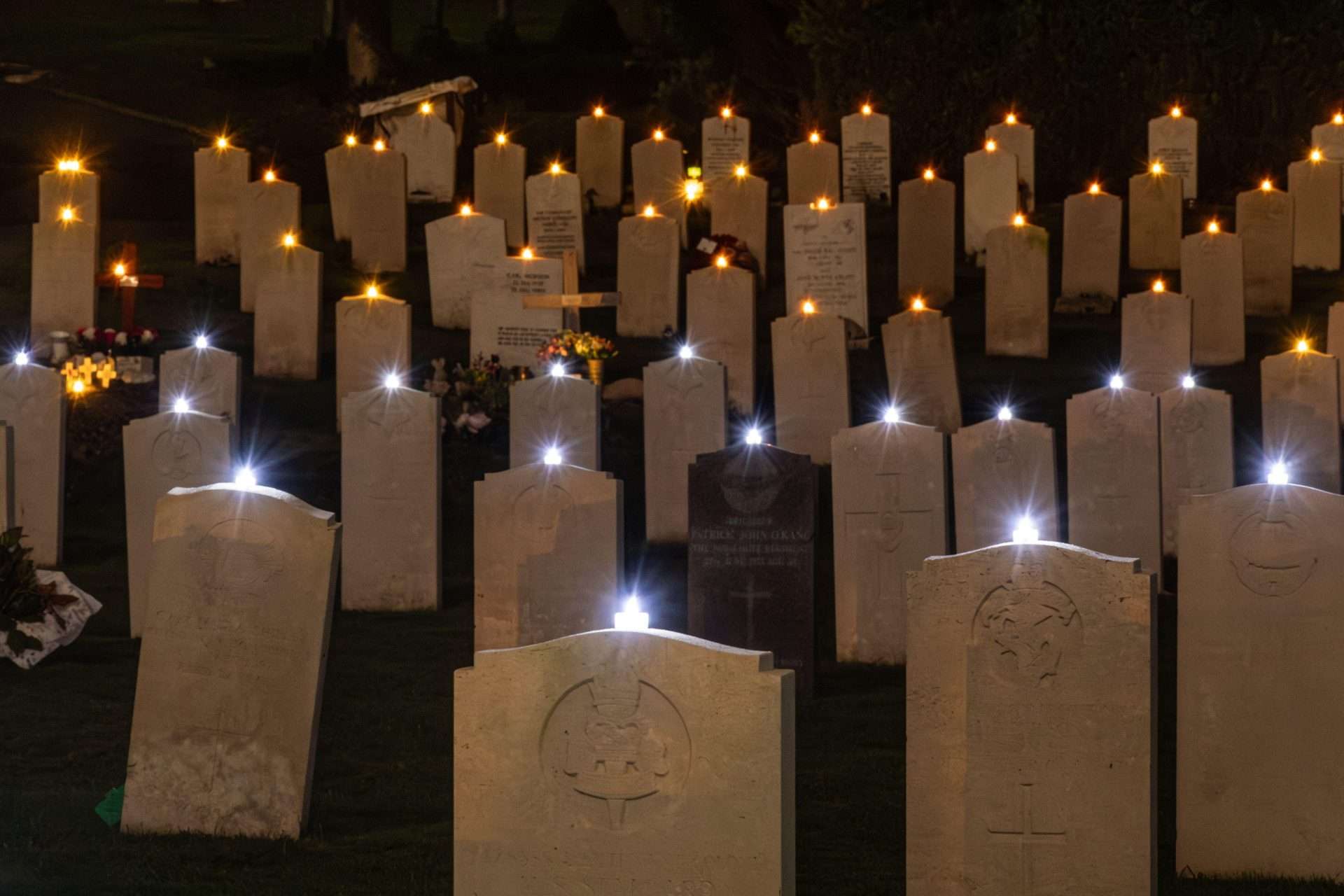
The annual Lighting of the Graves ceremony Remembrance Sunday at Aldershot Military Cemetery in Hampshire.
Gillian Pullinger / Alamy
A few weeks ago, I became a military dad. Our second-born, Greg, born in Cape Town in the Millennium year, completed his 36 weeks training – the longest such training in the world – and is now a Royal Marine Commando.
I cannot say that I ever expected to be a military dad – though there is a very cute photo of our first and second born in military uniform: Grenadier Guards costumes made by their mother. It’s a photo that was taken a few days after they had experienced one of the protests against the Iraq war in Parliament Square when, as I recall, they had been quite frightened by the chants and shouts.
There is absolutely no doubt that as any father would be I’m immensely proud of Greg’s achievement. Just the sheer physical nature of the training – he returned home at one point with the beginnings of trench foot, the disease soldiers lived with in the First World War – is cause for both pride and admiration.
The proto-trench foot had resulted from a practice six-mile run – a small warm-up for the thirty-miler with which Marine Commandos end their training – when, instead of 25kg, he had to carry 40kg. He failed to meet the finish time by about six minutes. One of his mates at this point who’d also failed simply went for what’s called a medical chit – which means he headed to the sanatorium to recover. But not Greg and a group of his fellow trainees. They were not going to be defeated, least of all by six minutes. The following morning, they all had a kit muster, so after two weeks in the wet of the field – which had set the foot up nicely for its decaying state of course – this meant staying up virtually all night to dry, clean or polish every item of kit.
After only an hour’s sleep, he redid the run and somehow he made it home within the time. Though after two six-mile runs on consecutive days following two week’s exercise in the cold and wet of Dartmoor we wondered whether even with two weeks off he’d make it back to training. But, of course, he did. Unlike a recent British Prime Minister, Greg really is a fighter not a quitter.
He simply has guts and determination which I could never possibly muster for this sort of thing. So I’m hugely proud and indeed in awe of what he’s done.
But as if switching between those two images of Greg with his older brother – child Grenadier guard standing to attention and fearful three-year-old weaving his way through Iraq protests in Parliament Square – at other levels I’m also ambivalent about what he’s doing. The professionalism, the integrity, the sense of service and dedication. All this about the military I greatly admire. But when I saw Greg’s official photograph – him with a fixed bayonet – or when, earlier, I had seen him holding his rifle, and indeed at the ceremony when we’d watched a video about the training programme, much of which focussed on the rifle skills involved, the ability to enter and attack enemy territory, the reality of course of being a marine – I got another surge of ambivalence indeed of an emotion not the least bit ambivalent because it was a surge of fear.
Part of this is of course just the worry that any parent will have felt in each of the wars that were commemorated just a few weeks ago around the globe on Remembrance Sunday and on Armistice Day, 11 November, when in 1918 the guns stopped and the First World War suddenly ended. The worry that your son will not come back.
Greg starts his marine commando career now by learning to drive trucks and lorries. It sounds like every young child’s dream. Until you remember how such lorries carrying medical aid and food were recently attacked in Gaza, when aid workers were killed by drone bombs. The possibility of another son’s name being engraved somewhere on a memorial seems just a little too close for comfort now.
For a few weeks in October I was in Vancouver in Canada. Where the streets are filled with banners on each of which was the photo of a different soldier from one of the world wars. Imagine London or Cape Town or Karachi filled with such banners. It would be an amazing way to remember the people of such diverse ethnicities – from across the Commonwealth – who fought and died in the two world wars and the many other conflicts since. Such a simple and direct way to bring home the personal reality that every banner photo represents not just a war statistic but flesh of our flesh and bone of our bone, a person no less with hopes and dreams, emotions and gifts that war literally stole from them. It’s easy to collapse all that into a few clichéd words about dying for freedom, and sacrifice for a greater cause. But just one life lost, let alone the millions and millions of them who actually perished, is a heavy price to pay for anyone’s freedom.
For a few days I went north from Vancouver into the Ukon. This is rural Canada. The rockies. Amazing scenery. The Ukon River flowing with salmon – sadly I caught none. Wall to wall snow from October to May. Imagine that. In a second-hand bookshop I picked up a volume of poetry by a man from Preston in the north of England, near where our second son spent the favourite years of his childhood, supporting Preston’s rival football team, Blackburn Rovers. This poet was a Red Cross ambulance stretcher-bearer in the First World War. He became one of the world’s most famous poets.
The name Robert Service is hardly known now. But when he went to Canada at the time of the gold-rush he discovered a talent for poetry that had great popular appeal. Indeed, it made him millions. And not many poets can say that. He is still known as the poet of the Yukon, and celebrated as one of Canada’s greatest adopted sons.
Flipping through the pages of Rhymes of a Red Cross Man (1916), I found a poem about a young lad joining up to fight and the thoughts of his dad about all this, thoughts which in some ways didn’t feel so very far from the mix of feelings that are my own right now. “Young Fellow My Lad” has a sing-song, ballad quality that these days is rather out of fashion. Nonetheless it has a dialogue-directness and pathos as father and son each reflects on the young man’s desire to join up, that expresses their different emotions in a simple, affecting way. “You’re all of my life,” says the Dad says with that mixture of simplicity and understatement so characteristic of Lancashire. “Don’t worry I’ll soon be back,” responds his son seemingly unaware of the intensity of his father’s love and anxiety. As the poem moves towards an image of the father waiting for the postman to deliver letters with much-sought news from the front, so the reader reaches the terrible moment when the father, his hopes shattered, is told the truth that his Son will “never come back again”. He opines that his boy was “one of the best” and will “live … in the gleam of the evening star”, and ends with the sort of words that Remembrance-tide may still on occasion evoke:
And you’ll never die, my wonderful boy,
While life is noble and true;
For all our beauty and hope and joy
We will owe to our lads like you.
I found the poem deeply moving until this point. For I’m not at all convinced by those last lines. Part of me wants to be. I want to feel that beauty and hope and joy might be owed to the likes of that lad. But the words seem a bit too clichéd, they seem to trot off the tongue too easily as they turn disaster and misery far too straightforwardly into a pride and glory that is surely just a bit too hollow. But who am I to criticise? What might it be like for me one day – a day I hope and pray never arrives – to hear the news that my young lad has perished in a conflict I probably won’t agree with? How on earth would I make sense of this?
Remembrance is a time globally when we are invited to think about these difficult truths. Because if we don’t think about them then the war dead will most certainly have died in vain. What, after all, was the point of all that fighting against Nazism if it didn’t make the generations that continue to follow think just a little more actively about the kind of world we all want to live in? The sort of world for which we think it’s actually worth both living and dying to create.
But then Advent follows, a season which used to begin on 11 November with the feast of St Martin of Tours, the soldier saint, and which was therefore known in France as St Martin’s Lent because of the accent on three day’s fasting during each week of a lengthened Advent season. Advent, characterised by its own ambiguity.
Light dawns in the darkness – and there is plenty of the latter right now – exactly at the point in the year when the days are becoming more, not less dark, as we head towards the Winter Equinox. But like those contrasting images of my infant son – parade and protest – or the ambiguity of my own feelings of pride and ambivalence, celebration and fearfulness, we may only be enfolded in the mystery of the Advent hope if we wrestle with the darkness within ourselves and the world, and realise that light is always hard-won.
Just three days before Christmas the year turns, the days begin to lengthen and a flickering gift – “the light of truth and the help of grace”, as the seventeenth-century divine, Benjamin Whichcote puts it – begins to dawn. It is for this twin dawn of peace and light that Remembrance and Advent – the season of a soldier saint’s Lent – call us to journey.
Chris Chivers teaches Religion and Philosophy, Government and Politics, and History at UCL Academy, London
Login
Please login to comment
0 Comments
Oldest

Help us keep The Tablet’s voice independent, clear and far-reaching.
Founded in 1840, The Tablet is the leading independent English-language Catholic weekly, celebrated for great writing, astute analysis, brilliant arts and books reviews and trustworthy reporting from correspondents in Britain, Ireland, Rome and across the world.
Independent, high-quality journalism is at the heart of what we do. The Tablet does not have deep pockets and we are not funded by rich donors. If you appreciate our work please consider supporting The Tablet’s Development Fund. It only takes a moment and you can cancel at any time.
- Support with £5 per month
- Support with £10 per month
- Support with other amount.

MOST READ ARTICLES
-
1
Church warns Zambian government against division after archbishop’s arrest
-
2
A craving for beauty
-
3
Breaking up … for now
-
4
The technological paradigm, AI and the human person
-
5
Bishops demand security investment to promote ‘common good’ in Nigeria
-
6
Rival church occupies Kyiv monastery in latest blow to Moscow-linked Orthodox
FROM THE EDITOR'S DESK