Doing it the hard way: Walsingham Pilgrimage 2026


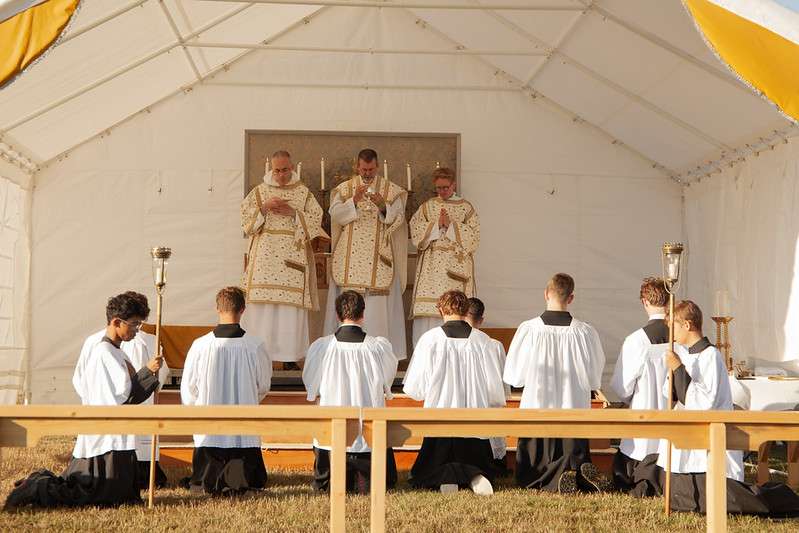
Photo by Joseph Shaw, Flickr
What can draw 240 Catholics over the lanes and paths of Cambridgeshire and Norfolk from Ely to Walsingham?
They ranged in age from 12 to 90, with many young adults and many recent converts and reverts, people deepening their Faith, or discovering it, in the company of the Traditional Latin Mass. They also discovered the traditions of Latin chants and English hymnody, and some hard truths about wet socks and blisters.
A pilgrimage is a way of honouring Christ or the saints. The more trouble we go to about it, to honour them, the greater the gift we are giving them. They don’t need our gifts, but it is good for us to give them: it creates, within us, a better ordering of priorities. It is good, also, for others to see the trouble we are going to, and for wider communities to take part in these efforts. We can’t increase the glory God enjoys in heaven, but as George Herbert expressed it, “In our hearts, though not in heaven, we can raise Thee.”
Every pilgrimage to Walsingham is a way of honouring Our Lady and the Incarnation, since the shrine there was, and remains, an evocation of the Holy House at Nazareth. Getting there through the narrow lanes of Norfolk can be quite an effort in a car, but why not go on foot? Why not make it a walk of more than 50 miles from Ely over three days, or even, for an intrepid minority of the pilgrims, of 180 miles from south London, over eight days?
Pilgrimages like this were familiar to our predecessors in the Faith, and were revived in England by groups like the Guild of Our Lady of Ransom. In the 1970s they fell into decline, but they have been creeping back. In the 1980s a group of French Catholics attached to the Traditional Latin Mass began to walk from Paris to Chartres, and after decades of uneven growth, last year they welcomed 20,000 pilgrims.
It is not surprising that traditionally-minded Catholics are at the forefront of reviving the tradition of walking pilgrimages. It is not just that this is one of those things that Catholics used to do, and then for some reason stopped doing after Vatican II; it is also an example of the incarnational spirituality associated with the ancient Mass. We want to express our piety in outward practices, in ritual and with symbols. Our state of repentance for sin is expressed not only by feelings and intentions, but by fasting; our love of God is expressed in the beauty of the liturgy and of church furnishings; our grief is expressed in black vestments and the Dies Irae. We honour the saints in their relics, in their holy places, and in processions. The ultimate procession to a saint’s holy place is a pilgrimage.
This year the Latin Mass Society (LMS) walking pilgrimage to Walsingham was joined by 240 people, a record number of people for this event, which began in its present form in 2010. We experienced a prolonged and torrential downpour on Friday afternoon, which drenched the walkers (not least me, since I didn’t have my poncho with me) for the last hour of the day’s journey. The subsequent blisters from wet feet and soaked shoes kept the first aiders busy for the rest of the pilgrimage. I’m not sure what the exchange rate is between blisters and souls converted to Christ, but no doubt you will get more souls if you walk another 35 miles on the blisters.
It is an important paradox of the Faith that God is served by joyful things and by suffering, accepted voluntarily and offered up to God. In the Great Litany, which we sing on the road, we ask God to liberate us through Christ’s sufferings and death, but also through His Nativity and Ascension. A walking pilgrimage is a penitential exercise – as we trudged through the rain, no one was in any doubt about that – but the shared penance sharpens the comradeship, the singing and praying, the liturgy, and the food.
The singing and praying on the road is supported by dedicated cantors, one in each chapter of 20-30 walkers. We sing the Rosary each day, in a mixture of English, Latin and – in a nod to the Chartres pilgrimage – in French. Each day we have High Mass, with deacon and subdeacon assisting the celebrant, a large serving team and a choir; in the evenings we had Compline. A portable altar is built on a trailer under an awning, and sited on a playing field by our campsite, or, on the final day, on the grass expanse in front of the massive west gable which is all that remains of Walsingham Priory, where England’s Holy House stood from 1065 until 1538.
We also go to a lot of trouble over the food. As our pilgrimage has grown, so has the challenge of providing a cooked evening meal, but our cooking volunteers continue to do it: this year, a pasta soup on Friday and a sausage casserole on Saturday, cooked from basic ingredients using a mobile kitchen unit and open-air gas burners. The effort of providing good food is a way of honouring the pilgrims, and supporting the work of piety that they have taken on.
The Latin Mass Society’s walking pilgrimage to Walsingham is small compared with similar events in France and Spain, but it is by far the largest Catholic walking pilgrimage in England. We have been fortunate that the LMS has been able to leverage its support base, contacts, and all kinds of resources, to support the pilgrimage, but what is most important has been the willingness of so many people to devote to it entirely unreasonable amounts of time and effort, for no earthly reward. This is part of the mysterious ingredient of the Faith that outsiders can’t account for: it is not simply a set of comforting ideas, but a source of motivation to do things one would never otherwise have contemplated. As T.S. Eliot noted in a 1929 letter, after his own conversion: “It [is] rather trying to be supposed to have settled oneself in an easy chair, when one has just begun a long journey afoot.”
Joseph Shaw is chairman of the Latin Mass Society
Login
Please login to comment
0 Comments
Oldest

Help us keep The Tablet’s voice independent, clear and far-reaching.
Founded in 1840, The Tablet is the leading independent English-language Catholic weekly, celebrated for great writing, astute analysis, brilliant arts and books reviews and trustworthy reporting from correspondents in Britain, Ireland, Rome and across the world.
Independent, high-quality journalism is at the heart of what we do. The Tablet does not have deep pockets and we are not funded by rich donors. If you appreciate our work please consider supporting The Tablet’s Development Fund. It only takes a moment and you can cancel at any time.
- Support with £5 per month
- Support with £10 per month
- Support with other amount.

MOST READ ARTICLES
-
1
The Tablet poem
-
2
Battling confession fatigue
-
3
Pope Leo announces operation to remove growth in lung
-
4
Catholic Social Teaching and universities
-
5
Nigerian first lady suffered death threat for practising Christian faith
-
6
Refugees admire ‘talent’ and ‘understanding of the topic’ of young competition winners
FROM THE EDITOR'S DESK


