As Advent and Christmas approach, this church musician loves being back in the swing after enjoying the choir’s summer holiday


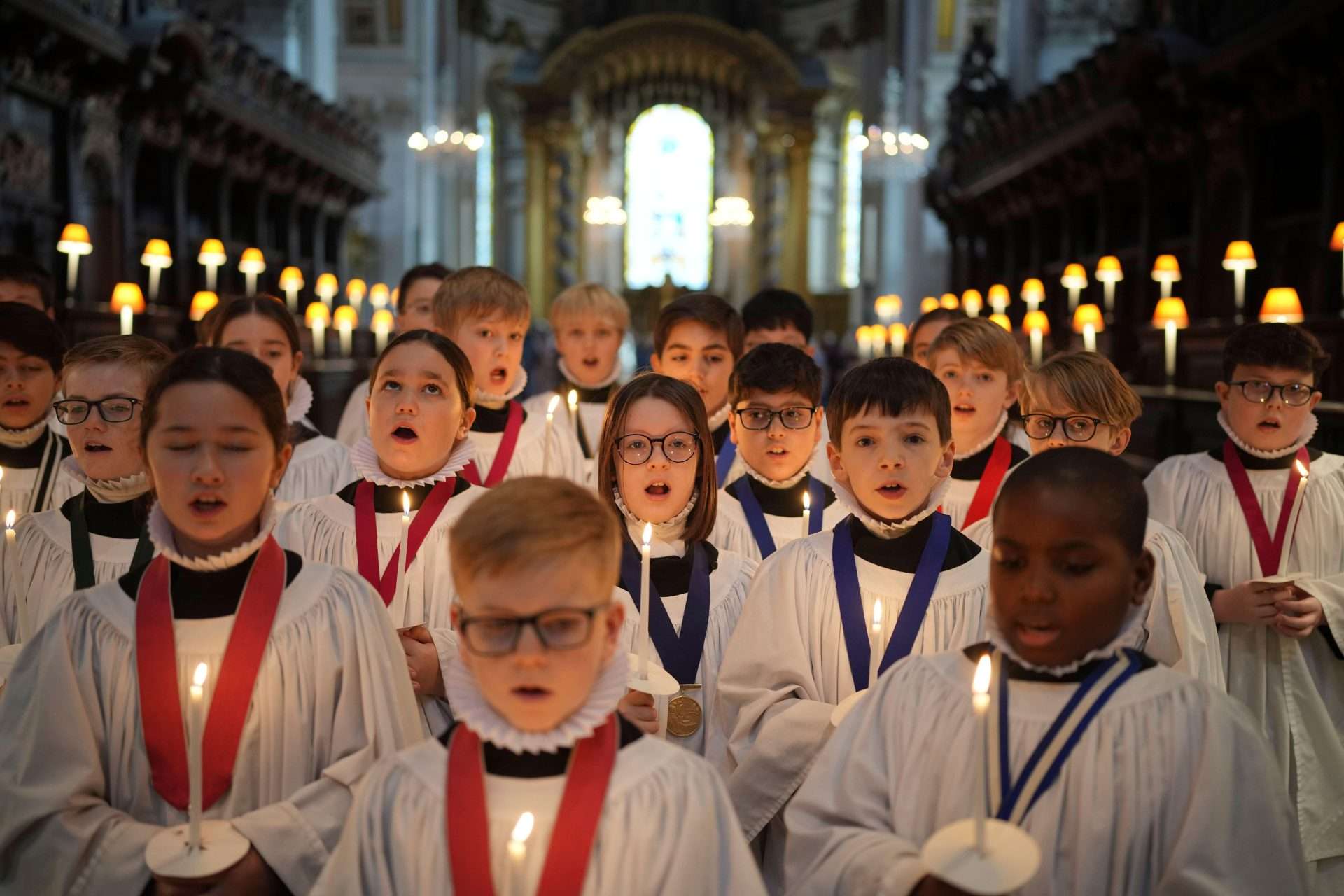
The Choristers of St Paul's choir, including girls for first time in 900-year history, rehearse for the Christmas services in St Paul’s last December.
Kin Cheung, Associated Press, Alamy
During the month of August, our choir, like many others, was technically on holiday. Some people have even been actually away on holiday for a week or two.
Mostly we’ve seen each other around on Sundays, of course, except when someone daringly goes to a different Mass, which can feel surprisingly restful. It is wonderful to have time to concentrate on what is happening without having to worry about when the next piece of music is coming up and whether everyone is ready for it.
Choirs need holidays, partly for practical reasons (it’s too hard to assemble a full group every Sunday during the main holiday month), but it also means that the congregation gets a month off, either as a respite for those who don’t like singing, or so that they realise how much difference the choir makes, as well as how much work is involved. The choir is there simply to support and lead the congregation, not to be a concert, but it’s still quite hard work, especially for the choir leader and the person who chooses the music week by week and now has to cope with the infelicities of the new lectionary, which are very wearing.
We traditionally take August off, probably timed then because of school holidays. In cathedrals, the choir often takes a week off after the big celebrations which involve lots of services, notably Christmas and Easter, but usually they find another choir to stand in, which is a great opportunity for a minor choir to sing in a cathedral, something we’ve enjoyed very much from both sides in the past. Usually, though, this is not an option for ordinary parishes. If the choir’s on holiday, Mass is just said, not sung, and our only official holiday is in the summer.
There are slight practical problems over taking this holiday. If you’re not actually away, you still have to go to Mass, and you may well go to the Mass you usually sing at, because it’s the most convenient, which is why you ended up there in the first place. Choir members sit with their friends, often in their usual places, out of sheer habit (we don’t have choir stalls or anything like that in our church). This should not mean that they can just be told to sing when they arrive. It’s very easy to find yourself in this position, but it’s not fair, because there is more to the music on Sundays than just picking four hymns.
Church musicians, even volunteers, take a real pride in what they do. It is a service they are happy to offer, and some of them spend a lot of time doing it. The choices are carefully made, the information or copies carefully prepared and then put out for the congregation, and the choir feels a sense of responsibility. The worst is to feel or be thought responsible for something where you have had no input, and I worry about visitors getting a wrong impression and perhaps never coming back. Obviously the music doesn’t belong to anyone in particular, and spontaneous music-making can work beautifully; but that tends to be in a congregation which has already been able to sing together and learn the music over time. If anyone ever tells you that “everyone knows” a piece of music, it’s not true. Humans don’t arrive at birth with plainsong apps already installed. They will sing any good music with love and feeling, but they have to learn it first. That takes commitment and time. If people feel that something important is missing from the Mass if there is no music, I would agree, but holidays are important too. Maybe one possibility would be to offer an opportunity for a willing musician to supply some background music for a given holiday Sunday, but this could be risky!
What sometimes happens is spontaneous music-making led by the priest, but this only works if he makes good choices. It’s excruciating if he sees this as a chance to make the congregation sing something he knows and they don’t, especially if there’s no music or words offered. The priest after all is the only person with a microphone, and it’s entirely possible to bully with music. I think this comes back to clericalism. If Mass is regarded as something we all actively do together, and if a priest has been listening to what normally happens at Mass, he’ll have a much better idea of what works with any given congregation.
It’s really difficult to correct clerical musical mistakes, especially in the dialogue bits of the Mass. Just because it’s in Latin doesn’t mean that you don’t need to get the tune right, especially as each part of the dialogue launches the next bit. The congregation needs a clear steer to set it off. And any musical choices need to be carefully considered, not just picked at random. You can sing Shine, Jesus, shine or the Salve Regina, but perhaps not usually both at the same Mass, certainly in my parish. I like both pieces of music, but I add them to the running order only when I think they will work. This means taking into account the occasion, the cross-section of the parish that will be there, what else is going on, and so on. I am carefully avoiding naming the hymns I don’t like to the extent that I won’t join in with singing them (except in Lent, when I offer it up).
One of my concerns with the choir is constantly to increase the repertoire of what we sing. There is so much good music available that it is a shame if people get stuck in a rut. Knowing the usual funeral and wedding hymns, along with a vague recollection of hymns that you sang at school, is not really enough church musical choice for the rest of your life. Old favourites are always welcome, but a new hymn can open your mind and make you think afresh. Having a choir means that there are enough people who know a tune for everyone else to be able to pick it up over the course of singing it through; and then we can reinforce it by having it again in the fairly near future. Now we are back from the holidays, it is a good time to think about introducing a couple of new hymns before we start the run-up to Advent. We shall be doing that this week as part of the music for the Exaltation of the Cross feast. We will also be able to strengthen the congregation’s grasp of the Salve Regina and the Regina caeli for October. Learning those two were our last two years’ special efforts to honour Our Lady. Now they even turn up occasionally and spontaneously at weekday masses, even without the choir, which is wonderful.
Another good reason for a choir holiday: it gives you a chance to catch up with a backlog of tasks left undone in all the excitement of Sunday-by-Sunday, and with any luck it also allows a bit of forward planning, as every weekend except one in October is something special, and then we’re already into Advent and the Christmas music is beckoning. It’s all go being a Church musician. The year directs what you need to sing, and you’re always running to keep up. The new lectionary has meant a whole lot more work every week, trying to make sure that we are singing the words in the Missals and Mass books in their new versions. I can’t put them online yet because I can’t get far enough ahead to have them officially approved before we need them, but maybe one day…
My choir has just come back together again singing in September. I was really looking forward to seeing them, and above all, hearing them. Their service is so generous and loving. They want to deliver music for the Mass that is appropriate and beautiful, something which enhances and deepens the experience, adding to its coherence and efficacy. The more thought goes into planning the music, the better the Mass hangs together, the more prayerful the sacrifice, the more loving the service. Music isn’t the icing on the cake, it’s a crucial element in the recipe. Any choir needs and deserves its holidays, but I love it when we all come back to sing together.
Kate Keefe composes musical settings for the Mass and writes about the psalms. You can follow her on Facebook, Twitter, LinkedIn and Instagram.
Login
Please login to comment
0 Comments
Oldest

Help us keep The Tablet’s voice independent, clear and far-reaching.
Founded in 1840, The Tablet is the leading independent English-language Catholic weekly, celebrated for great writing, astute analysis, brilliant arts and books reviews and trustworthy reporting from correspondents in Britain, Ireland, Rome and across the world.
Independent, high-quality journalism is at the heart of what we do. The Tablet does not have deep pockets and we are not funded by rich donors. If you appreciate our work please consider supporting The Tablet’s Development Fund. It only takes a moment and you can cancel at any time.
- Support with £5 per month
- Support with £10 per month
- Support with other amount.