What the Dickens – Mark Lawson on A Christmas Carol


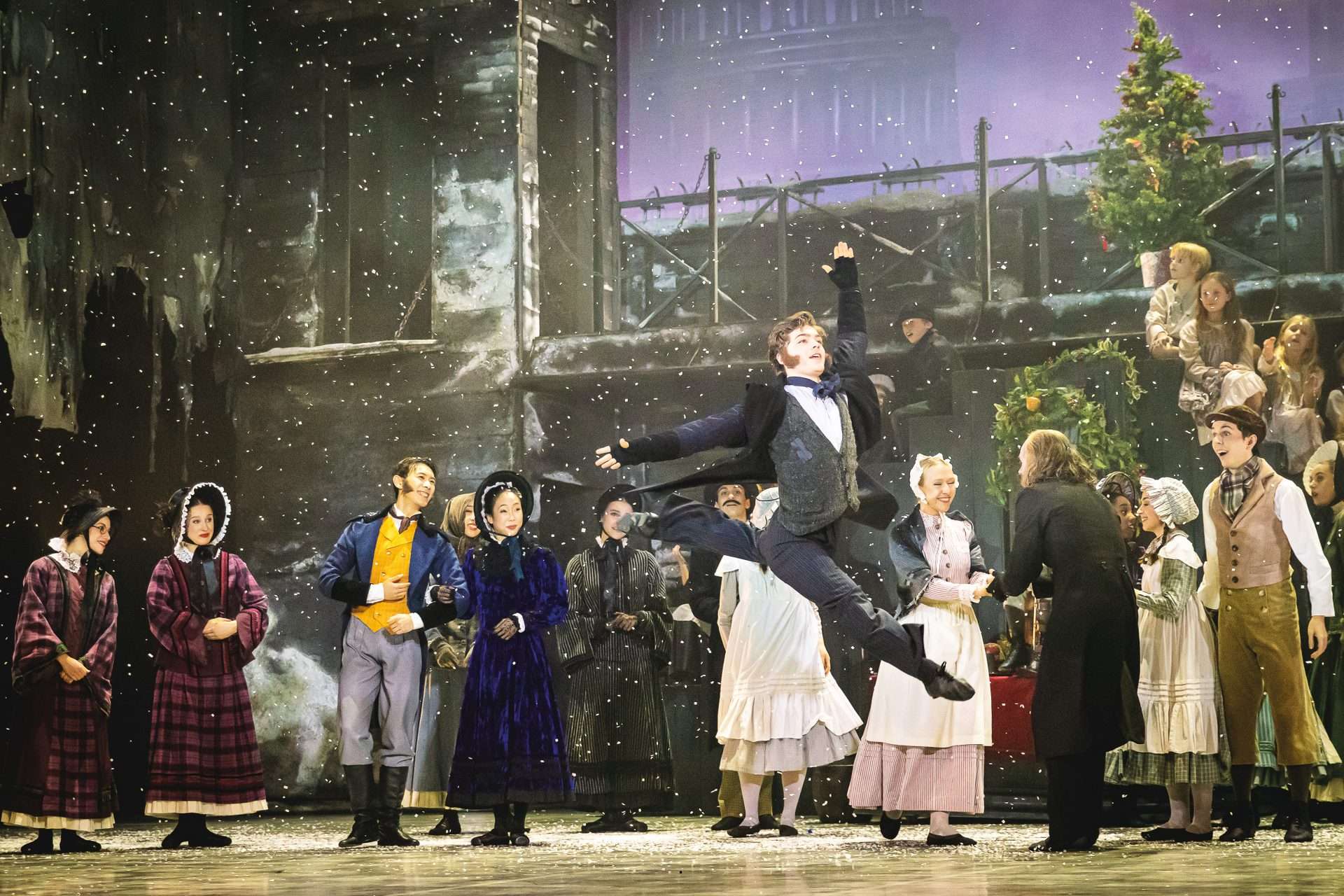
Northern Ballet’s Harris Beattie at Soho Place in reimaginings of the Dickens novella
photo: Colleen Mair
With pantos in decline, A Christmas Carol stands out as the surefire seasonal hit. Mark Lawson highlights some of the myriad versions across the country
In October 1843, Charles Dickens had an idea for a fiction set at Christmas that would be sold in the run-up to that festival. Those familiar with modern publishing rhythms will be astonished that it was published in December of that year; a writer who came up with a holly-and-ivy project this October would be lucky to see it in 2026 stockings. But, quickly turned round, A Christmas Carol endured long beyond Twelfth Night, reaching a seventh edition by the following May.
The story of a financier miser inspired by three nightmares to become a kinder man invented or solidified the music, food and mood of an English Christmas and also the genre of the Christmas book. Dickens produced several more, including The Chimes (1844) and The Haunted Man (1848), and almost every popular writer since has extended the yuletide library: 2024 contributions come from writers of fantasy (J.K. Rowling’s Christmas at Hogwarts), crime (Richard Coles’ Murder Under the Mistletoe) and romance (Sarah Morgan’s The Christmas Cottage), although, 181 years on, A Christmas Carol still gives them a fright in the bestseller lists.
And, while theatrical versions of the reform through haunting of Ebenezer Scrooge reached the stage as soon as 1844, it is in recent years that A Christmas Carol has become the go-to November–January show. This year, there are four versions in London; Leeds has had two (a dance version by Northern Ballet and ghost story from Carriageworks Theatre); with another pair in Belfast and other major productions in Birmingham, Edinburgh, Aylesbury and Chester Cathedral (the most atmospheric stop for a touring show by the Chapterhouse company that started in Bridlington in November and will end in Burnley on Christmas Eve).
This long popularity might not have surprised the author. Claire Tomalin, in Charles Dickens: A Life (2011), records him telling friends that he had composed the story in his head on long night walks “weeping and laughing and weeping again”, an astute preview of the combination of comedy and tragedy that has always attracted audiences.
He considered the resulting publication “the greatest success he had yet achieved”. (For comparison, his shelf already held Oliver Twist, Nicholas Nickleby and The Old Curiosity Shop.)
However, for the exceptional volume of UK productions now, there are a combination of historical and contemporary reasons. Tomalin argues that the initial success of the book was because it appealed to two sections of Victorian society. The religious appreciated the explicitly Christian moral of a story in which a man of bad character repents and is redeemed, while the politically engaged responded to a story in which poverty and exploitation are exposed.
The biography points out that, in the period before writing A Christmas Carol, Dickens had visited a Ragged School, which charitably educated destitute children, and read a “Report of the Children’s Commission” on children under seven working for up to 12 hours per day. Such young labourers are summoned up by the Spirit of Christmas Present.
David Edgar, in a 2017 RSC version that has been twice revived in Stratford-upon-Avon (though rested this year to give nearby Birmingham its turn at the tale), foregrounded the politics, bookending the story with conversations between Dickens and his publisher about how to achieve more impact with a Christmas fiction than a pamphlet on bad industrial conditions could.
This capacity of the narrative for different interpretations was shown by the premiere in the same year as Edgar’s of what has become the gold standard of adaptations. Jack Thorne’s 2017 version for the Old Vic is now the London venue’s equivalent of Slade’s single “Merry Xmas Everybody”, an annual seasonal banker that gets the country into the festive mood. Revived for the eighth successive year (streamed online during Covid) – with a Broadway spin-off that won five Tony awards – it has had eight Scrooges: Rhys Ifans, Stephen Tompkinson, Paterson Joseph, Andrew Lincoln, Stephen Mangan, Owen Teale and Christopher Eccleston, now followed by John Simm.
This means that Matthew Warchus has been able to revisit and perfect the show in a way common for opera directors but unusual in theatre. Both the biblical and socialist strands of the book (which readers of this publication will be particularly aware can overlap) are strongly present.
Rarely has there been A Christmas Carol that feels so inflected by the third word of the title. Multiple songs from the church and concert repertoire are sung by the cast, beautifully accompanying themselves on handbells, beginning and ending with “God Rest Ye Merry Gentlemen”. These testimonies to the Nativity are interspersed with the realities of extreme poverty and the workhouse before the third concern of Dickens’ story after faith and labour – food – is celebrated as huge chutes unfurl from the theatre roof, down which roll potatoes, apples and tangerines, while the cast marshals the audience in passing down turkeys, cakes, pies and trifles across the stalls.
Thorne and Edgar show how Dickens’ central conceit is easily tweakable to emphasise or add particular aspects, and this continues in the current glut of productions.
One recent Scottish show refashioned the spectral messengers from three time zones as the ghosts of, in Caledonian vernacular, “lang Syne”, “nowdays” and “ayont”.
And the flexibility of the text continues in this year’s Scrooge tsunami. In Nick Mohammed’s enjoyable musical play, A Christmas Carol (Ish), running until
31 December at the Soho Place theatre in London, the reluctant reveller is not Scrooge but a disillusioned Santa Claus. Mark Shanahan’s ingenious A Sherlock Carol (Marylebone Theatre, London, until 5 January) has the nice new Scrooge suddenly disappearing and sought by another giant nineteenth-century literary figure, Sir Arthur Conan Doyle’s Sherlock Holmes; while The Lost Estate company (until 12 January) turns the novella into an “immersive dining experience”, the story served out between courses.
At the Birmingham Rep (until 5 January), Mark Gatiss calls his adaptation A Christmas Carol: A Ghost Story. The subtitle emphasises his own interest in the spooky – he has adapted tales by M.R. James and others for BBC Christmas schedules – but also that, besides shaping the traditions of 25 December, Dickens’ story also made spectres central to the English literary tradition. He later completed what Scrooge’s night visitors had begun with an 1866 spine-tingler called The Signal-Man, a short story still often performed as a solo show.
While Birmingham plays up the ghosts, the Lyric Belfast (until 11 January) changes location. What is often thought of as a London / Cockney story is transplanted by playwright Marie Jones to the streets and accents of Belfast.
But the rise of A Christmas Carol as Britain’s favourite Christmas show also marks the fall of another winter theatrical tradition. Until very recently, many of the venues currently hosting Scrooge would have staged a pantomime. Indeed, such shows had become the only thing keeping some regional playhouses solvent, the run of Cinderella or Dick Whittington or another perennial making enough money – especially if the run could be stretched from close to October until well into February – to offset box office losses elsewhere.
In the last three years, though, the volume of pantos has significantly decreased. The reason is that two staples of the scripts – sexual innuendo and comic cross-dressing – have become sensitive as a result of, respectively, the #MeToo movement and the expansion of gender identities. An artistic director of a regional theatre whom I happened to meet last week told me they had spent much of that day cutting out of the panto jokes or moments that might offend someone or, during previews, already had.
Dickens is sparing with puns, although Scrooge’s suggestion that the ghostly visions result from over-eating (“gravy not the grave!”) has been included in every adaptation that I have ever seen. And the story is at little risk of being accused of sexism; one of Scrooge’s identified errors is to have under- appreciated the only woman he loved. So Mother Goose’s loss is to the gain of Bob Cratchit’s goose lunch.
Dickens initially failed to make the money he had hoped for from A Christmas Carol. His insistence on the best paper, ink and binding was aesthetically correct – positioning the book as a Christmas present for future Christmases – but made the first edition unprofitable, while action against the outfit behind a pirate print run lost him more in costs than it won in compensation. But such is the astonishing power of the book now that, if royalties were still paid to his heirs, every day would be Christmas for them.
Login
Please login to comment
0 Comments
Oldest

Help us keep The Tablet’s voice independent, clear and far-reaching.
Founded in 1840, The Tablet is the leading independent English-language Catholic weekly, celebrated for great writing, astute analysis, brilliant arts and books reviews and trustworthy reporting from correspondents in Britain, Ireland, Rome and across the world.
Independent, high-quality journalism is at the heart of what we do. The Tablet does not have deep pockets and we are not funded by rich donors. If you appreciate our work please consider supporting The Tablet’s Development Fund. It only takes a moment and you can cancel at any time.
- Support with £5 per month
- Support with £10 per month
- Support with other amount.

MOST READ ARTICLES
-
1
Church warns Zambian government against division after archbishop’s arrest
-
2
A craving for beauty
-
3
Nurturing young Catholics in STEM
-
4
The technological paradigm, AI and the human person
-
5
Bishops demand security investment to promote ‘common good’ in Nigeria
-
6
Too many people face future of poverty and unemployment, charities warn after Spring Statement
FROM THE EDITOR'S DESK